

Every 12 minutes, someone dies from dengue fever worldwide. According to a report from the Ministry of Health , from December 14, 2024 to February 17, 2025, Vietnam recorded 16,607 cases, including one death, due to dengue fever. The Department of Disease Prevention (Ministry of Health) assesses dengue fever as one of the major challenges facing Vietnam's health sector in 2025.
In recent years, dengue fever in Vietnam has become increasingly complex, ranking among the countries with the highest number of cases and a wider spread of the epidemic than before. Globally , in 2024, dengue fever was a hot issue with a new record number of cases nearly double that of the previous year. Brazil alone recorded over 10 million cases. Entering 2025, as of February 15th , the Philippines had over 43,000 cases, 56% higher than the usual peak in June, and Laos also issued a warning of an early outbreak risk from the beginning of the year.
A person can contract dengue fever multiple times in their lifetime, and a second infection is very dangerous because the condition is usually more severe than the first time. Patients may experience unpredictable developments, with a higher risk of becoming seriously ill. Therefore, even those who have previously had dengue fever should not be complacent about this disease.
Climate change is having a significant impact on the epidemiology of dengue fever in Vietnam.
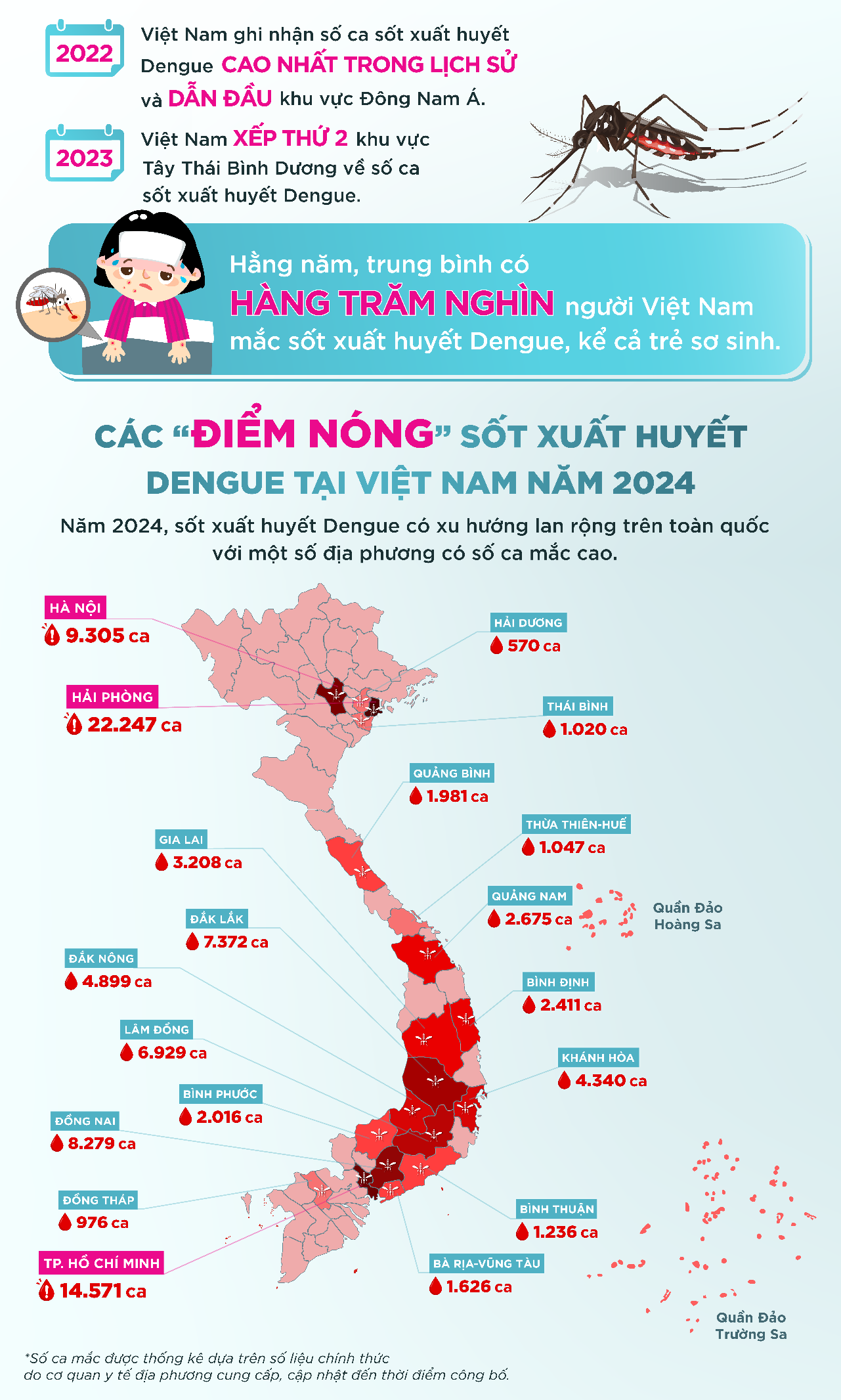
- Southern Vietnam: For many years, it was the epicenter of the pandemic nationwide.
According to representatives from the Ho Chi Minh City Department of Health , in 2024, the southern region accounted for 41% of the total 141,000 dengue fever cases recorded nationwide . For many years, the South has been the dengue fever hotspot in the country. Previously, in the Mekong Delta, outbreaks mainly occurred during the rainy season, but now they have spread and increased even during the dry season.
Alarmingly, a report from the Ho Chi Minh City Center for Disease Control shows that, as of week 7 of 2025, 3,431 cases of dengue fever were recorded in Ho Chi Minh City, an increase of 125.3% compared to the same period in 2024.
According to experts, climate change is one of the causes of the risk of an outbreak in 2025. Droughts and saltwater intrusion have led to a scarcity of freshwater, forcing people to store water, creating a favorable environment for mosquitoes to breed. Unusual, unseasonal rains also contribute to an increase in the density of disease-carrying mosquitoes.
- Central Vietnam: The epidemic is spreading from the coast to the Central Highlands.
In recent years, the disease has tended to shift to the Central and Central Highlands regions. For many years, the number of cases in this area has increased significantly, not only in coastal provinces but also spreading to the highlands.
Unseasonal storms and prolonged flooding during the dry season are the main reasons for the increase in Dengue fever in Central Vietnam. For example, the flooding in Tay Hoa, Phu Yen in February 2025 created favorable conditions for mosquitoes to breed, leading to an outbreak. Even cooler areas like Lam Dong, Dak Lak, and Dak Nong – which were previously less affected – became new hotspots for Dengue fever in 2024.
- Northern Vietnam: No longer a safe zone from Dengue fever.
Previously, northern Vietnam was less affected by dengue fever, but climate change, with shorter winters, longer summers, and rising temperatures, has created favorable conditions for the Aedes mosquito to breed. Simultaneously, rapid urbanization, dense population, and developed trade have also accelerated the spread of the disease.
In 2023, Hanoi recorded a record 36,795 cases, double that of Ho Chi Minh City. Alarmingly, even during the cold spell at the beginning of 2025, Hanoi still recorded 137 cases. Notably, dengue fever has spread to mountainous provinces – areas that had not recorded any cases in previous years. In recent years, trade and urbanization have led to outbreaks of dengue fever in 11 northern mountainous provinces, including Son La, Tuyen Quang, and Phu Tho. Lao Cai province detected its first local case in 2023 and reported four more cases in 2024.
From a localized seasonal disease to a healthcare burden.
According to research on PubMed (USA) – a free database providing life sciences and biomedical documents – among patients hospitalized with dengue fever, 3.3-4.8% experience severe complications with a risk of acute kidney failure (of which 14.1% require hemodialysis). These cases can also progress to chronic kidney failure. For example, an 11-year-old boy in Binh Chanh (Ho Chi Minh City) with underlying obesity was hospitalized in early March 2025 in dengue shock, severe respiratory failure, and coagulation disorders, requiring continuous hemodialysis.
The epidemic also overloaded the healthcare system. Many lower-level hospitals lacked the capacity to treat severe cases, forcing them to transfer patients to higher-level hospitals, placing a burden on larger hospitals such as Children's Hospital 1, Children's Hospital 2, Ho Chi Minh City Hospital for Tropical Diseases, National Hospital for Tropical Diseases, and Saint Paul Hospital…
Furthermore, dengue fever has a significant socio-economic impact. Treatment costs for severe complications are very high, potentially reaching hundreds of millions of Vietnamese dong. People with dengue fever need 1-2 weeks to recover, or longer if severe complications require hospitalization. During this time, dengue patients may experience pain, fever, and fatigue, requiring intensive care. This not only affects the patient's ability to work but also impacts the employment and income of their family members due to the need to care for the patient.

Currently, Vietnam has a dengue fever treatment protocol that is highly regarded internationally, but the disease remains complex due to many factors, especially climate change. Introducing the dengue vaccine in Vietnam is expected to help reduce the risk of outbreaks, limit severe cases, and ease pressure on the healthcare system. However, controlling the epidemic is not just about epidemiological surveillance, vector control, or improving treatment capacity; it also requires proactive action from each individual – don't let "mosquitoes" become a serious problem.
Medical information
This information is for informational purposes only and should not be used to diagnose or treat a health problem or disease. It is not intended to replace a consultation with a doctor. Please consult your doctor for further advice.
Content provided by Takeda Pharmaceutical Vietnam Co., Ltd., and professionally approved by the Vietnam Association of Preventive Medicine. C-ANPROM/VN/NON/0007, Mar 2025
Compiled from sources including WHO, the Ministry of Health , provincial and city health departments, and other official sources.
Source: https://thanhnien.vn/sot-xuat-huyet-dung-de-chuyen-muoi-lam-lon-185250325170325144.htm






















































































Comment (0)