Families cannot completely delegate the responsibility of raising children to others.
An evening in many families today unfolds in a similar way. Parents each hold a phone. Children are also engrossed in their tablets or phones. The whole family is in the same space but lives in different " worlds ." This is no longer an isolated incident but has become a common sight in the digital society.
Technology offers countless benefits; with just a few taps, children can learn foreign languages, explore history, discover science, or connect with friends around the world. However, this same space can also expose them to misinformation, harmful content, violence, incitement, or distorted values if they lack proper guidance. Even more worrying is that many parents are unknowingly "handing over the responsibility of educating " their children to the internet.
 |
| Illustrative image. Source: vietnamnet.vn |
Many busy parents treat their phones as an "electronic babysitter." They hand the phone to a crying child, turn on YouTube for fussy kids, and play cartoons while the child eats. Initially, it's just a few minutes, but it escalates to hours a day. Only when the child becomes dependent on the screen, loses communication skills, loses interest in learning, or exhibits behavioral problems do parents become alarmed.
No app can replace a parent's embrace, and no algorithm can teach children to love, share, or respect their elders. These qualities are only formed within the family environment.
Schools can impart knowledge, society can create an environment. But the family is still where the first bricks of character are laid. If that first brick is laid incorrectly, it will be very difficult for the layers above to be built firmly.
Technology changes the way we live, but it can't replace love.


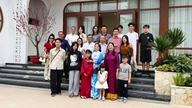
A paradox is unfolding: People are more connected to the world than ever before, yet they talk less with their loved ones than ever before.
Many parents know what videos their children like online, but don't know if their children are happy or sad today. They know what extra classes their children are taking, but don't know what pressures their children are facing at school. They know how many hours their children spend on their phones, but don't know what their children need to be listened to. This gap isn't created by technology; it's created by the lack of parental presence in their children's emotional lives.
Many education experts have warned that the biggest problem today is not the lack of information among children; what is more worrying is the lack of companions to help them distinguish right from wrong, truth from falsehood, real values from virtual values.
Social media can teach children how to become famous, but only family can teach them how to live a decent life. Artificial intelligence can answer millions of questions, but only parents can answer a child's most important question: "Who am I and what kind of person should I become?" This further demonstrates that, in the digital age, the role of parents has not diminished but has become even more important. Parents don't need to know more technology than their children, but they need to understand their children more than technology does.
Instead of just controlling screen time, pay attention to what your child is watching, thinking, and believing. Instead of banning, teach your child how to use technology responsibly. A phone-free meal, an hour of reading together, a conversation before bedtime... These seemingly small things are the best "vaccine" to help children build resistance to the negative impacts of the internet.
To build a better society, let's start with each home.
For generations, Vietnamese people have believed that family is the root of society. A loving family nurtures loving individuals. A disciplined family produces responsible citizens. A family that values honesty contributes to an honest society; this remains unchanged in the digital age. On the contrary, as technology develops at an increasingly rapid pace, family values need to be preserved even more as a cornerstone.
It is no coincidence that many developed countries consider family education to be the foundation of national education. A civilized society is not measured solely by the number of high-rise buildings, internet speed, or the level of artificial intelligence. More importantly, it is about whether parents still spend time with their children in those homes; whether children still respect their grandparents and parents; and whether family members still see the home as a place to return to or merely a place to sleep.



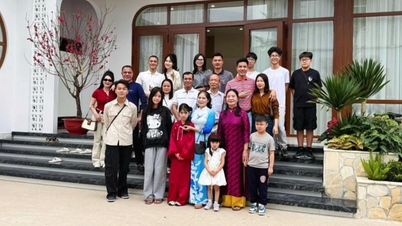
Vietnamese Family Day is not only an occasion to honor traditional values, but more importantly, it's a reminder for everyone to reflect on their own homes. Put down your phones more often, spend more time with your family, listen to your children more instead of just asking about their grades, and let them see the love in the small things every day.
Technology will continue to develop, artificial intelligence will become increasingly intelligent, but no machine will ever be able to replace a father's heart, a mother's compassion, or the warmth of a family. Nor will any digital platform be able to create a humane society if each home is not built on love, responsibility, and companionship. Because, ultimately, a sustainably developed country, a civilized and happy society, must begin with happy families.
Source: https://www.qdnd.vn/van-hoa/doi-song/dung-de-cong-nghe-day-con-thay-cha-me-1046482
![[Photo] National Assembly Chairman Tran Thanh Man attends the Conference to announce the Master Plan for Hanoi Capital City with a 100-year vision.](https://vphoto.vietnam.vn/thumb/1200x675/vietnam/resource/IMAGE/2026/06/29/1782709639728_ndo_br_1-jpg.webp)
![[Image] A look back at the capital's preparations for the century-long master plan.](https://vphoto.vietnam.vn/thumb/1200x675/vietnam/resource/IMAGE/2026/06/29/1782750453122_quy-hoach-100-nam-minh-duy-1-2118-jpg.webp)
![[Photo] General Secretary and President To Lam works with the Party Committee of the Government on the work of preventing and combating storms, floods, extreme natural disasters and climate change.](https://vphoto.vietnam.vn/thumb/1200x675/vietnam/resource/IMAGE/2026/06/29/1782729441945_a1-bnd-0385-9454-jpg.webp)
















































































![[Infographic] Notable new regulations for civil servants effective from July 1, 2026](https://vphoto.vietnam.vn/thumb/402x226/vietnam/resource/IMAGE/2026/06/30/1782779868692_infographic-nhung-quy-dinh-moi-dang-chu-y-doi-voi-vien-chuc-co-hieu-luc-tu-ngay-1-7-202620260629111721.webp)