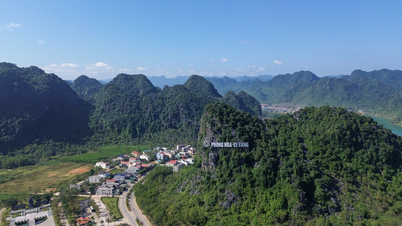
Viewed from its starting point, the section of National Highway 9 connecting to National Highway 1 is strategically located right next to the Hieu River, with the Dong Ha Bridge spanning across it. Looking from east to west, Highway 9 traverses the midland and mountainous region of Quang Tri province , connecting with neighboring Laos, and extending to northeastern Thailand and Myanmar.
It should also be noted that before National Highway 9 was built, Quang Tri already had a road connecting the coastal plains with the highlands. However, that was only a dirt road suitable for pedestrians or small, rudimentary vehicles. Construction of Highway 9 began in 1904.
 |
| National Highway 9, the section passing through Cam Lo commune, where the historical site of Hill 241 is located - Photo: PXD |
In the 1930s and 1940s, the French gradually completed the construction of this road. At that time, the road was narrow, only 2.5-3.5 meters wide, with a steep slope, so traffic was still very limited. The area where the road began was the territory of two ancient villages, Tay Tri and Dong Ha. Highway 9 passing through these two villages changed the appearance of these two villages, giving rise to signs of towns and streets alongside the rice fields and the traditional lifestyle of the farmers.
A century has passed, but in the footsteps of the people here, the story of Highway 9 continues to be passed down from generation to generation.
Over a century of turbulent warfare and chaos, many historical landmarks along Highway 9 have disappeared. However, by a twist of history, one important landmark remains: the site of the former Dong Ha railway station, now located at the Dong Ha Post Office intersection. Its convenient location, combining rail and road transport, made Dong Ha station a popular destination. Between 1927 and 1928 alone, the station served over 33,000 passengers.
From any perspective, the creation of this vital transportation artery has become deeply ingrained in the lives of not only the people of Quang Tri, but also in their past and present lives, opening a path from the past to the future. It holds within it many messages of time and history. Researcher and Master of History Le Duc Tho stated: “Highway 9 is a tool road, a salt road from East to West, a spice road in the opposite direction. It is also a road connecting the lowlands with the highlands, connecting the sea, the plains with the mountains; connecting the coastal people, the agricultural people, the market people with the indigenous people; connecting the Cham and Kinh people of the lowlands with the ethnic minorities of the mountainous region of Quang Tri.”
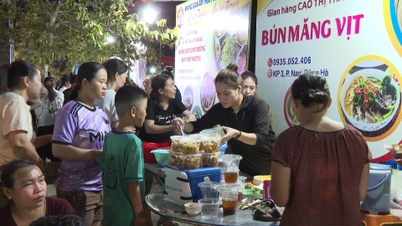
The place where the road was born a hundred years ago is now Dong Ha Street. A large market is located beside the Hieu River, right at the beginning of the intersection where National Highway 9 meets National Highway 1. The market is bustling with buyers and sellers, and passersby—those who have traveled on Highway 9 once, and those whose lives are intertwined with this highway—cannot be counted. Not far south of the market is the Monument to General Secretary Le Duan, in Le Duan Park, Dong Ha Ward.
Today, the Indochina crossroads has also transformed itself in line with the flow of history, embracing integration and openness. It serves as a gateway city on the East-West Economic Corridor. Surely, the road builders of yesteryear could never have imagined that the place where they first struck the ground would, after generations, become a bustling, noisy city with remarkable advancements in civilization.



Pham Xuan Dung
Source: https://baoquangtri.vn/dat-va-nguoi-quang-tri/202606/duong-9-mot-khuc-bien-nien-f7d15aa/