

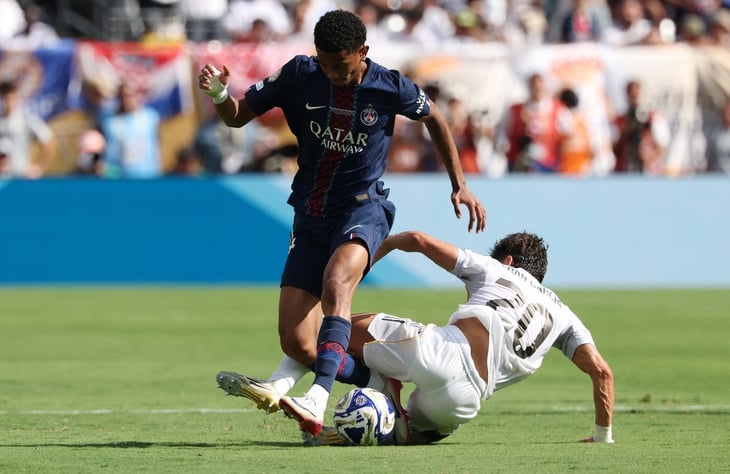
The number of exciting matches in the FIFA Club World Cup is far too small - Photo: REUTERS
In reality, none of the matches were as exciting as fans had hoped, starting from the semi-finals.
Lack of professional quality
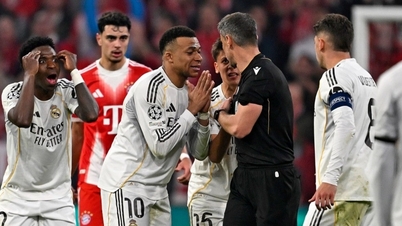
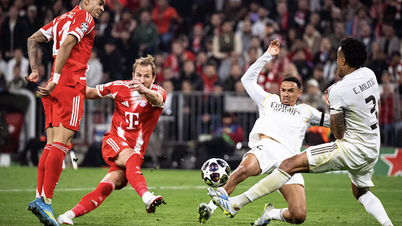
Chelsea easily defeated Fluminense due to the vast difference in strength between the two teams. PSG annihilated Real Madrid in just over 20 minutes because of individual errors. Then, in the final, PSG were destroyed by Chelsea in a single half. These three matches, supposed to be the highlights of the tournament, completely lost their dramatic edge.
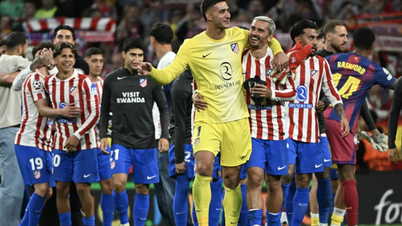
There are several reasons to explain PSG's rapid downfall. First is physical fitness. PSG endured a crazy season, playing a total of around 15 "big matches" in just four months, facing Liverpool, Aston Villa, Arsenal, Inter Milan (in the Champions League), as well as Atletico, Botafogo, Bayern Munich, and Real Madrid (in the FIFA Club World Cup).
There's no denying Chelsea's deserved victory. But Chelsea truly had a huge advantage in terms of the fixture list. They didn't have to exert themselves in the Champions League last season, and they were fortunate to have an easy schedule in the US where the big teams were successively eliminated.
The football feast promised by FIFA ultimately turned out to be nothing more than a series of disjointed matches. Most of the big teams couldn't perform at their peak due to exhaustion after an overly long season, as well as FIFA's controversial organizational methods. Name a few truly spectacular matches from the FIFA Club World Cup? Very few: Al Hilal beat Man City, Flamengo beat Chelsea…
195 goals were scored in 63 matches, averaging 3.1 goals per game. That's a very high number, but don't be fooled, because high goals don't automatically mean exciting football. Thirteen matches ended with a margin of three goals or more. And the majority of those were one-sided demolitions, like Auckland City's 0-10 loss to Bayern Munich and their 0-6 defeat to Benfica, or Inter Miami's crushing 4-goal thrashing by PSG in a single half.
The FIFA Club World Cup is reminiscent of the World Cup of the 1990s and early 2000s, when FIFA began expanding the tournament to 32 teams. Back then, the gap between Europe and South America and Asia, Oceania, and North and Central America was like night and day. But today, that gap has narrowed to the point where even Saudi Arabia can defeat the reigning champions Argentina.
Too many shortcomings
The disparity in skill levels is unavoidable, as clubs from South Korea, Japan, and Africa are significantly weaker than their national teams. However, FIFA may have made a mistake in trying to "level the playing field" in the tournament to limit the number of European representatives.
First, there's the issue of the number of participating teams: only 12 European teams, whereas the World Cup (before increasing to 48 teams from 2026) has traditionally allocated 13 slots to Europe. Next, there's the rule limiting each country to a maximum of two clubs. With this rule, FIFA has directly disqualified Liverpool, Barcelona, Napoli, and Leverkusen from the tournament, replacing them with weaker teams like Salzburg or Porto.
Only the continental champions are exempt from the rule limiting the number of clubs in a competition to two. While this might sound fair, it's actually not, as European football is far more competitive than in other regions.
For example, Brazil has dominated the Copa Libertadores (the South American championship, the European equivalent of the Champions League) for many consecutive years, resulting in them having four representatives in the FIFA Club World Cup.
The powerful European teams couldn't qualify. And the rest endured two to three weeks of absurd torture in the US. From the weather, the pitches, the organization, to even the midday match times – all factors worked against the stars of top-level football. And that's the basis for teams from South America or the Middle East to create surprises.
Was that dramatic football? Certainly not. Real football was Morocco's beautiful adventure at the 2022 World Cup, where they defeated both Spain and Portugal. It was also about matches with fewer goals but still full of excitement, like the fiery spirit of Japan and South Korea, or the mesmerizing dances of the African teams.
Without those things, the FIFA Club World Cup would be nothing but controversy and fatigue. If the tournament remains the same four years from now, fans will have a choice to make.
Source: https://tuoitre.vn/fifa-club-world-cup-co-tuong-lai-2025071610444324.htm


![[Photo] National Assembly Chairman Tran Thanh Man attends the policy seminar to promote Vietnam-Türkiye cooperation.](https://vphoto.vietnam.vn/thumb/1200x675/vietnam/resource/IMAGE/2026/04/16/1776351415367_vna-potal-chu-tich-quoc-hoi-tran-thanh-man-du-toa-dam-chinh-sach-thuc-day-hop-tac-viet-nam-tho-nhi-ky-8705791-jpg.webp)
















![[Image] Bridges and roads connecting the eastern part of Ho Chi Minh City](https://vphoto.vietnam.vn/thumb/1200x675/vietnam/resource/IMAGE/2026/04/16/1776328595108_ndo_br_bh-vt5-jpg.webp)




























![[Infographic] Details of the Hanoi-Quang Ninh High-Speed Railway Project](https://vphoto.vietnam.vn/thumb/402x226/vietnam/resource/IMAGE/2026/04/16/1776338188424_anh-man-hinh-2026-04-16-luc-18-16-10.png)

![[Photo] National Assembly Chairman Tran Thanh Man meets with the Speaker of the Georgian Parliament](https://vphoto.vietnam.vn/thumb/402x226/vietnam/resource/IMAGE/2026/04/16/1776338494029_anh-man-hinh-2026-04-16-luc-18-21-21.png)





















Comment (0)