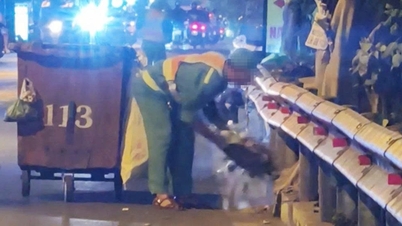
Waste is dumped indiscriminately.
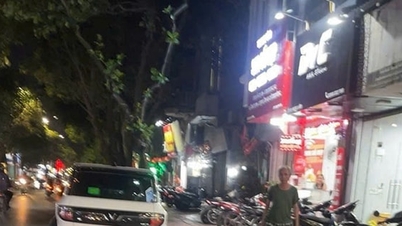
According to observations by a reporter from SGGP newspaper, along Luong Ngoc Quyen street – the area bordering An Nhon ward and Binh Loi Trung ward – there are many bags of garbage, construction debris, old mattresses, etc., dumped haphazardly, forming an impromptu garbage dump stretching for tens of meters. Mr. NT, a local resident, expressed his frustration: “We can’t determine where the waste comes from. Perhaps because it’s a deserted road, many people take advantage of the darkness to bring trucks full of construction debris to dump. Occasionally, the ward’s forces come down to clean it up, but then a few days later, a new pile of garbage appears.”

The surveillance camera system is installed at the An Nhon Ward Police Station, Ho Chi Minh City.
Similarly, the vacant land next to the Tham Luong - Ben Cat Wastewater Treatment Plant (Vuon Lai Street, An Phu Dong Ward) has been a makeshift garbage dump for many years, despite regular cleanup efforts by the authorities. Ms. MD, a resident of Vuon Lai Street, said: “People in the area are very frustrated by this makeshift garbage dump. After a few days of cleaning, people bring more garbage to dump. This area is damp, overgrown with weeds, and the garbage and dead animal carcasses emit a foul odor. Some people take advantage of the hot weather to burn the garbage neatly, but this is not a good method because each time they burn it, thick smoke rises, causing environmental pollution and a high risk of fire.”
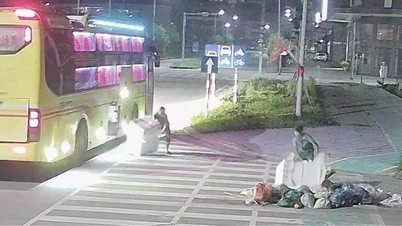
Accessing camera footage to issue fines remotely.
One of the solutions being implemented by many localities to combat littering is using surveillance cameras to issue fines based on photographic evidence.
Typically, on Bung Ong Thoan Street – the section at the foot of Vam Xuong Bridge (Tang Nhon Phu Ward) – garbage piled up for months, causing pollution in the area. After receiving complaints from residents, the ward carried out cleanup work, and by October 2025, the ward installed cameras in some vacant lots in the area to record and monitor environmentally damaging activities. According to our recent observations on Bung Ong Thoan and La Xuan Oai streets, the garbage situation has improved significantly.
According to a report by the Ho Chi Minh City Department of Agriculture and Environment, in March 2026, 74 pollution hotspots with remaining waste were recorded in the wards and communes. Specifically, 59 hotspots had been cleaned and processed, but 3 new hotspots reappeared, and 12 hotspots remained uncleaned.
In the vacant lots along Rach Cau Suoi and Tran Hai Phung roads in Tan Vinh Loc commune, the problem of illegal waste dumping has also decreased thanks to surveillance cameras. Mr. Truong Ngoc Thanh Nhan, Vice Chairman of the Tan Vinh Loc Commune People's Committee, said that through local management, the commune's People's Committee has identified 16 hotspots for illegal waste dumping, mainly vacant lots in sparsely populated areas with little traffic, and areas bordering other communes and wards. Violators take advantage of deserted roads, late nights and early mornings, and locations obscured by security cameras to secretly dump waste. To enhance monitoring and detect violations, the commune has installed 102 security cameras, mainly in vacant lots and locations with complex security and waste dumping situations. "Through surveillance cameras, the commune has fined two cases of illegal waste dumping and prevented several other cases," Mr. Truong Ngoc Thanh Nhan said.
In An Nhon ward, 67 cameras have been installed to monitor security in the area and penalize illegal dumping. Mr. Duong Van Kim, Vice Chairman of the An Nhon Ward People's Committee, shared that these surveillance cameras will be connected to the camera system at the ward police station. The transmission quality is guaranteed to be clear, recording from all angles, and officers are on duty 24/7. When violations are detected, the ward police will connect to relevant data to extract images and identify the offenders.
For cases where the offenders come from other areas and the ward's camera system cannot trace and identify them, the ward police connect to the vehicle registration system's data to find the vehicle owner. "Since implementing the two-tiered local government model, the ward has fined more than 20 cases of illegal dumping through the camera system. At the same time, the ward has also required vehicle owners to commit to not repeating the offense," Mr. Duong Van Kim informed.
You may also like

Nam Cam Ranh commune organizes home medical check-ups for the elderly.To commemorate the 85th anniversary of the Traditional Day of the Elderly in Vietnam (June 6, 1941 - June 6, 2026), on June 4th, a delegation from the People's Committee of Nam Cam Ranh commune, in coordination with the commune's health station, organized medical check-ups for the elderly in the villages of Thinh Son, My Thanh, Hoa Diem, and Hoa Son. Thanh Hien
Source: https://www.sggp.org.vn/gan-mat-than-tri-nan-xa-rac-post848405.html


























































![[Video] Sunset at Lap An Lagoon – Where the sun sets over the fishing nets](https://vphoto.vietnam.vn/thumb/1200x675/vietnam/resource/IMAGE/2026/05/31/1780192137701_beach-landscape-sea-water-nature-grass-745871-pxhere-com.jpeg)






































Comment (0)