My father used to be a fisherman. From a young age, I was used to the absence of a male head of the household. He was often away for long periods, sometimes weeks, sometimes months at a time. I grew up listening to his stories about his work during the days his boat was docked. Through his tales, the sea wasn't just a calm blue; it was also a place of raging storms, sleepless nights spent pulling in nets with his crew, hands bleeding from cuts, and the bone-chilling cold of being drenched in the stormy nights.

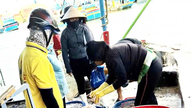
Mr. Tran Duc Nam (far right), residing in Kien Luong commune, working with his fellow crew members. Photo: CAM TU
Yet, in my father's deep, weathered eyes, I saw only a strange unwavering determination. He loved the sea, the profession that had sustained generations of fishermen, and more importantly, it was the only lifeline he had to support his family. Each of his voyages not only carried the hope of bountiful catches but also the weight of my sisters and me into our future. He accepted facing the rough seas, solely to keep the surface of our lives calm, hoping we would change our lives through knowledge, free from the burden of making a living.
Stepping onto the deck of fisherman Nguyen Trung Hieu (33 years old) – a seasoned fisherman residing in the Phu Quoc Special Economic Zone – before departure, I encountered the very image of my father from the past. A sturdy, robust body like ebony wood. Eyes always squinting against the dazzling, glittering light of the open sea, yet a strangely gentle smile. The harshness of the sea may roughen the skin, but it seems to soften the souls of these men who spend their lives befriending the waves.
Having been involved in seafaring since the age of 16, Hieu's impoverished life forced him to quickly adapt to the salty sea air and learn to stand firm against the waves of his early life. Through years of ups and downs, he has become accustomed to the life at sea. For him and his fellow fishermen, the boat is their home, and the sea is their second homeland.


With a deep, husky, and hearty voice, Mr. Hieu confided: "The seafaring profession is incredibly difficult in countless ways. There are nights when storms rage, waves crash over the cabin, and the crew on board turn pale, clinging tightly to the sides of the boat, praying for safety. At those times, everyone tells themselves: 'This trip back to shore means selling the boat and quitting the profession!' But strangely enough, after a few days at home, missing the salty smell of the sea and the rumbling sound of the engine, we feel restless, can't sleep well, and have to go again. When the sea calls, we can't stay ashore."
Each voyage, lasting from half a month to several months, is a gamble with nature for the fishermen. These include sudden storms, tropical depressions, or engine failures that leave the boat stranded and drifting aimlessly in the open sea. Even on calm days, danger remains, from slipping on the deck during rough seas to accidents involving heavy fishing nets weighing tons.
For fishermen, the price of a boat full of fish and shrimp is not only sweat and blood, but also months of separation from home. They must accept missing important milestones in their children's lives. All their joys and sorrows on land must be conveyed through hurried phone calls or encapsulated in the intense longing felt at sea. They accept the trade-off of their own loneliness for a more comfortable and prosperous life for their families after each stormy voyage.
Hardship and danger are inevitable, but never once have they thought of giving up. These fishermen can stand firm against the waves and winds, primarily for the sake of making a living to provide for their families and children. "My whole life has been spent at sea; my words can be summed up in just two words: 'life' and 'the sea.' I've suffered enough, so I'm determined to raise my children properly, enduring the storms and exchanging my sweat at sea for a brighter future for them," said Mr. Hieu.
Mr. Tran Duc Nam (46 years old), a young fisherman residing in Kien Luong commune, gently takes out a smartphone carefully wrapped in three layers of nylon from his breast pocket to protect it from seawater. His eyes sparkle with pride as he shows a photo of his eldest son standing on the podium receiving an award for being an outstanding student. This photo, wrapped in three layers of nylon, is not only his personal treasure but also represents the "spiritual anchor" of a father silently sacrificing for his children. The scars from seawater cuts, the joint pains whenever the weather changes, become insignificant; he accepts hardship in exchange for knowledge and a brighter future for his children. Mr. Nam confided: "Staying up all night facing strong winds and waves, I've never been afraid, because behind me is the educational future of my children. My life has been hard because of my lack of education; what does all this hardship matter as long as my children receive a proper education and fulfill their dreams? That's all I need to be content."
Many people say that seafaring is a profession where you "eat standing up and talk with your fingertips." Amidst the roaring waves of the ocean, everything must be done quickly and hastily. Yet, this arduous and dangerous profession has a strange allure, deeply rooted in the consciousness of the people from generation to generation as an inseparable "calling."
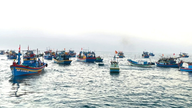

Such is the plight of fishermen, burdened with both anxiety and overflowing with hope. They go to sea not just to make a living, but with the pride of being masters of the ocean, and with boundless love for their families. Amidst the vast ocean, their sails of aspiration continue to glide forward, towards the light of knowledge and a brighter future for generations to come.
CAM TU
Source: https://baoangiang.com.vn/ganh-bien-nuoi-con-a489216.html


![[Photo] General Secretary and President To Lam attends the Central Public Security Party Committee Conference](https://vphoto.vietnam.vn/thumb/1200x675/vietnam/resource/IMAGE/2026/06/24/1782302063612_a1-bnd-9302-9166-jpg.webp)
![[Photo] Opening Ceremony of the 13th National Congress of the Ho Chi Minh Communist Youth Union](https://vphoto.vietnam.vn/thumb/1200x675/vietnam/resource/IMAGE/2026/06/24/1782286753905_ndo_br_1-8510-jpg.webp)
![[Photo] The 13th National Congress of the Youth Union conducts personnel work.](https://vphoto.vietnam.vn/thumb/1200x675/vietnam/resource/IMAGE/2026/06/24/1782299943080_ndo_br_1-6868-jpg.webp)