

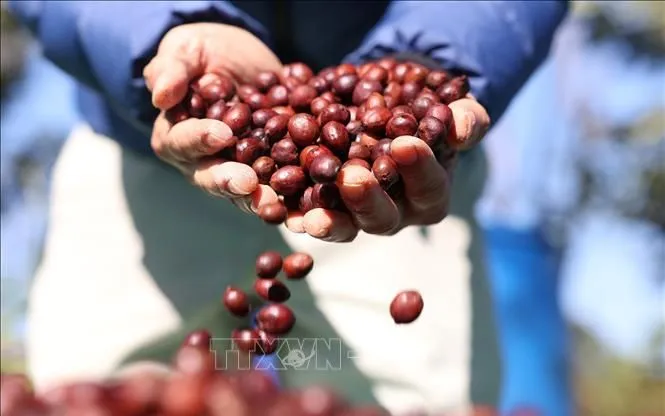
The January 21st trading session saw a dominant green trend in the industrial raw materials market, with 6 out of 9 commodities experiencing price increases; notably, coffee prices surged. Specifically, Robusta coffee prices rose nearly 3.5% yesterday, closing at $4,078 per ton, while Arabica coffee prices also increased slightly by nearly 0.3% to $7,661 per ton.
According to the Vietnam Commodity Exchange (MXV), world coffee prices were supported by Brazil's tight monetary policy and stable demand from the US market. The most important driver in the recent trading session came from the surge in the Brazilian Real. Following its end-of-year 2025 policy meeting, the Brazilian Monetary Policy Committee (COPOM) continued to maintain the Selic interest rate at a high level of 15% per year, marking the fourth consecutive time maintaining a tight policy to control inflation.
This decision pushed the Real to its highest level against the US dollar in over a month and a half, helping it close 2025 with a gain of nearly 9%. The strengthening domestic currency reduced the price advantage of exports when converted to USD, leading Brazilian farmers and businesses to limit sales, waiting for more favorable prices. This directly created short-term supply pressure on the global coffee market.
The tightening supply is clearly reflected in the latest figures from the Brazilian Coffee Exporters Association (Cecafe). In December 2025, the country's total green coffee exports fell sharply by 18.4% year-on-year to only 2.86 million bags; of which, Arabica coffee exports decreased by 10%, reaching 2.6 million bags, while Conilon (Robusta) coffee recorded a particularly severe decline of 61%, to just over 222,000 bags.
The sharp decline, especially in Robusta coffee, indicates a growing and evident shortage of supply in Brazil – the market leader. Against this backdrop, US demand remains steady, with a 4% increase in the first 10 months of 2025, despite tariff barriers. This supply-demand imbalance is becoming a key factor supporting coffee prices in the short term.
Conversely, the medium- and long-term outlook for the market is gradually becoming more positive thanks to favorable weather conditions in key production regions. In Brazil, forecasts of abundant rain this week in key growing areas have somewhat eased concerns about the upcoming crop. Meanwhile, in Vietnam, dry weather is creating favorable conditions for farmers to complete the final stages of harvesting.
Following yesterday's unexpected sharp decline, the domestic coffee market staged its most spectacular comeback of the season on the morning of January 22nd. From the start of trading, purchase prices at dealers surged, recording an average increase of 1,800 to 2,100 VND/kg across the Central Highlands region. With this upward trend, Vietnamese coffee prices officially conquered and surpassed the historic milestone of 100,000 VND/kg.
In the two "coffee capitals" of Dak Lak and Gia Lai, coffee prices simultaneously increased by 1,800 VND/kg, settling at a round figure of 100,000 VND/kg. Lam Dong province, although having the lowest price, recorded the strongest increase in the region at 2,100 VND/kg, pushing the price of bulk coffee beans from its lowest point to 99,500 VND/kg.
Source: https://vtv.vn/gia-ca-phe-but-pha-manh-100260122171010997.htm


![OCOP during Tet season: [Part 1] Ba Den custard apples in their 'golden season'](/_next/image?url=https%3A%2F%2Fvphoto.vietnam.vn%2Fthumb%2F402x226%2Fvietnam%2Fresource%2FIMAGE%2F2026%2F01%2F26%2F1769417540049_03-174213_554-154843.jpeg&w=3840&q=75)





Comment (0)