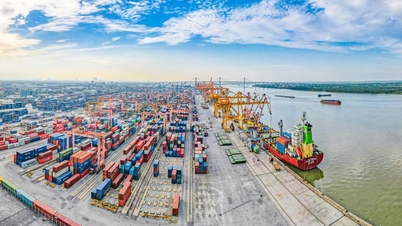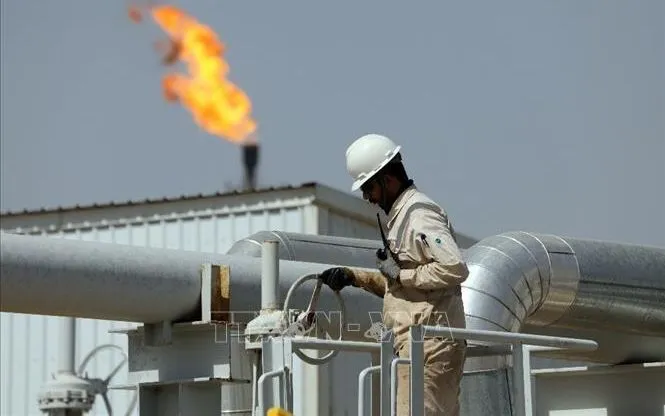
Oil prices recovered after planned US-Iran talks in Switzerland unexpectedly fell through - Photo: THX
After plummeting to its lowest level in more than three months due to expectations of a swift restoration of global supply, oil prices rebounded in late-week trading as signs emerged that the implementation of the agreement still faces significant obstacles.
At the close of trading on June 19, North Sea Brent crude rose 66 cents, or 0.53%, to $80.38 per barrel, while West Texas Intermediate (WTI) crude rose 94 cents, or 1.23%, to $77.54 per barrel. However, overall for the week, Brent crude prices were still down about 8%.
The market's focus at the end of the week was on signals indicating that the US-Iran peace process was not progressing as smoothly as expected. Early on June 19th (local time), the Swiss Foreign Ministry announced that the technical talks between the US and Iran, scheduled for that day at the Bürgenstock resort, had been canceled. The original plan was for officials and experts from both countries to discuss the specific implementation steps of the recently reached peace agreement.
Multiple sources indicate that renewed fighting between Israel and Hezbollah forces in Lebanon has increased the risk of a breakdown in the diplomatic process. The White House announced that Vice President JD Vance would not be traveling to Switzerland as planned due to unresolved issues related to the next round of negotiations. Meanwhile, Iran is believed to have proactively postponed participation in the talks in protest against new Israeli airstrikes in Lebanon. These developments have led investors to believe that even though Washington and Tehran have reached an agreement on a peace framework, many external factors could still slow down or even derail the implementation of the agreement. These doubts contributed to a recovery in oil prices at the end of the week.

Despite a rebound in oil prices at the end of the week, the dominant trend for the entire week remained a sharp decline due to expectations of a return to increased global supply - Photo: Getty Images



Meanwhile, the market continues to closely monitor the situation in the Strait of Hormuz, a strategic waterway that carries approximately 20% of the world's oil and liquefied natural gas supply. Following the ceasefire between Israel and Hezbollah in Lebanon, oil shipping through the region has shown signs of resurgence. Maritime tracking data indicates that at least four tankers carrying crude oil, petroleum products, and liquefied petroleum gas passed through the Strait of Hormuz on June 19th, heading towards Iraqi ports. However, Iran has simultaneously signaled tighter controls on maritime activity through this route. Iranian state television reported that ships wishing to pass through the Strait of Hormuz must coordinate with the naval forces of the Islamic Revolutionary Guard Corps. A notice sent to the shipping industry also stated that ships must have valid permits to navigate. These new conditions from Iran raise concerns that the normalization of shipping through Hormuz may be slower than expected. This contradicts previous market expectations that oil supplies from the Gulf region would be quickly restored following the US-Iran agreement.
Despite a recovery in oil prices at the end of the week, the dominant trend for the entire week remained a sharp decline due to expectations of a return to global supply. Starting on June 15th, the market witnessed a sharp sell-off after US President Donald Trump announced that the US and Iran had reached a preliminary agreement to end the conflict and reopen the Strait of Hormuz. The decline continued into June 16th, as the market reacted to more details of the ceasefire agreement, which allowed Iran to resume oil exports and the Strait of Hormuz was expected to soon return to normal operation.
Beyond geopolitical factors, the prospect of weaker demand is also putting pressure on oil prices. Data shows that China's refining capacity in May 2026 fell to its lowest level in nearly four years. Meanwhile, the possibility that the US Federal Reserve (Fed) will maintain high interest rates for longer than expected is also increasing concerns about economic growth and global energy demand.
After two consecutive sessions of sharp declines, oil prices recovered on June 17th when President Trump emphasized that the agreement with Iran was only a memorandum, not a final, binding agreement. He also warned that the US could resume airstrikes if Iran did not fully implement its commitments. This information led investors to reassess the level of risk in the Middle East. By June 18th, further doubts emerged about the sustainability of the agreement after US Vice President JD Vance warned Israel against further military operations against Hezbollah in Lebanon.
In addition, the prospect of a significant increase in supply has led many major financial institutions to simultaneously lower their oil price forecasts. Citi Group, a banking and financial group, believes that if shipping through the Strait of Hormuz is sustainably normalized, the oil market could shift to a state of oversupply, and oil prices could fall to the $60-$65/barrel range by the first quarter of 2027. Commerzbank also lowered its forecast for Brent crude oil prices at the end of this year to $80/barrel, instead of the previous $85/barrel.



Analysts estimate that the agreement between the US and Iran could help release more than 85 million barrels of oil currently stranded in the Gulf region, and the lifting of sanctions on Iranian oil will add significant supply to the market in the near future. However, experts believe that a full recovery of oil production, export, and transportation in the Middle East will not happen overnight. Developments in the weekend trading session show that geopolitical risks remain and could continue to strongly impact the global oil market in the coming period.
Source: https://vtv.vn/gia-dau-phuc-hoi-100260620114340965.htm
![[Photo] General Secretary and President To Lam attends the Central Public Security Party Committee Conference](https://vphoto.vietnam.vn/thumb/1200x675/vietnam/resource/IMAGE/2026/06/24/1782302063612_a1-bnd-9302-9166-jpg.webp)
![[Photo] The 13th National Congress of the Youth Union conducts personnel work.](https://vphoto.vietnam.vn/thumb/1200x675/vietnam/resource/IMAGE/2026/06/24/1782299943080_ndo_br_1-6868-jpg.webp)
![[Photo] Opening Ceremony of the 13th National Congress of the Ho Chi Minh Communist Youth Union](https://vphoto.vietnam.vn/thumb/1200x675/vietnam/resource/IMAGE/2026/06/24/1782286753905_ndo_br_1-8510-jpg.webp)