

Selling pressure returned, ending the rally in global commodity markets. At the close, the MXV-Index fell nearly 0.7% to 2,542 points, amid heightened caution stemming from forecasts of a record global grain surplus and news that the US had temporarily postponed tariffs on strategic minerals, causing copper prices to cool down rapidly.
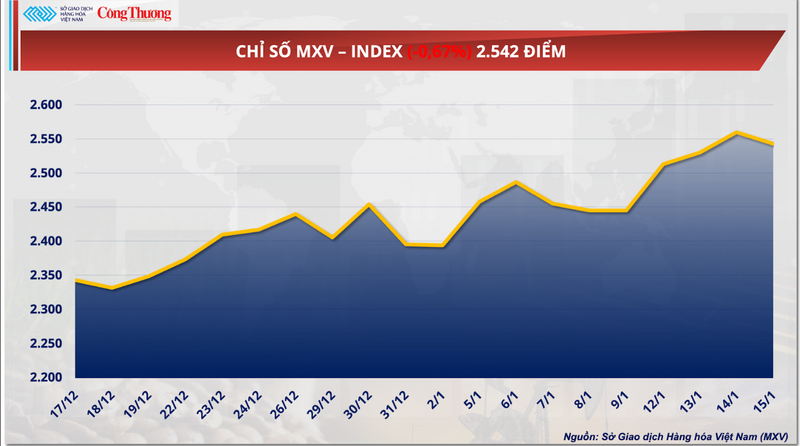
MXV-Index
Corn and wheat prices both fell.
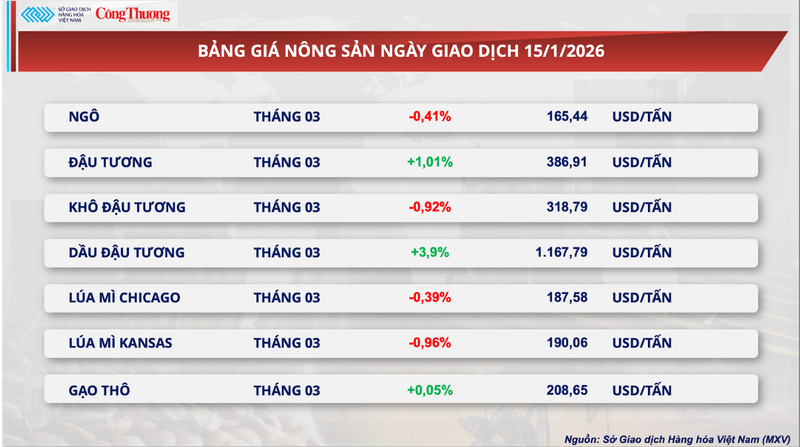
The recovery in the global agricultural market was officially halted yesterday as grain prices fell sharply. On the CBOT, Chicago corn and wheat futures for March delivery both fell by about 0.4%, closing at $165.4 and $187.6 per ton, respectively. Notably, Kansas wheat recorded a sharp decline of nearly 1%, falling to a record low of $190 per ton since the beginning of 2026.
Agricultural product price list
The negative market sentiment stems from the International Grains Council (IGC) January 2026 Grain Market Report. According to the report, total global grain production is growing faster than expected, projected to reach 2.46 billion tonnes in the 2025-2026 crop year, an increase of 31 million tonnes compared to the November 2025 forecast and 5.7% higher than the previous crop year. As a result, total global end-of-year stocks are projected to reach 634 million tonnes.
Specifically for corn, IGC has raised its forecast for global production to 1.31 billion tons, an increase of 15 million tons compared to its previous report. The main drivers of this growth are the surge in production in the US and China. These data not only reinforce the assessments in the US Department of Agriculture 's (USDA) WASDE report released earlier this week but also directly increase selling pressure on CBOT corn prices.
Supply from South America is also contributing to downward pressure on corn prices. The Rosario Grain Exchange (BCR) has just raised its forecast for Argentina's 2025-2026 corn crop to a record 62 million tons, 9.5 million tons higher than the previous peak of the 2023-2024 crop. According to the BCR, larger-than-expected planted area and the crop's good resilience to the hot, dry weather in recent weeks are the main reasons for this adjustment.
For wheat, the IGC forecasts a global supply increase of 12 million tons compared to previous forecasts, reaching 842 million tons in the current crop year. Argentina and Canada have had their production forecasts raised to 27.7 million tons and 40 million tons respectively, consistent with positive figures from the USDA. In addition, Russia – the world's largest wheat exporter – is contributing to the surplus, with the consulting firm IKAR raising its export forecast to 46.5 million tons. The bumper harvest in central and Siberia has fully offset the production shortfall in southern Russia.
Conversely, the soybean market is becoming a bright spot as it extends its recovery. At the close of trading, soybean prices on the CBOT rose 1%, reaching $386.9 per ton – the highest level since the beginning of 2016.
The upward trend in soybean prices is strongly supported by expectations of increased domestic demand in the US. The market is currently reacting positively to news that the US plans to finalize its 2026 biofuel blending quota as early as the beginning of March. In addition, a report from the National Oilseed Processors Association (NOPA) shows that December 2025 crushing output reached its second-highest level in history, confirming strong consumption in the extraction industry.
COMEX copper prices weaken.
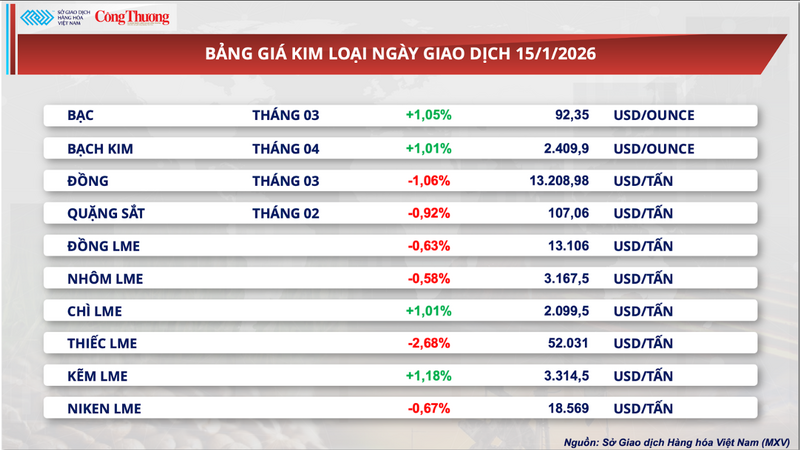
Meanwhile, the metals market also saw a predominance of red, with 6 out of 10 commodities experiencing price declines. Copper prices, in particular, attracted investor attention after the US announced a temporary suspension of new tariffs on strategic imported minerals. This news immediately triggered selling pressure, pushing COMEX copper prices down by more than 1% to $13,208 per ton.
Metal price list
Notably, this negotiating roadmap aims to establish a price floor mechanism for key minerals—a solution long awaited by mining corporations and Western policymakers to stabilize the market. Previously, since last year, copper has been added to the US list of strategic minerals due to its crucial role in the military and advanced technology sectors.
From a supply perspective, the market is witnessing a significant increase in inventory on the COMEX exchange. This development has led to a continuous build-up of copper inventories at COMEX storage facilities since 2025. As of January 15, 2026, inventory reached 488,716 tons, a 7.8% increase compared to the beginning of the year.
In the domestic market, Vietnam's copper imports recorded a strong surge in the last month of the year. According to preliminary data from the Customs Department, copper imports in December reached 42,697 tons, an increase of 12.5% compared to November and a 5.2% increase compared to the same period in 2024. The main driving force behind this increase comes from increased domestic production demand, combined with a strategy of taking advantage of low global prices in the preceding months to optimize input material costs.
Price list for some other types of goods
Energy price list
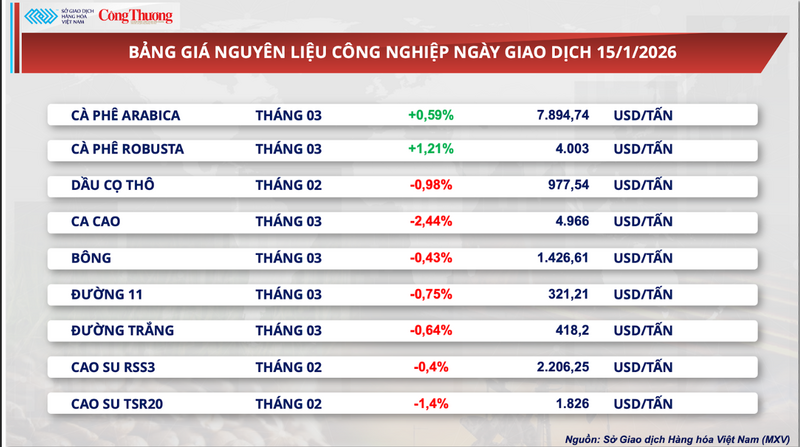
Industrial raw material price list
Source: https://congthuong.vn/gia-lua-mi-lui-ve-moc-190-usd-tan-439170.html








































































































Comment (0)