

Young people are getting diseases typically associated with the elderly.
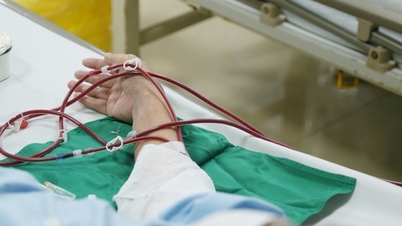
For the past two years, the journey from his rented room to Le Van Thinh Hospital (Ho Chi Minh City) has been a lifeline for Duong Van Lam (32 years old, Binh Trung Tay Ward, Ho Chi Minh City). For a long time, he frequently experienced dizziness and paleness but did not seek medical attention. By the time he was admitted to the emergency room, his condition had progressed to end-stage chronic kidney failure, requiring dialysis three times a week. Each dialysis session starts very early and lasts about three hours. Toxins are removed through the filter, restoring "healthy" blood to Mr. Lam.
“Before, I worked in construction, and my health and income were good. Since falling ill, my work is no longer the same, and I spend about 3 million VND per month on medication. My health has deteriorated rapidly, and sometimes I have to ask the doctor for oxygen to feel comfortable. I have registered for organ transplantation at Cho Ray Hospital, hoping to escape this situation soon,” Mr. Lam shared.
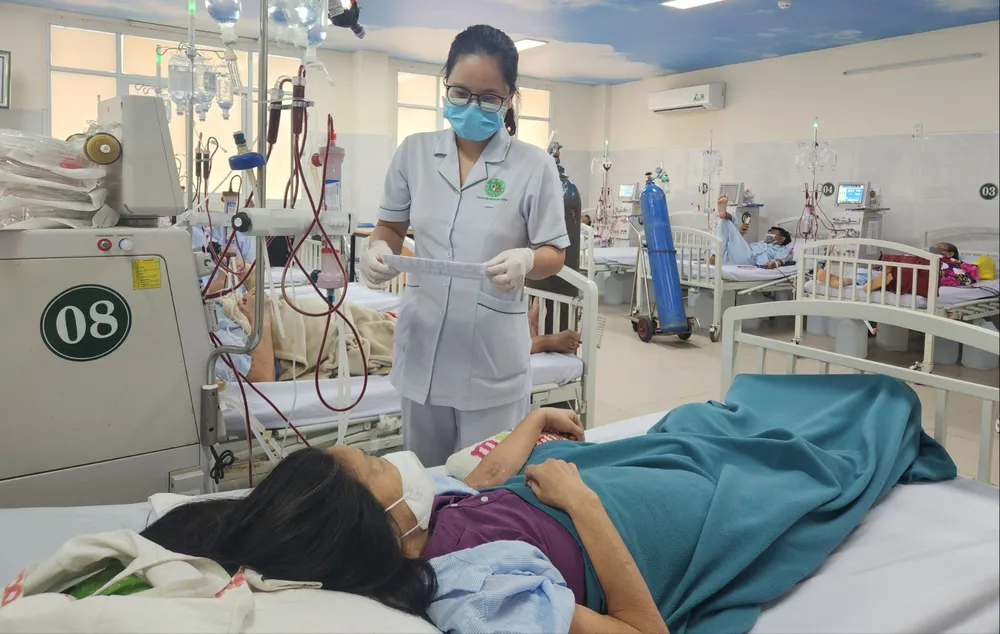
Once the family's main breadwinner, Nguyen Van Trieu (Binh Khanh commune, Ho Chi Minh City) was completely devastated when he had to undergo dialysis at the age of 31. His wife had to accompany him to the hospital while also taking care of their three young children, and the treatment costs depended on support from relatives.
At that time, Mr. and Mrs. Trieu had to travel dozens of kilometers to hospitals in downtown Ho Chi Minh City for dialysis, which was expensive and arduous. Later, the Can Gio Medical Center established a dialysis unit, which greatly helped many patients like Mr. Trieu feel more secure in receiving treatment.
"Compared to before, we are much luckier now because the hospital is closer to home, saving us time and money. End-stage kidney failure requires lifelong treatment, so we just have to try our best," said Ms. Vo Thi Ve (Mr. Trieu's wife).
According to Dr. Nguyen Thi Minh Trang, Department of Endocrinology - Nephrology - Dialysis, Le Van Thinh Hospital, the demand for dialysis is increasing at most medical facilities. Previously, the hospital performed 3 dialysis sessions per day, but in 2025 it will have to increase to 4 sessions to accommodate 250 patients, and is even considering a 5-session option in the near future. For the 4th dialysis session (evening), patients finish their dialysis and return home close to midnight, exhausted.
This means that healthcare workers also have to work longer hours. Nearly 15% of dialysis patients here are young (under 40 years old), with many cases under 30. A disease once considered to be for the elderly is now silently attacking young people.
According to Associate Professor, Doctor Nguyen Bach, Head of the Nephrology Department at Thong Nhat Hospital, glomerulonephritis is also a cause of early-onset kidney failure complications. In 1,000 kidney biopsies at this medical facility, approximately 300 cases were young people with glomerulonephritis (commonly seen in people aged 17-40). Urine tests can detect the disease for timely intervention.
The disease is insidious, and patients are often complacent.
Dr. Bui Thi Ngoc Yen, Deputy Head of the Department of Endocrinology and Nephrology at Gia Dinh People's Hospital, said that the trend of chronic kidney disease affecting younger people is related to the increase in underlying diseases such as hypertension, diabetes, obesity, and early-onset metabolic syndrome due to sedentary lifestyles and the consumption of processed fast food, in addition to factors such as glomerulonephritis, environmental pollution, and extreme heat.
At the Department of Endocrinology and Nephrology, Gia Dinh People's Hospital, most young patients are diagnosed with chronic kidney disease very late, leaving them with no opportunity for medical treatment. Many cases are admitted with dangerous complications such as acute pulmonary edema, hypertensive crisis, uremia, severe hyperkalemia, etc., requiring emergency hemodialysis.
The worrying thing is that chronic kidney disease progresses silently, with no typical symptoms in the early stages. Meanwhile, young people are very careless about their health, so they only discover the disease at a very late stage.
“End-stage chronic kidney disease and renal replacement therapy severely impact health and life. For example, a 40-year-old undergoing dialysis has a remaining lifespan equivalent to that of a 75-year-old. Besides the high treatment costs, opportunities for education, employment, marriage, and having children are also affected, creating pressure on families, society, and the healthcare system,” explained Dr. Bui Thi Ngoc Yen.
Many experts warn that the overload at dialysis centers continues due to inadequate facilities and personnel. Therefore, the best approach currently is to detect chronic kidney disease early and treat it effectively, reducing the number of patients progressing to the end-stage.
Besides maintaining a healthy diet and lifestyle, and avoiding the indiscriminate use of medications and supplements, people should have regular health checkups to detect and treat many diseases early, including chronic kidney disease. This habit can effectively prevent the risk of young people having to rely on dialysis machines for life.
Statistics from the Ministry of Health show that Vietnam currently has over 10 million people with chronic kidney disease, of which about 26,000 are in the end-stage and require kidney replacement therapy (regular dialysis, peritoneal dialysis, kidney transplantation) to maintain life.
Source: https://www.sggp.org.vn/gia-tang-nguoi-tre-chay-than-post826469.html
![[Photo] National Assembly Chairman Tran Thanh Man arrives in Türkiye to attend IPU-152](https://vphoto.vietnam.vn/thumb/1200x675/vietnam/resource/IMAGE/2026/04/15/1776261003665_tnk10-jpg.webp)
![[Photo] My Son at night: A thousand-year-old heritage site amidst the Milky Way](https://vphoto.vietnam.vn/thumb/1200x675/vietnam/resource/IMAGE/2026/04/15/1776261039184_ndo_br_chon6-jpg.webp)
![[Photo] Mrs. Ngo Phuong Ly meets and exchanges views with Mrs. Peng Li Yuan](https://vphoto.vietnam.vn/thumb/1200x675/vietnam/resource/IMAGE/2026/04/16/1776277858080_phu-nhan-1-jpg.webp)

![[Photo] National Assembly Chairman Tran Thanh Man attends the opening session of IPU-152](https://vphoto.vietnam.vn/thumb/1200x675/vietnam/resource/IMAGE/2026/04/16/1776277863731_ctqh5-jpg.webp)
![[Photo] The General Secretary, President and his wife meet with Vietnamese-Chinese friendship leaders.](https://vphoto.vietnam.vn/thumb/1200x675/vietnam/resource/IMAGE/2026/04/15/1776264829725_vna-potal-tong-bi-thu-chu-tich-nuoc-to-lam-gap-mat-nhan-sy-huu-nghi-viet-nam-trung-quoc-8703641-3130-jpg.webp)

















































































Comment (0)