


The textile and garment industry, with its heavy reliance on exports and thin profit margins, is facing significant cost pressures. Many businesses are forced to optimize operations to maintain profitability while simultaneously meeting increasingly stringent requirements from international customers.
To adapt to the new context, optimize costs, and improve production efficiency, many textile and garment businesses are adopting a solution that emphasizes the application of technology and digital transformation across various stages, from production management and order processing to supply chain control. The application of modern management software helps businesses improve operational efficiency, reduce errors, and shorten response times to market demands.
Promoting digital transformation and automation.
At Vinatex Da Nang Textile Company Limited (Hoa Khanh Industrial Park, Lien Chieu Ward), the company has recently focused on investing in modern, automated machinery. As a result, 30-40% of its equipment has been converted to new technology. This not only increases productivity but also ensures consistent product quality and reduces reliance on skilled workers. This helps improve the productivity and quality of high-end textile products, meeting the stringent technical standards of international markets such as the US, EU, and Japan, which the company consistently maintains.
Meanwhile, at Phong Phu Textile Co., Ltd. (Hoa Khanh Industrial Park), a production unit serving the global COATS supply chain, the main products include denim fabric and towels of various types, manufactured using different machines.
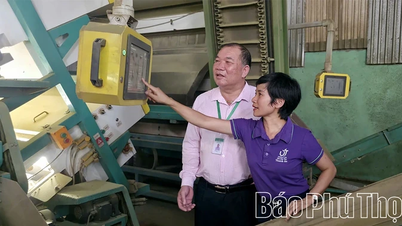
To implement digital transformation and information digitization, the company installed sensors on 100% of its old machines, converted production signals into digital form, developed its own data conversion and reading system, connected and wrote apps to manage production data, costs, and technology modes; and extracted and provided daily the required data for the supply chain.
Thanks to its bold adoption of new technologies and enhanced digital transformation, the unit consistently meets the stringent requirements of both domestic and international partners.
Mr. Nguyen Chi Truc, Director of Vinatex Textile Company Limited, said that digital transformation is not about having a ready-made set of solutions that businesses can simply apply or follow. Choosing the wrong approach can lead to significant costs and risks of disruption due to financial constraints. This necessitates businesses carefully considering the appropriate level and scale of implementation, thoroughly addressing the balance between financial and human resources, and recognizing this as a long-term strategy.
“The group's goal is to ensure that digital transformation activities guarantee the company's products can enter and secure a firm position in the global supply chain, while also building sustainable development capabilities. We understand that, in the context of the textile and garment industry facing fierce competition and increasingly high market demands, technological innovation and automation have become key to enhancing competitiveness,” Mr. Nguyen Chi Truc stated.
The stringent requirements of green transition
Alongside digital transformation, the demand for "greening" is becoming a mandatory standard from major, traditional markets for Da Nang's textile and garment industry, namely Europe and the United States. International brands are not only concerned with price and delivery time, but also set strict criteria regarding emissions, the use of recycled materials, and the company's responsibility towards the environment and the community.
To meet this requirement, many businesses have invested in energy-saving systems, utilized renewable energy sources such as solar power, and improved production processes to reduce material consumption. Building factories that meet international standards for environmental protection and labor is becoming a clear trend throughout the industry.
According to Mr. Huynh Van Chinh, Chairman of the Board of Directors of 29-3 Textile and Garment Joint Stock Company, the transformation process is not simple and inevitably faces obstacles such as high initial investment costs, while businesses have limited access to capital. In addition, changing production processes requires adaptation time, retraining of personnel, and carries inherent risks in the initial operational phase. It is clear that the textile and garment industry is facing a crucial transformation phase with urgent demands for proactive technological innovation and improved management capabilities.
“Meeting green standards will determine the industry’s ability to sustain growth and enhance its position in the coming years. Anticipating market fluctuations, for many years, 29-3 Textile and Garment Joint Stock Company has proactively taken a step ahead by building a green factory in Duy Trung (formerly Quang Nam province) and is gradually ‘greening’ its production facility located in Thanh Khe ward, Da Nang city,” Mr. Huynh Van Chinh shared.
Most textile and garment businesses in the city acknowledge that, in the long term, digital transformation and sustainable development will not only help the industry overcome immediate challenges but also open up opportunities for deeper participation in the global value chain. By meeting high standards in technology and the environment, textile and garment businesses in the city will have a significant advantage in accessing high value-added markets.
Source: https://baodanang.vn/nganh-det-may-day-manh-chuyen-doi-so-3332747.html
![[Photo] Delegation attending the 14th Congress of the Vietnam Trade Union visits the Mausoleum of President Ho Chi Minh.](https://vphoto.vietnam.vn/thumb/1200x675/vietnam/resource/IMAGE/2026/06/03/1780451842301_ndo_br_img-3824-jpg.webp)








































































Comment (0)