

 |
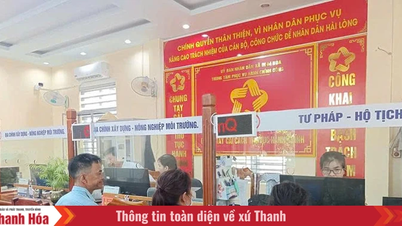
| People conduct transactions at the Public Administrative Service Center of Ha Giang 2 Ward. |
Bottlenecks stemming from a lack of connectivity.
Information technology systems are supposed to free up labor, but instead, they are creating immense pressure on both the administrative apparatus and the people.
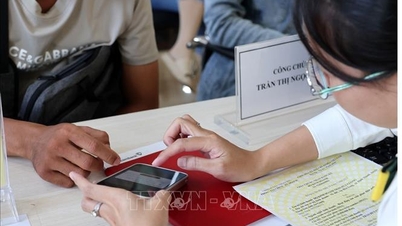
Sitting at her desk every day, Ly Thi Van Anh, an officer at the Public Administrative Service Center in Binh Thuan ward, has her computer screen cluttered with tabs from the administrative procedure information portals of various ministries and agencies. To process a single application, she has to log into multiple systems and repeatedly type in the same identification information due to the lack of automatic synchronization. What is called "interoperability" in written documents, when implemented in practice, has transformed into a "digital manual" process. Instead of physically moving between departments as before, officers like Ms. Lan Anh now have to manually navigate between independent software programs on their keyboards.
Sharing the same pressure, Ms. Nguyen Thi Chuc, a civil servant in the Justice and Civil Registry department of Vinh Tuy commune, said that every day she has to juggle dozens of tasks on separate software programs, which sometimes leads to confusion. The core reason is that the specialized management systems of the units currently cannot be interconnected, communicate with each other, or synchronize with the National Population Database.
This prolongs the document processing time, forcing staff to perform many repetitive manual tasks. Instead of being streamlined by technology, the lack of synchronization between platforms inadvertently creates additional barriers, reducing overall efficiency and putting great pressure on the staff at the grassroots level," Ms. Chúc shared.
According to a survey, a commune-level civil servant is currently operating up to 15 different specialized software programs from various ministries and agencies simultaneously. Due to inconsistent interfaces and data architecture, instead of simply exporting data with a click as before, officials now have to manually gather and add up each number to create reports. To "fix" this problem, many places have been forced to revert to using the province's old shared software.
A review report by the Department of Science and Technology clearly highlighted this situation: Operating on multiple independent systems leads to increased workload, repeated data entry, and directly impacts the progress of administrative procedures. The cause of this paradox does not lie in technological limitations, but stems from a parochial mindset. The fact that managing units design closed software systems to serve only the management interests of their respective sectors has inadvertently transformed data—a shared national resource—into separate private assets.
 |
| Ms. Ly Thi Van Anh, a specialist at the Public Administrative Service Center of Binh Thuan Ward, constantly has to display the information system tabs of various departments for searching and cross-referencing. |
The challenge of the "right - sufficient - clean - livable" requirement.
Not only are officials struggling with the software, but citizens are also having to navigate a fragmented and even erroneous data flow.
After nearly a month of searching for information, Mr. Doan Xuan Viet, from Kim Ban village, Hung An commune, finally completed the procedures to register his car in his name. According to Mr. Viet, the car was originally purchased within the province, and he thought the process of withdrawing the registration would be simple, but it turned out to be very complicated. The original registration was in Hanoi , but due to the lack of seamless integration of specialized data systems, verifying and withdrawing the original documents took a very long time. During the days waiting for the data to be processed, the car had to sit idle at home.
More importantly, the lack of synchronization and haste in the initial stages of digitizing population data left behind errors that caused inconvenience to citizens. In some localities, due to pressure to meet targets and the data entry and verification process not being thoroughly calibrated, there were instances where children were not listed in the family household registration on the electronic system.
Ms. Tran Thi Hoai Phuong, from Group 8, Nong Tien Ward, shared that her child, born in 2020, is entering first grade this year. During the registration process, she was shocked to discover that her child's name was not in the family's electronic household registration book. As a result, she had to go back and forth requesting confirmation documents and waiting for the police to separate and correct the original data.
The problem of data errors, even complete data blanks, persists in many localities, making it almost impossible to share and utilize information on digital infrastructure. According to a report from the Department of Agriculture and Environment, out of over 3.6 million land parcels for which land use rights certificates have been issued, only over 1.3 million have been updated into the database (a modest rate of approximately 37%). This means that nearly 2.3 million land parcels, equivalent to 63% of the land resources with granted ownership , remain outside the digital system. Furthermore, 44 localities currently have no data at all.
 |
| Staff at the Lung Phin Commune Public Administrative Service Center assist residents in carrying out administrative procedures. |
Unblocking the digital flow
To ensure that the digital flow is no longer fragmented and isolated, and to minimize these avoidable errors, the solution certainly doesn't lie in creating more new applications or software. Instead, a comprehensive and synchronized integration strategy at the macro level is needed.
Ms. Ho Thi Phuong Lan, Head of the Digital Transformation Department of the Department of Science and Technology, analyzed: To definitively resolve this situation and restore data to its rightful position as a driving resource, in the coming time, it is mandatory to integrate and synchronize all specialized data to the National Data Center, under the close coordination and cooperation of ministries and sectors.
To realize this goal, technology and administrative management experts believe that focus should be placed on two core areas. First, it is time to eliminate the "isolated" mindset by issuing a mandatory technical standards framework from the central to local levels. Ministries and agencies cannot maintain a "my way or the worse" mentality but must take responsibility for opening up connections, forcing specialized systems to "communicate" and share data with each other on a single common platform. Simultaneously, the architecture of the Information System for Handling Administrative Procedures must be redesigned, using the convenience of local officials and citizens as a measure of effectiveness, and resolutely eliminating the situation where the same information has to be entered multiple times.
Synchronized integration not only frees up labor in the administrative apparatus but is also the only way to ensure that data resources achieve two crucial criteria: "cleanliness" by minimizing errors from manual data entry, and "viability" through continuous real-time updating and exchange. A national digital map can only be completed when the flow of data is unobstructed, becoming a continuous source serving the development of the entire society.
Text and photos: Tuan Quang
Efficient operation of shared data
 |
| Comrade Nguyen Van Hien Deputy Director of the Department of Science and Technology |
In recent times, Tuyen Quang province has actively coordinated with central ministries and agencies in connecting, integrating, and testing administrative procedure resolution processes on the centralized systems of ministries and agencies. However, in the practical implementation process, some difficulties remain, such as incomplete operational functions; inconsistent connection with specialized software; and limited information technology infrastructure in some remote areas. To ensure the effective operation of the shared data warehouse, it is necessary to allow parallel operation between the province's administrative procedure resolution information system and the Ministry's centralized administrative procedure resolution information system during the transition period; complete conversion should only be ensured when 100% of the technical conditions are met to avoid disrupting the resolution of administrative procedures for citizens and businesses. Simultaneously, it is necessary to accelerate the standardization of data, complete real-time synchronization functions, implement electronic signatures, electronic archiving, and ensure seamless interconnection with the National Public Service Portal. At the same time, continue to strengthen professional training for grassroots officials; research implementation roadmaps suitable to the actual conditions of each locality.
Strengthening connectivity and data sharing between industries.
 |
| Comrade Vu Hoai Nam Director of VNPT Ha Giang |
In my opinion, the biggest reason for the current inability to standardize data is that the development of specialized databases in the past was fragmented, with each industry and field implementing different standards and platforms, leading to difficulties in connecting and sharing data.
In many cases, the same citizen's information has to be entered multiple times into different systems due to the lack of complete data interoperability. Some databases have been digitized, but data standards across sectors are not standardized, hindering the sharing and exploitation of information. Furthermore, information technology infrastructure in some remote and rural areas is uneven; and the capacity of some local officials to access and utilize digital data remains limited.
To address this situation, it is necessary to continue improving national databases for critical data and databases formed by localities to become national databases; promote data connectivity and sharing between sectors, making data-centric in serving citizens and businesses, while minimizing the need for officials and citizens to re-provide information that the State already possesses.
Maximizing the benefits of VNeID at level 2
 |
| Lieutenant Colonel Tran Van Hung Deputy Head of the Administrative Police Department for Social Order, Provincial Police |
Over the past period, the Police Department for Administrative Management of Social Order has proactively coordinated with relevant departments, agencies, and units to regularly review, compare, update, and clean up population data; at the same time, it has actively participated in coordinating the construction, creation, supplementation, cleaning, and enrichment of specialized data to ensure accuracy, consistency, and uniformity between data systems, effectively serving state management and resolving administrative procedures for citizens and businesses.
In addition, the unit proactively advised the leaders of the Provincial Police and the Provincial People's Committee to continue directing relevant departments, forces, professional offices, and police in communes and wards to strengthen propaganda, guidance, and support for people to register and activate level 2 electronic identification accounts (VNeID), integrating document information, contributing to the comprehensive development of the VNeID application, making it a national digital super app.
Ready to cooperate in updating data.
 |
| Ms. Nong Thi Xuyen Chang Tham village, Bang Lang commune |
Currently, much of the public's information has been updated on digital data systems. However, to ensure that the data remains complete, accurate, and reflects reality correctly, cooperation between citizens and relevant agencies is essential in the process of reviewing and updating information.
We hope that the relevant authorities will regularly provide information and guidance when reviewing and updating data so that people are aware and can proactively cooperate. In reality, many people are not yet aware of the information that needs to be updated or when it needs to be done, so specific and timely guidance is essential.
When a request for data review and updating is made, we are ready to provide the necessary information and cooperate according to the instructions. We hope that the updated data will be used consistently, avoiding situations where citizens have to declare the same information multiple times.
Source: https://baotuyenquang.com.vn/chuyen-muc-cai-cach-hanh-chinh/202606/khoi-thong-dong-chay-du-lieu-so-5db74ec/


![[Photo] First session of the 14th Congress of the Vietnam Trade Union](https://vphoto.vietnam.vn/thumb/1200x675/vietnam/resource/IMAGE/2026/06/03/1780465947883_ndo_br_img-3852-jpg.webp)


























![[Photo] Delegation attending the 14th Congress of the Vietnam Trade Union visits the Mausoleum of President Ho Chi Minh.](https://vphoto.vietnam.vn/thumb/1200x675/vietnam/resource/IMAGE/2026/06/03/1780451842301_ndo_br_img-3824-jpg.webp)


































































Comment (0)