

When the soil is no longer healthy
The Ham Yen mandarin orange growing region once experienced a period of great prosperity, with over 8,000 hectares covering most of the communes in the area. For many farmers, the mandarin orange tree was a source of wealth, with many families building multi-story houses and buying cars thanks to the orange crop.
According to preliminary statistics from the Ham Yen Commune People's Committee, the total area of orange orchards surveyed in 2025 is estimated at approximately 830 hectares. Of this, 760 hectares are ready for harvest, mainly consisting of mandarin oranges, Xa Doai oranges, lemon oranges, V2 oranges, and some other varieties. The average yield is estimated at 155 quintals/hectare, with an estimated production of 117.8 tons. However, the area of dead or reduced-yielding orange trees has reached 271.4 hectares compared to previous years. This figure reflects the reality of the decline of the mandarin orange growing region. In many areas, people are forced to cut down large areas of orange trees with yellowing leaves, root rot, and stunted growth.
 |
| Residents of Yen Phu commune are being guided on dragon fruit cultivation techniques according to VietGAP standards. |
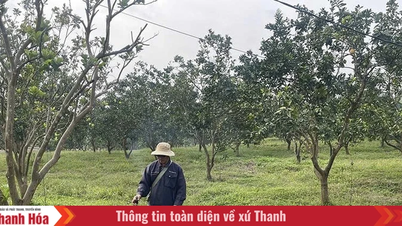
Mr. Bui Quang Trung, from Hamlet 68, Yen Phu Commune, has been involved in orange cultivation for decades. With 9 hectares of orange trees, he used to earn hundreds of millions of dong each harvest season. But that was many years ago; currently, his family has lost all their orange trees. His orchard is showing signs of yellowing leaves, shriveled fruit, and then withering and dying. What worries Mr. Trung most is that when he tries to replant new trees, they also turn yellow and die.
Many other specialized orange-growing areas are also facing similar risks. Thousands of hectares of oranges in Bac Quang and Quang Binh provinces suffered from yellowing leaves, root rot, and depletion due to pests, diseases, and soil degradation after many years of continuous cultivation.
Studies on citrus orchard soils indicate that, after years of continuous cultivation, the majority of the area has very high acidity, is poor in organic matter, and deficient in calcium, magnesium, and trace elements; over 82% of the area planted on sloping land faces a serious risk of erosion. Notably, the amount of inorganic fertilizer used in many orchards is 2-3 times higher than recommended, while the percentage of households using organic fertilizer is very low.
Mr. Tran Ngoc Thanh, Head of the Plant Protection Department, Crop Production and Plant Protection Sub-Department, Department of Agriculture and Environment, acknowledged that the decline in the area of mandarin oranges in the locality is due to many orchards entering the aging cycle after 20-25 years of continuous exploitation. Meanwhile, the prolonged overuse of chemical fertilizers and pesticides has depleted the soil faster than predicted.
Inspections of orange orchards revealed a common problem: many orchards have been using unbalanced nutrient supplementation for many years, with excessive use of chemical fertilizers and pesticides. Inappropriate farming practices (such as weeding and burying fertilizers) lead to soil erosion, and some orchards even use herbicides, causing soil compaction, poor drainage, and stunted root development.
A warning bell
The phenomenon of "over-fertilization" with chemical fertilizers and pesticides has also occurred in citrus fruit and tea-growing areas in the province. The soil is "depleted" by chemical fertilizers and herbicides over a long period, causing the topsoil to become compacted, deficient in organic matter, and its water retention capacity to decrease significantly.
According to experts, the efficiency of nitrogen fertilizer application in many localities only reaches 30 to 50%, depending on soil type, crop variety, season, application method, and fertilizer type. As a result, a large amount of fertilizer is washed away by surface water and flows into ponds, lakes, and streams, causing surface water pollution; some seeps into groundwater, and some evaporates due to temperature changes or denitrification, causing air pollution…
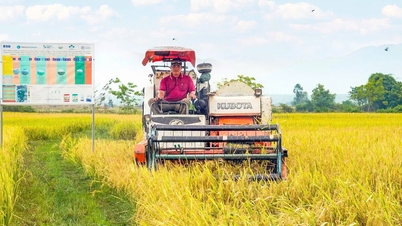
Currently, in some localities, farmers still apply more fertilizer than recommended, which not only causes waste but also reduces the plants' resistance to pests and diseases, especially rice blast disease in the winter-spring season and bacterial leaf blight and bacterial stripe disease in the summer season.
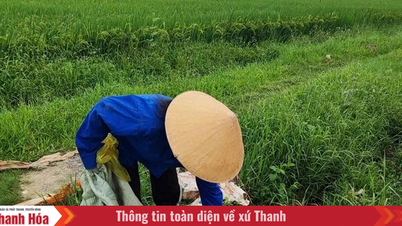
Not only have managers and scientists warned about the harmful effects of overusing inorganic fertilizers, but farmers themselves also recognize the harm of chemical fertilizers and pesticides, yet for various reasons, they still have to use them. Ms. Do Thi Loc, from Hung Thinh village, Truong Sinh commune, shared: "For my 5 sao (approximately 0.5 hectares) of rice fields and paddy paddies, which I just planted at the beginning of spring, I had to buy NPK fertilizer for both base fertilization and top dressing. I know that using compound fertilizers only has a short-term effect and also leads to soil compaction, but I have no other choice because my family doesn't raise livestock, so the supply of animal manure is limited."
At a meeting with the Vietnam Organic Agriculture Association at the end of April, Mr. Phan Dang Dong, Deputy Director of the Department of Science and Technology, stated that the province has implemented many projects related to assessing the impact of pesticides, orange degradation, and safe orange and tea production models. However, according to Mr. Dong, one of the biggest obstacles currently remains the overuse of herbicides, a factor that degrades the soil in the long term and directly affects the foundation of organic production. Without soil restoration and strict control over compliance with procedures, traceability or QR codes will hardly create real value.
Drawing on costly lessons from specialized farming areas, Tuyen Quang province is gradually shifting towards greener agriculture, focusing on restoring soil health, reducing reliance on chemicals, and developing circular and organic farming models. Many comprehensive solutions, from managing agricultural inputs and improving soil to changing farmers' production practices, are being implemented to rebuild the foundation for sustainable agricultural development. This will improve soil health, increase the value of agricultural products, and ultimately contribute to achieving the government's commitment to NetZero.
(to be continued)
Text and photos: Nguyen Dat, Thanh Phuc, Ly Thu
Lesson 1: When the soil... gets poisoned
Source: https://baotuyenquang.com.vn/kinh-te/202606/bai-2-bai-hoc-dat-gia-a4c6aab/

![[Photo] Secretary of the National Assembly Party Committee, Chairman of the National Assembly presides over the meeting of the Standing Committee and Executive Committee of the National Assembly Party Committee.](https://vphoto.vietnam.vn/thumb/1200x675/vietnam/resource/IMAGE/2026/06/03/1780480353201_ndo_br_bnd-2585-jpg.webp)


![[Photo] First session of the 14th Congress of the Vietnam Trade Union](https://vphoto.vietnam.vn/thumb/1200x675/vietnam/resource/IMAGE/2026/06/03/1780465947883_ndo_br_img-3852-jpg.webp)
![[Photo] General Secretary and President To Lam presides over a meeting with the Central Organizing Committee.](https://vphoto.vietnam.vn/thumb/1200x675/vietnam/resource/IMAGE/2026/06/03/1780482764658_a1-bnd-4741-3342-jpg.webp)











































![[Video] Sunset at Lap An Lagoon – Where the sun sets over the fishing nets](https://vphoto.vietnam.vn/thumb/1200x675/vietnam/resource/IMAGE/2026/05/31/1780192137701_beach-landscape-sea-water-nature-grass-745871-pxhere-com.jpeg)




































Comment (0)