

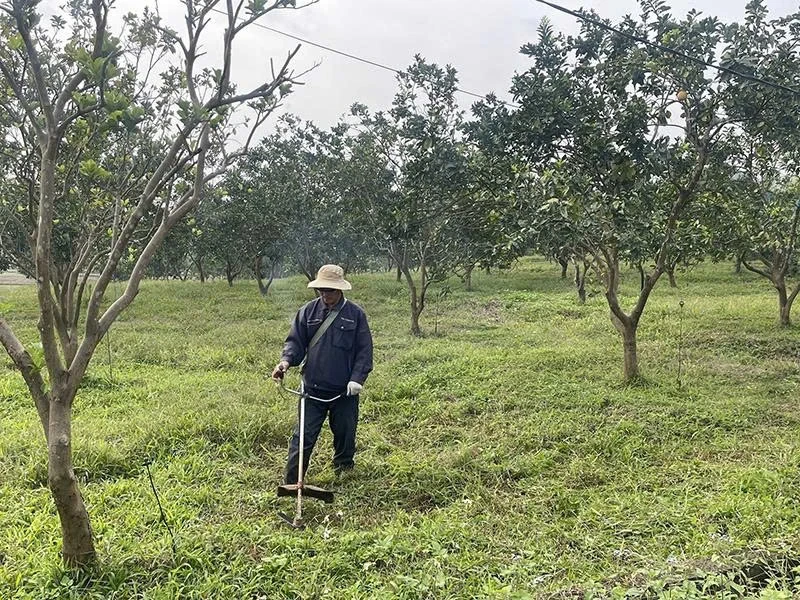
An organic grapefruit farm in Thuong Xuan commune.
In agricultural production, crop yields largely depend on inorganic fertilizers and chemical pesticides, which not only increase input costs but also pollute the soil and water sources. Farmers' failure to adhere to the "four correct principles" (food safety, quality, and environmental protection) increases chemical residue in agricultural products, directly impacting the health of both producers and consumers. Faced with this reality, the agricultural sector is gradually adjusting its development direction towards sustainability, focusing on quality, food safety, and environmental protection; applying science and technology, producing according to VietGAP standards, organic farming, using biological methods, gradually reducing the use of chemical pesticides, and maintaining biodiversity... to protect water resources and prevent soil degradation and erosion.
In many key rice-growing areas of the province, such as communes in the former districts of Yen Dinh, Tho Xuan, Vinh Loc, and Thieu Hoa, the authorities actively encouraged people to expand improved farming models with groundbreaking techniques such as the System of Rice Intensification (SRI), integrated pest management (IPM), and the application of the "3 increases, 3 decreases" and "1 must, 5 decreases" principles...
Ms. Do Thi Hoa, director of Xuan Minh Agricultural Service and Rural Development Cooperative in Xuan Lap commune, said: “With the goal of producing clean rice, the cooperative has developed a rice cultivation model following organic farming practices. Participating members and farmers receive support in terms of seeds, organic fertilizers, technical training, and production without chemical fertilizers or pesticides. The use of organic fertilizers not only improves product quality but also changes the farming mindset of the people. In the long term, it contributes to protecting the ecological environment, improving soil, and increasing productivity and quality. The finished rice grains are slender, white, have a light natural aroma, and the cooked rice is soft and sweet. Thanks to its stable quality, the Hoa Minh rice brand of the cooperative is increasingly trusted by consumers.”
On farms and in production models, people are also boldly applying environmentally friendly measures such as raising earthworms, collecting sugarcane bagasse, corn, straw, shells of aquatic species, and some types of probiotics to produce organic fertilizer.
Mr. Le Xuan Hoang, owner of a pomelo orchard in Thuong Xuan commune, said: “To provide nutrients to the trees, improve the quality of the pomelo fruit, and restore the soil's health, I use waste products from finely ground fish bones, composted for 30 to 40 days, and hydrolyzed to make liquid fertilizer for the trees; all livestock waste and garbage are also composted, and fallen pomelos are collected and fermented with EM enzymes to make fertilizer. Then, the fertilizer is mixed with water in large tanks, and a drip irrigation system delivers the fertilizer to each tree root. Strict adherence to the 'eight no's' (no artificial colors, no artificial colors, no artificial colors, no artificial colors) is required to meet organic standards.”
Currently, the province has approximately 2,500 hectares of production certified under VietGAP; nearly 20 hectares of crops meeting organic standards and about 5,100 hectares producing according to organic farming practices; and about 3,600 hectares of crops applying advanced, water-saving automatic irrigation systems... Although this percentage is still small compared to the total cultivated area, it is considered a positive sign in the journey towards developing "green" agriculture.
Beyond simply reducing the use of chemical fertilizers and pesticides, many cooperatives and businesses in the area are investing heavily in high-tech agriculture, applying digital transformation in production management; greenhouse models, automatic irrigation systems, and traceability are gradually becoming common in many concentrated production areas. This is considered an important step in helping people change their mindset from "large-scale production" to "clean and sustainable production," creating favorable conditions for localities to build brands and expand their consumer markets.
Although the transition to green farming still faces many challenges, it is considered an essential requirement for the sustainable development of Thanh Hoa's agriculture in the new era. When the government, businesses, and people work together to change their production mindset, green agriculture will become an important driving force in increasing the value of agricultural products, protecting the environment, and improving the economic efficiency for the people.
Text and photos: Kim Ngoc
Source: https://baothanhhoa.vn/mo-loi-phat-trien-nong-nghiep-ben-vung-288860.htm




![[Image] Hanoi's urban life under the challenge of a "scorching hot" environment](https://vphoto.vietnam.vn/thumb/1200x675/vietnam/resource/IMAGE/2026/05/25/1779706979265_nang-nong-t5-2026-minh-duy-7-4636-jpg.webp)


























































Comment (0)