Buying at the beginning of the day, losing over 10 million VND per tael by the end of the day.
Yesterday (June 10th), Saigon Jewelry Company (SJC) adjusted its gold prices seven times. In total, each SJC gold bar decreased by 5.5 million VND, with the buying price at 133.3 million VND and the selling price at 138.3 million VND. Similarly, SJC's 9999 gold rings also decreased by 5.3 million VND, with the buying price at 133.2 million VND and the selling price at 138.2 million VND per tael. Notably, the buy-sell price difference for both SJC gold bars and gold rings reached a record high of 5 million VND per tael in the past three days. This means that those who bought early yesterday morning ended up losing a significant 10.5 million VND per tael by the end of the day. Furthermore, compared to the peak of 192 million VND per tael at the end of January, the price of gold has plummeted by nearly 54 million VND, a decrease of 28%.
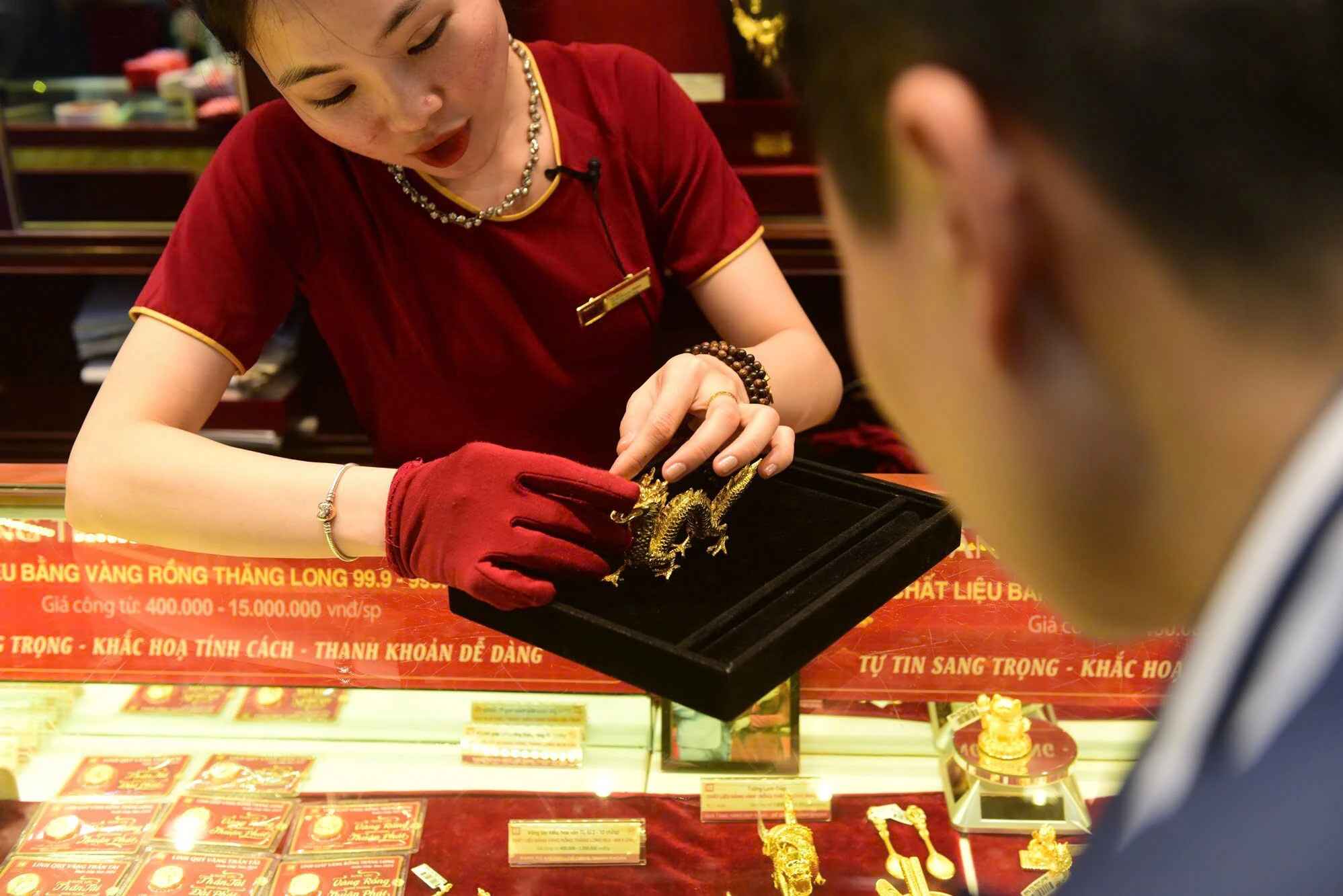
Gold prices are continuously falling and are likely to continue to decline.
PHOTO: NGOC THANG
Many who bought at the bottom, at prices as low as 160 million VND or 150 million VND, have suffered losses, and even now, no one knows where the bottom of the precious metal will be as the downward trend continues. Yesterday, the price of the precious metal continued to fall to $4,166 per ounce, down $170 from the previous day. Gold prices have fallen to their lowest level this year due to pressure from a wave of sell-offs in financial markets and increasing expectations that the US Federal Reserve (Fed) will raise interest rates this year.
According to financial market expert Phan Dung Khanh, after reaching its peak, gold prices have shifted to a sideways trend and have been gradually declining over the past six months. The current correction and consolidation of gold prices are influenced by four main factors, weighing heavily on the short- and medium-term outlook for this precious metal. Firstly, profitability has declined due to the excessively high price increases. In recent years, gold and silver have yielded enormous returns, at times increasing by 50-60% annually.


Secondly, the bull cycle of gold has been prolonged and is starting to lose its appeal. Unlike silver, which only experienced a strong surge last year, gold has maintained a continuous upward trend for 3-4 years. This prolonged growth has slowed momentum, especially in the context of other investment channels proving more attractive. Money is tending to shift to markets that are continuously reaching new highs, such as stocks, particularly technology stocks.
Thirdly, pressure from US government bond yields and the cash flow problem. Unlike bank deposits that generate interest, real estate that generates rental income, or stocks that provide dividends, holding gold does not generate passive income (no interest). When US government bond yields surge, the opportunity cost of holding gold becomes more expensive, thereby creating pressure for sell-offs or profit-taking in the precious metals market.
Another factor is the recovery of the USD and changes in Fed policy expectations. The USD has stopped its downward trend and is beginning to trend upwards again. In addition, US macroeconomic data, especially the labor market, remains strong. This inadvertently creates a sense of anxiety among investors. The probability of the Fed raising interest rates later this year or next year is increasing. Therefore, Mr. Khanh emphasized that although institutions and central banks are still buying gold, the pace has slowed, raising concerns about widespread profit-taking in the near future. With the changes in macroeconomic factors, gold's position is no longer as attractive as before.
Will the downward trend continue?
Economist Dr. Dinh The Hien believes that the price of gold this year is being influenced by two opposing forces. On the one hand, the Fed's tight monetary policy and the prospect of high interest rates are putting pressure on gold prices. On the other hand, global economic and geopolitical uncertainties continue to drive capital flows towards safe-haven assets, thereby supporting gold prices. In addition, gold prices are also being supported by two important factors. Firstly, several central banks, led by China, are seeking de-dollarization, meaning they will reduce their USD reserves and shift a portion to gold. Even if only a small portion of global USD reserves is transferred to gold, the increased demand could provide significant impetus to the price of the precious metal. If 1% of USD reserves are transferred to gold, it could push the price of gold above $6,000 per ounce. The second key factor is the renewed preference among investors for holding gold, rather than buying real estate or investing in stocks.
In the long term, gold prices continue to move according to the principle of balancing risk and return, similar to real estate, stocks, or bonds. Following this direction, Mr. Hien predicts that the return on gold can be referenced against the US government bond interest rate or US inflation plus a certain margin of 0.5-1%. Assuming an average return of about 4% per year since the global economy stabilized after 2012, the price of gold at the end of 2026 could fluctuate in the range of $3,000-$3,500 per ounce. If tensions in the Middle East are controlled, oil prices stabilize, and the US continues to promote the restructuring of the global economy through tariff policies, the price of gold at the end of 2026 is likely to fluctuate in the range of $3,500-$4,000 per ounce.
Expert Phan Dung Khanh predicts that gold prices will find it difficult to return to their previous peak. In fact, this decline could push the precious metal below $4,000 per ounce, hitting technical resistance around $3,800 per ounce. Investing all or more than half of one's assets in gold at this time is extremely risky. Mr. Khanh suggests that for investors holding a very large proportion of gold (90-100%) or using financial leverage (borrowing to buy gold), the best course of action is to wait for technical market rebounds to reduce their holdings. Reducing holdings helps protect financial safety, especially by reducing the pressure of interest payments, even if it means breaking even or incurring a slight loss.
For short-term traders, this is not the right time to buy at the bottom. The market is forming a prolonged corrective and sideways trend, not just temporary fluctuations lasting a few days. However, for long-term investors or those holding only a low proportion of gold (5-10%), gold still serves as a good defensive asset and there's no need to sell. If you don't own gold and want to accumulate it long-term, you can take advantage of low prices to gradually buy more; absolutely do not invest all your capital at once.



Silver prices fell nearly 8% in a single day.
At the end of June 10th, Phu Quy Company bought silver at 64.77 million VND/kg and sold it at 66.77 million VND, a decrease of 4.61 million VND compared to the previous day. Sacombank - SBJ Company bought silver at 65.92 million VND and sold it at 68 million VND/kg, a decrease of 3.2 million VND… Adding the buy-sell price difference of 2-3 million VND, those who bought silver after one day would lose over 6 million VND/kg, equivalent to a decrease of about 8%.
Source: https://thanhnien.vn/gia-vang-lao-doc-khong-phanh-185260610223728722.htm