

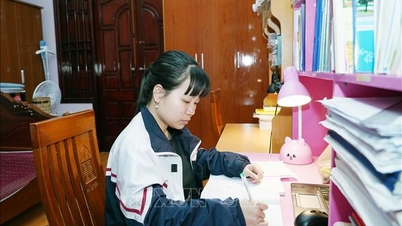
With the high school graduation exam approaching, effective studying and revision for 12th-grade students is a major concern for many teachers, parents, and especially the students themselves.
According to teacher Dinh Thi Thuy, a Master of Literature, 2025 marks a significant shift in the high school graduation exam. Literature will become the only compulsory subject in a completely essay-based format.
To study and review Literature effectively, this teacher believes that, firstly , students need to correctly understand the structure of the 2025 high school graduation exam .
According to Ms. Thuy, with the goal of developing competencies and qualities in the 2018 program, the structure of the Literature exam has a balanced coverage of requirements regarding reading comprehension and writing skills, as well as knowledge and thinking about social and literary issues.
Specifically:
The exam consists of two parts:
Part I – Reading Comprehension (4 points):
- Textual material: Literary texts (poetry/stories/memoirs) or informational texts, argumentative texts.
- Questions: 5 questions with 3 levels: Recognition – Comprehension – Application.
Part II – Writing (6 points):
The structure is flexible according to the reading comprehension text in Part I:
If Part I is a literary text, then Part II includes:
- Write a literary analysis essay (2 points)
- Write a social commentary essay (4 points)
If Part I consists of argumentative and informational texts, then Part II includes:
- Write a social commentary essay (2 points)
- Write a literary essay (4 points)
Secondly, students need to know how to systematize their knowledge and skills.
Students are provided with foundational knowledge in each specific lesson. In the final stage, they need to synthesize this foundational knowledge and develop the skills (formulas) to answer the different question types in Part I (Reading Comprehension) and Part II (Writing) of the exam.
Knowledge of literature: a correct and focused understanding of the formal and thematic characteristics of literary genres: poetry, short stories, memoirs, and drama.
Knowledge of informational and argumentative texts: understanding the meaning of the title, thesis, arguments, reasoning, evidence, non-verbal means, author's attitude, etc.
Knowledge of Vietnamese language: Rhetorical devices (all rhetorical devices, paying attention to new knowledge such as: breaking common language rules, irony, paradox, ambiguity, some devices that increase affirmation and negation...); meaning of words, Sino-Vietnamese words; errors in words, sentences, use of footnotes, omitted components...
Students need to master the skills of reading various types of texts, and the skills of writing literary and social commentary essays in both forms: essay writing and paragraph writing (because the exam structure announced by the Ministry is flexible - as explained above). These skills are all taught to students in class.
Teacher Dinh Thi Thuy also noted that in the reading comprehension section, students should answer concisely, correctly, accurately, and completely.
Writing an argumentative essay: Ensure the essay/paragraph structure is correct, addresses the issue being discussed accurately and profoundly, presents clear arguments, establishes coherent connections between arguments, combines reasoning and evidence, and demonstrates critical thinking.
In addition, students need to pay close attention to presentation skills in their work. They should practice writing on exam paper during the comprehensive practice test phase. Ensure the following requirements are met: Clearly identify sections, topics, and sentences; ensure neat and even margins, minimizing erasures; and indent the first line of each paragraph by approximately 2cm.
Third, students need to develop a study plan.
Ms. Thuy emphasized that after synthesizing all the knowledge and skills, students should build a phased learning roadmap, creating a detailed plan for their studies each week/month.
For example: Students review the material by week.
Week 1: Reviewing knowledge and skills
Week 2: Review knowledge, reading comprehension skills, and practice with sample tests based on the exam structure.
Week 3: Review knowledge and skills in writing social commentary essays and practice with sample questions based on the exam structure.
Week 4: Review knowledge and skills in writing social commentary essays and practice with sample questions based on the exam structure.
Week 5: Review knowledge and skills in writing literary argumentative essays and practice with sample questions based on the exam structure.
Week 6: Review knowledge and skills in writing literary essays and practice with sample questions based on the exam structure.
The remaining weeks will involve practicing comprehensive exam papers (similar to those provided by the Ministry of Education), supplementing any knowledge and skills gaps (with the support of teachers); reading supplementary texts outside the curriculum categorized by genre, and updating on current events and topics worth discussing…
In addition, this teacher also suggested that students should participate in peer grading/evaluation with their peers and receive grading/evaluation from their teachers when completing assignments.
And some notes
Ms. Thuy believes that students need to understand that there are no "secrets" that fall from the sky; the most important secret lies in each student's inner energy. Establishing the right mindset, thinking positively, and maintaining a positive attitude during the learning process will be the "secret" to their success in the exam.
Therefore, according to Ms. Thuy, students need to proactively cultivate their knowledge and skills (closely following the requirements shown in the textbook), proactively practice and learn from each assignment.
"Don't be subjective or biased in your studies and revision. For example, students might predict that the exam is likely to be a social commentary essay, so they don't focus on revising literary essays. It's necessary to study and revise all genres, knowledge, and skills, especially those covered in grades 11 and 12," Ms. Thuy emphasized.
This teacher believes that emphasis should be placed on developing logical and critical thinking skills. The 2018 curriculum exam focuses on testing and evaluating students' abilities and qualities. Therefore, in addition to honing language skills and creativity in expression, the primary requirement is that students' answers must be well-structured, logical, and dialectical; they must utilize critical thinking in argumentation and explanation of issues in a profound and comprehensive manner.
Ms. Thuy emphasized that, with the 2018 Literature program, the Ministry of Education and Training clearly stated the objectives and specifically implemented the program content (through the textbooks), and the Ministry also clearly announced the exam structure.
"Therefore, there will certainly be no 'trick' exam questions designed to trick students. The important thing is that students grasp the basic knowledge, study correctly and deeply the key content, practice their skills thoroughly, and maximize their abilities and personal mark in their work. They will surely conquer the Literature subject in the upcoming exam," Ms. Thuy emphasized.
Ms. Dinh Thi Thuy holds a Master's degree in Literature specializing in Literary Theory, was recognized as an outstanding Literature teacher at the city level in 2016, and has many years of experience teaching Literature at major schools in Hanoi . Ms. Thuy also has over 20 years of experience in teaching and preparing students for the Literature competition at the city and national levels.
Source: https://tienphong.vn/giao-vien-mach-bi-quyet-on-ngu-van-trong-ky-thi-tot-nghiep-thpt-de-dat-diem-cao-post1735379.tpo
![[Photo] Prime Minister Pham Minh Chinh presides over the conference announcing the establishment of the International Finance Centre in Vietnam.](/_next/image?url=https%3A%2F%2Fvphoto.vietnam.vn%2Fthumb%2F1200x675%2Fvietnam%2Fresource%2FIMAGE%2F2025%2F12%2F21%2F1766309817714_ndo_br_dsc-3400-jpg.webp&w=3840&q=75)


![[Photo] Prime Minister Pham Minh Chinh presides over a meeting on private sector economic development.](/_next/image?url=https%3A%2F%2Fvphoto.vietnam.vn%2Fthumb%2F1200x675%2Fvietnam%2Fresource%2FIMAGE%2F2025%2F12%2F20%2F1766237501876_thiet-ke-chua-co-ten-40-png.webp&w=3840&q=75)


























































Comment (0)