

THAI NGUYEN: Due to favorable soil and climate conditions, the canarium fruit grown in Ha Chau is very special, with a rich, creamy, fragrant flavor and firm flesh that is far superior to canarium fruit grown in other localities.
THAI NGUYEN: Due to favorable soil and climate conditions, the canarium fruit grown in Ha Chau is very special, with a rich, creamy, fragrant flavor and firm flesh that is far superior to canarium fruit grown in other localities.
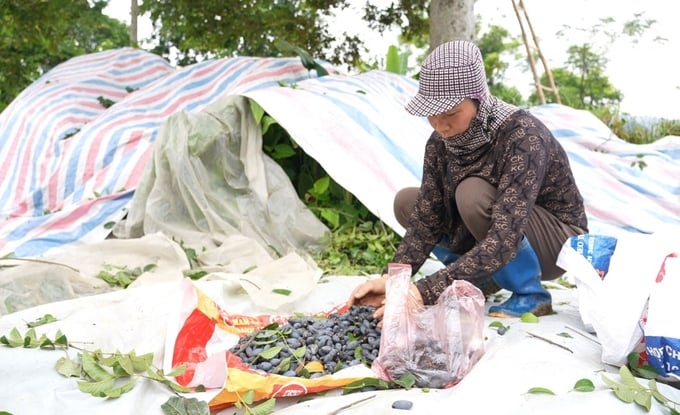
The black olives of Ha Chau are famous along the Cau River in Phu Binh district, Thai Nguyen province. Photo: Pham Hieu.
Black olives are a specialty of the northern mountainous region. Wherever there are hills and forests, black olives can be found. However, perhaps the most famous are the black olives of Ha Chau, a commune located along the Cau River in Phu Binh district, Thai Nguyen province.
No matter where people go, they'll find their way back.
"Remember the season of the wild plum blossoms in Ha Chau and come back."
Black olive trees have been cultivated in Ha Chau commune for hundreds of years. Belonging to the woody plant group, they flower in February, and their fruit ripens and is harvested from July to September of the lunar calendar each year. Due to the favorable soil and climate conditions, the olives grown in Ha Chau are very special, with a rich, creamy, fragrant, and firm flesh, superior to olives grown in other localities. Therefore, black olives have become a specialty of this region.
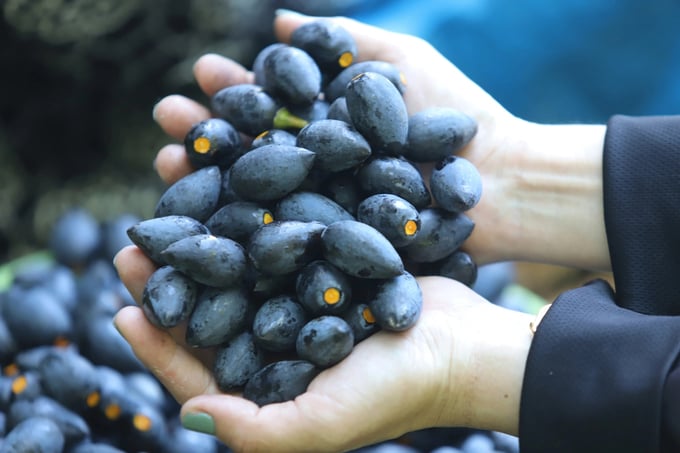
Ha Chau black olives have a richer, fattier, more fragrant flavor and a firmer texture than olives grown in other localities. Photo: Pham Hieu.
According to local experience, the best black olives should be long and spindle-shaped, with bright yellow flesh when bitten into. In good years, a single tree can yield 100 to 150 kg of fruit. The price of good quality black olives is around 90,000 - 100,000 VND/kg. Compared to other crops, black olive trees offer high economic returns.
When harvest time comes, people hardly have to take their produce to the market because traders come to their homes to buy it, and even order entire trees when the trees start bearing fruit. Thanks to this, Ha Chau canarium fruit has spread beyond Thai Nguyen and reached many parts of the country.
Canarium fruit is one of the popular folk dishes. People can prepare black canarium fruit in many different ways, such as: stewed canarium fruit and canarium fruit sticky rice; canarium fruit braised with meat or fish; canarium fruit salad; and especially the canarium fruit salad, which has become a famous specialty of the people of Ha Chau.
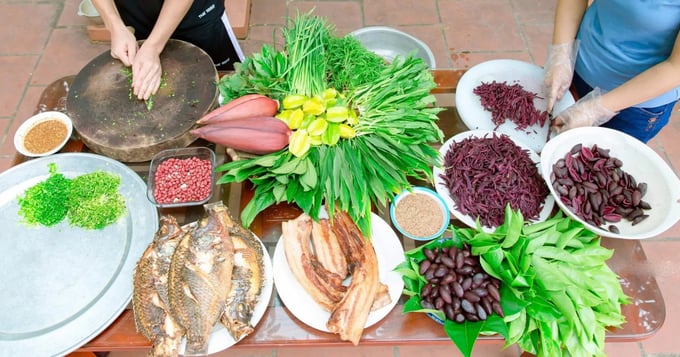
The dish called "nham tram" requires elaborate preparation. Photo: Pham Hieu.
Canarium fruit is rich in nutrients. The pulp contains protein, fat, sugar, and especially vitamins C, B1, PP, fiber, and minerals such as calcium, iron, zinc, phosphorus, potassium, magnesium, and carotene... all of which are very beneficial to health.
In traditional Chinese medicine, the Chinese olive has a sour, sweet, and astringent taste, and a warm nature... it is used to treat many diseases such as bronchitis, dysentery, dermatitis, joint pain, and to cool the body...
In Ha Chau, most households, from the elderly to the young, know how to make canarium fruit jam. Especially nowadays, to cater to the demand of tourists who want to enjoy this local specialty, restaurants in Ha Chau and Phu Binh districts all include black canarium fruit on their menus. Besides jam, black canarium fruit can be used in many other dishes such as stewed with meat or fish, cooked with sticky rice, or pickled in fish sauce...
Ha Chau olives can be used in many dishes, but the first step is always braising them. First, you need to prepare hot water until it's just right, then soak the olives in it. Accurately measuring the water temperature is crucial. If the water temperature is correct, the olives will become soft and creamy, but if the water is too cold or too hot, the olives will become tough and unappetizing, and may even have to be thrown away.
After the canarium fruit is simmered until tender, it can be eaten in simple ways such as dipping it in sesame salt or mixing it with chili fish sauce to eat with white rice. This way of eating allows diners to best appreciate the rich, nutty flavor and the slightly sour aftertaste of the canarium fruit. More elaborate dishes include braised canarium fruit with meat, stuffed canarium fruit with meat, or sticky rice with canarium fruit…
There is an even more elaborate dish made from canarium fruit that requires 14 different spices to prepare. That is the "Nham Nau" dish, unique to the Ha Chau region.
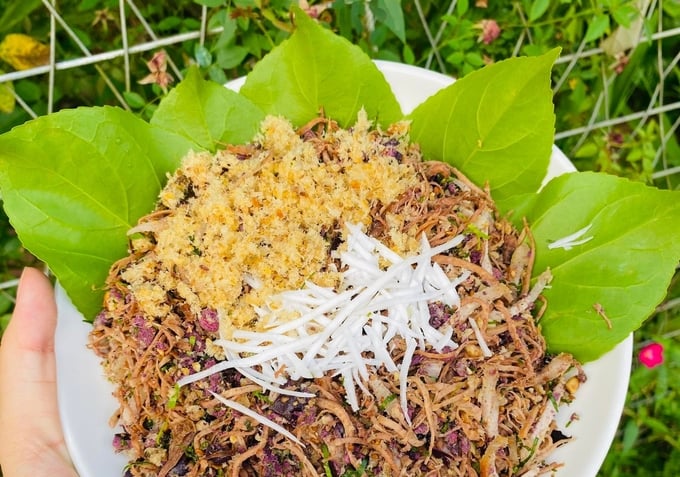
When enjoying the fruit of the Chinese olive tree, you will experience a combination of sweet, nutty, sour, and astringent flavors. Photo: Pham Hieu.
The softened black olives are then finely ground. Grilled catfish or white carp are deboned and then roasted until fragrant. Pork belly, young banana stems, sour starfruit, ginger leaves, fig leaves, and Dinh Lang leaves are sliced into strips. Grated coconut pulp, roasted sesame seeds and peanuts are crushed... Then all ingredients are mixed together.
The way to enjoy this unique dish is to pick up a small amount of wild plum, place it in the middle of a thick, astringent wild leaf, then roll it up and dip it into a sauce that has been prepared with a little sugar. When eaten, diners will fully experience the sweet, nutty, sour, and astringent flavors from the produce of the mountains and forests of Ha Chau.
Preserving ancient Terminalia trees as local heritage
Currently, Ha Chau commune has over 4 hectares planted with more than 1,500 black ebony trees. These trees are concentrated in Moi hamlet, Tao hamlet, and scattered in Nui hamlet, Dong hamlet, etc. Annual production is estimated at 20-25 tons; average yield is 40-50 kg per tree.
Through the Black Canarium Tree Conservation and Development Project, Ha Chau commune is focusing on preserving ancient canarium trees to become local heritage trees. Simultaneously, Ha Chau commune has been coordinating with specialized agencies of Phu Binh district to support the Ha Chau Black Canarium Conservation, Development and Processing Cooperative in building a brand for its salted black canarium and canarium jam products to reach a wider consumer base.
Simultaneously, the commune is promoting and encouraging people to expand the area for planting black ebony trees to create a concentrated raw material zone. Currently, Ha Chau commune is planning to develop the area of black ebony trees in the area, striving to have an additional 3 hectares of new plantings by 2025 in the Cay Troi, Nui Chua, and Bai Quan fields, thereby increasing the total area of black ebony trees in the commune to 7.5 hectares.
Source: https://nongsanviet.nongnghiep.vn/gin-giu-phat-trien-bau-vat-den-xu-che-d370072.html





















![The Essence of Viet Bac Villages: [Part 3] The Precious Fragrance of Nghinh Tuong](https://vphoto.vietnam.vn/thumb/402x226/vietnam/resource/IMAGE/2026/05/29/1780020600366_5237-tinh-tuy-ban-lang-viet-bac-bai-3-chuyen-o-nghinh-tuong-050626_700.jpeg)
![The Quintessence of Northern Vietnam's Villages: [Part 2] The Famous Cassava Noodles of Kunming](https://vphoto.vietnam.vn/thumb/402x226/vietnam/resource/IMAGE/2026/05/28/1779937455892_3929-3144-mien-dong-15-nongnghiep-023138.jpeg)
![The Essence of the Village: [Part 1] Wine on the mountain, tea in the clouds - Bang Phuc](https://vphoto.vietnam.vn/thumb/402x226/vietnam/resource/IMAGE/2026/05/27/1779841729178_3821-1jpg-nongnghiep-103814.jpeg)




















![[Video] Sunset at Lap An Lagoon – Where the sun sets over the fishing nets](https://vphoto.vietnam.vn/thumb/1200x675/vietnam/resource/IMAGE/2026/05/31/1780192137701_beach-landscape-sea-water-nature-grass-745871-pxhere-com.jpeg)




























Comment (0)