They are not always recognized as part of urban architecture, often appearing only as faint, easily overlooked traces amidst signs, traffic, and the hustle and bustle of daily life.
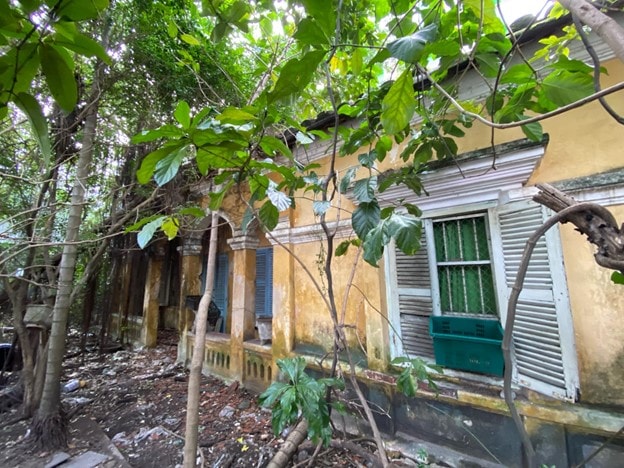
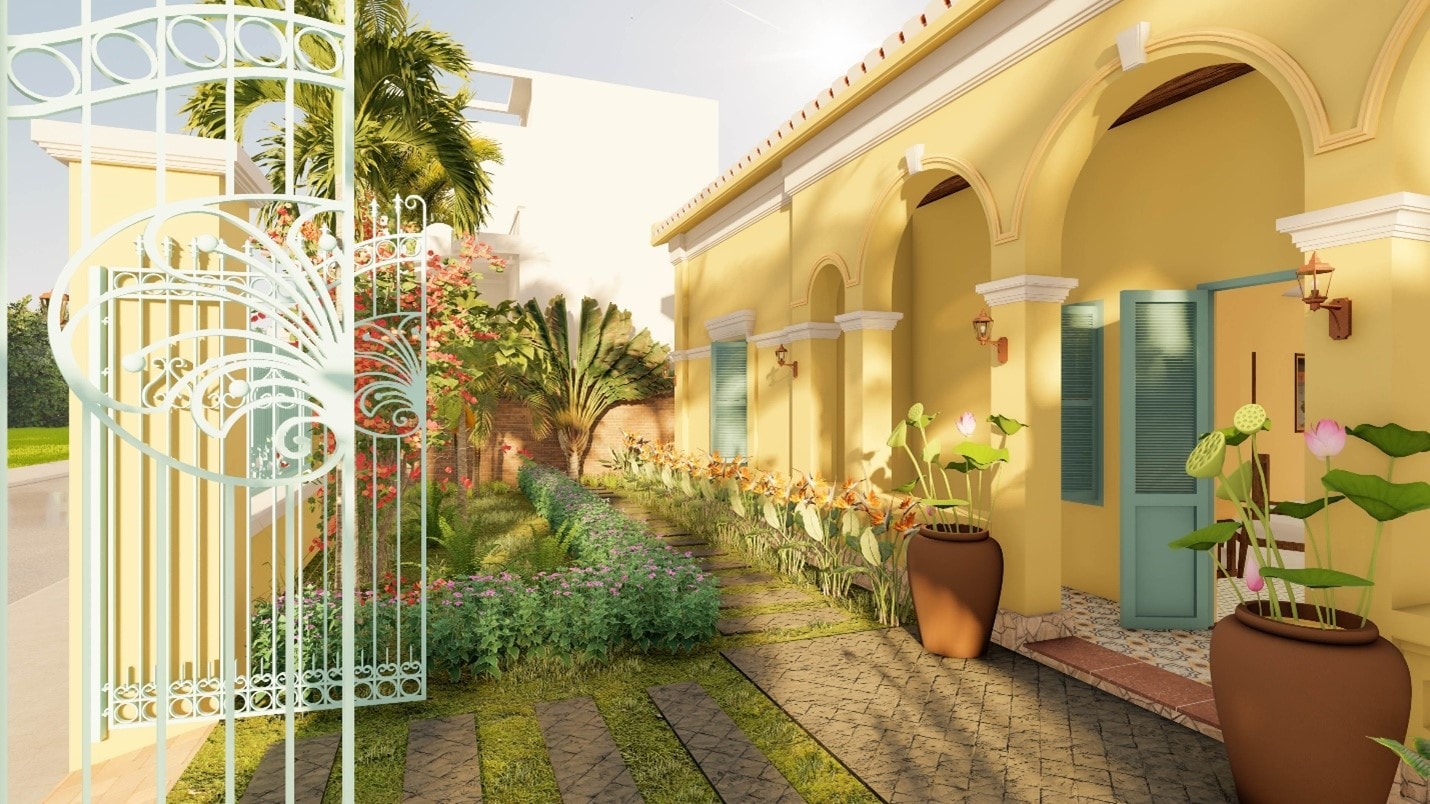
But upon pausing and observing a little more closely, we can recognize familiar features of a bygone urban class, with low eaves, arched doorways, faded wooden shutters, and old, yellowed walls.
The houses tell stories in silence.
These houses, mostly dating from the late 19th to the first half of the 20th century, reflect a diversity of architectural styles, from French local, neoclassical, Art Deco, to even a fusion of Eastern and Western styles. They no longer stand side-by-side in distinct rows as before, but are scattered, interspersed among new constructions and the ever-changing city.
Over time, these houses have become more than just places to live; they've become a form of urban memory, existing in various states. In fact, people are aware of their value. Anyone who has ever cared about Da Nang 's old appearance understands that they are the remnants of a layer of urban life from the early stages of the city's modern development.
In that memory, public buildings such as the old Governor's Palace, the Cathedral, or a few remaining villas are often mentioned. But alongside them, there is also a group of smaller, more scattered, and quieter colonial residences.
Walking along those streets, one gradually notices that each building is in a different condition. Some buildings still retain their relatively intact architectural form, from the facades, tiled roofs, shutters, porches to the spatial proportions. Others still retain their original appearance but have been gradually modified to meet living needs. And there are also buildings that are clearly dilapidated, with cracked walls, damaged roofs, abandoned, and overgrown with trees.



Conservation gap
A rather stark contrast emerges here. The value these buildings create largely belongs to the urban landscape: the streetscape, the rhythm of the low-rise rows, the familiar feeling of walking past an old street corner. But the cost of maintaining them rests almost entirely on the owner.
For a small, privately owned house, keeping it is never just an emotional choice. It involves money for roof repairs, door replacements, dealing with damp walls, and hiring the right people to work with the old materials and structure.
Many homeowners still want to keep, and are even proud of, living in a part of the city's history. But there's a very real gap between that desire and the ability to do so. Renovating such a house is often more expensive than renovating a regular house, the procedures are more complicated, and finding the right professionals isn't always easy. In some cases, simply bringing the living costs to an acceptable level is a huge burden.
Current support is often unclear. Homeowners aren't unmotivated; what they lack is a clear roadmap. When repairs are needed, they have to figure out how to navigate regulations, technical advice, documentation, costs, and permissible intervention limits on their own. Without a sufficiently clear system to support them, preservation efforts easily fall into a piecemeal fashion, with repairs being made as needed, and ultimately, what remains are only a few scattered traces.
Therefore, it's impossible to simply assume that the failure to preserve these houses is solely the homeowners' fault. Often, they aren't turning their backs on their old homes; they're simply facing an overwhelming dilemma alone. A city can hardly preserve its shared heritage if it relies solely on the patience of individual citizens. If an old building holds value for the urban landscape, the responsibility for its preservation cannot rest solely on the shoulders of its owner. At this point, the question of preservation or loss is no longer a single individual choice, but a shared urban issue.
Therefore, simply appealing to people's conscience or emotions is often insufficient. For this group of buildings, saying they need preservation because they are heritage sites is still inadequate. Preservation is unlikely to be sustainable if it relies solely on the goodwill of individuals, without specific mechanisms in place to make their preservation feasible.
The essential thing is not to preserve everything, nor to freeze old houses like artifacts, but to determine what needs to be preserved, what can be changed, and to what extent so that the building remains true to itself. Preservation does not mean immobility; preservation means finding the limits of change so that the building remains recognizable within the current flow.



This group of houses is therefore part of the city's microstructure. Their value lies not in each individual building, but in how they coexist and form a continuous layer of space within the city. Preserving an old house is not just about preserving a past form; it's about working with what existed before it was demolished.
The disappearance of old houses in the city is often not a noisy event, not beginning with large-scale demolitions, but rather with very small changes: adding a roof, replacing a door, expanding a space.
Each of these individual changes may seem small, but collectively they have made it impossible for us to recognize the original image of a building that has become part of history. Therefore, the question of preserving or losing is not just about a few old houses; it is also a question about how the city treats its own memory. A city can develop very quickly, but if all traces of the past disappear, that development will become flat and lacking depth.
Source: https://baodanang.vn/giu-hay-de-mat-nhung-ngoi-nha-cu-3334323.html