


In 2017, Le Thuy folk singing was recognized by the Ministry of Culture, Sports and Tourism as a national intangible cultural heritage. To this day, this unique and distinctive folk melody has maintained its identity and continues to develop strongly.
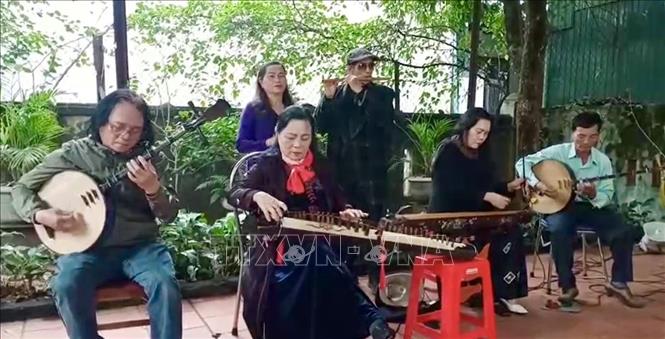 |
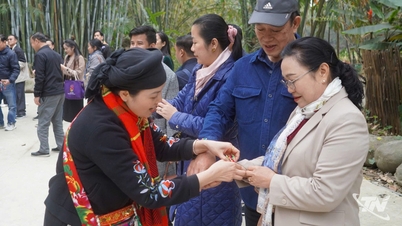
| Artisans and folk culture clubs in Quang Tri province persistently practice and pass on traditional cultural values to the community and future generations. (Photo: VNA) |
The distinctive folk singing of Le Thuy
According to local artisans, Le Thuy folk singing is a highly collective form of folk performance, originating from the process of labor and production and characteristic of the low-lying, riverine region of Le Thuy. People here are born hearing folk songs sung by their grandparents and parents, growing up with these melodies in their families and villages, absorbing into themselves the lyrics and music that embody the soul of their homeland.
Distinguished Artisan Nguyen Thi Ly (Phong Thuy commune, Le Thuy district, Quang Binh province; now Le Thuy commune, Quang Tri province), Head of the Le Thuy Folk Song Club, has dedicated her life to Le Thuy folk singing. With her passion and unwavering commitment, she has become one of the most knowledgeable artisans of the melodies and songs of her homeland. Le Thuy folk singing has nine styles (or melodies), including: long, rươi, chè, nện, ba, xắp, hò khơi, lỉa trâu, and hò nậu xăm. The "styles" (themes) sometimes employ storytelling or narrative techniques. The melodies are simple, familiar, and close to the lives and work of the people, reflecting all aspects of life.
Le Thuy folk singing doesn't distinguish between performers and audience; it has a lead singer and a supporting singer. The lead singer is the "master," while the supporting singers are the "followers." Each verse is usually led by a single person, while the "followers" can be a single person or a whole crowd, known as a "following group." This clearly demonstrates its popular nature and strong appeal to the crowd, creating a lively and exhilarating effect. The content of Le Thuy folk songs is deeply humanistic, combative, humane, and promotes equality in society, without distinction between rich and poor, noble and humble, master and servant, age, occupation, or origin. This reflects the truth, goodness, and beauty in daily life as well as the passion for folk singing among the people of Le Thuy. Along with expressing deep love for the country and homeland, Le Thuy folk singing always reminds people to live with filial piety, loyalty, righteousness, and faithfulness.
The most distinctive feature is the high degree of improvisation and creativity in the performance. When singing, one side sings a random line, the more challenging the better, and the other side must respond immediately. A delay of even one beat means defeat. Some singing styles involve riddles and intellectual battles, requiring quick wit, a good understanding of life, and a rich vocabulary to respond effectively. The musical instruments used in Le Thuy folk singing are quite simple, such as large drums, ceremonial drums, or hands clapping together rhythmically, creating an engaging sound that serves as a backdrop for the song.
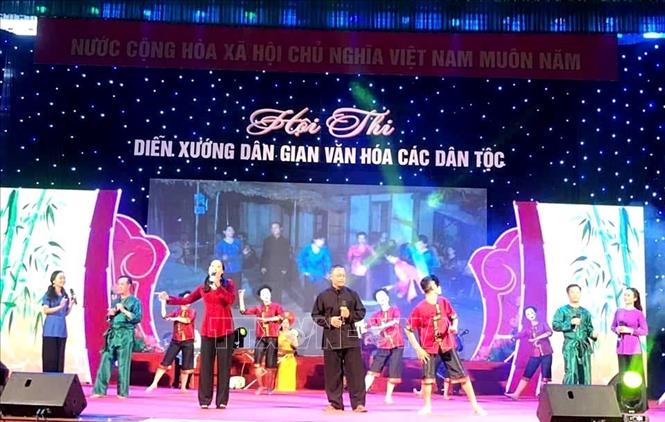 |
| Artisans and folk culture clubs in Quang Tri province persistently practice and pass on traditional cultural values to the community and future generations. (Photo: VNA) |
Le Thuy folk singing is performed in a rich and diverse way, at all times and in all places, during holidays, festivals, village celebrations, important local events, or during labor and production activities. With its simple, endearing, sweet melodies and the deep affection for the land and people of Le Thuy, Le Thuy folk singing is cherished and preserved by the people, becoming an indispensable spiritual bridge for the local community. The connection to their roots, along with their love for their homeland and pride in each child of Le Thuy, is further strengthened when Le Thuy folk singing is honored as one of the national intangible cultural heritages.
Persistently preserving and passing on the heritage of our homeland.
Le Thuy folk singing is a heartfelt expression, a deeply ingrained and indispensable part of the community life of Quang Tri province and its people. This folk song is cherished, preserved, and widely promoted throughout the country and even abroad. This is thanks to the important role and significant contributions of the folk singing artisans. They are the silent guardians of this heritage, ensuring that the values of the nation's folk culture endure.
Despite being over 70 years old, Meritorious Artist Nguyen Thi Ly, Head of the Le Thuy Folk Song Club, remains dedicated to keeping the flame alive for the Le Thuy folk song tradition. Not only is she skilled in performance, playing musical instruments, composing lyrics, and teaching folk songs to younger generations, but Meritorious Artist Nguyen Thi Ly is also a responsible and devoted "captain," working alongside club members to persistently practice, preserve, and pass on this valuable cultural and artistic form to the community.
Artisan Nguyen Thi Ly shared: “What we are always concerned about is how to nurture and spread love and folk cultural values to the younger generation. We must strive to preserve, transmit, and promote Le Thuy folk singing – an intangible cultural heritage of the nation – so that it does not fade away amidst the modern pace of life today.”
Despite being busy with their personal lives and work, each member of the Le Thuy Folk Song Club strives to maintain regular practice sessions, practicing and performing folk songs about twice a week. Along with collecting, composing, writing lyrics, organizing, staging, and performing performances to serve local political propaganda, the artisans and the Le Thuy Folk Song Club, as well as other folk culture clubs in the province, actively promote their homeland's heritage and pass it on to the next generation. For the younger generation, the artisans wholeheartedly share their knowledge, guide them in practice, and refine each song and melody to ensure accuracy. They also directly participate in teaching local students and those passionate about their homeland's folk songs.
Following the provincial merger, to strengthen solidarity and create a meaningful platform to connect those passionate about folk singing and folk culture, folk culture clubs in Quang Tri province have held meetings and exchanges. In September 2025, at the Le Thuy Cultural, Information and Communication Center, the Le Thuy Folk Singing Artists Club organized an exchange and connection program with 14 folk culture clubs in the area.
According to the Organizing Committee, many performances were meticulously prepared, harmoniously combining the folk music genres of Binh Tri Thien, highlighting the beauty and charm of Le Thuy's traditional folk singing. The program also received the support and cooperation of the Party Committee and government of Le Thuy commune, and the Le Thuy Cultural, Sports and Communication Center in the journey of preserving and spreading the value of the homeland's heritage.
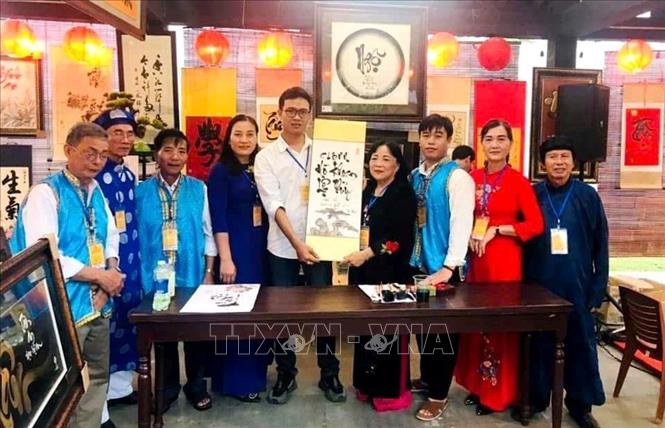 |
| The Le Thuy Folk Song Artists Club, as well as other folk culture clubs in Quang Tri province, are actively promoting their homeland's heritage and passing it on to the next generation. (Photo: VNA) |
According to folk artist Nguyen Thanh Thieu, head of the Ngu Thuy Folk Song Club (Sen Ngu commune, Quang Tri province), the club was established with the desire to contribute a small part to the preservation, safeguarding, and collection of folk melodies, especially the distinctive "ho khoan" melodies of the homeland.
Over the past period, the club has strived to preserve the "ho khoi" and "ho nau xam" (fishing chants), two characteristic chants of the people in the coastal region, while also practicing and teaching folk songs of Binh Tri Thien, including the "ho khoan" of Le Thuy... In October 2025, the festival of folk chant and dance clubs attracted enthusiastic participation from a large number of people and many folk culture-loving clubs, especially those dedicated to the "ho khoan" of Le Thuy. It was encouraging to see the diverse range of participants, from experienced clubs to enthusiastic young people.
These exchange programs and festivals not only create a space for meeting, exchanging, and learning among clubs, but also contribute to improving practical skills, nurturing, and spreading the value of cultural heritage, including Le Thuy folk singing. Through this, love for the homeland and national pride continue to be fostered, contributing to building a rich and healthy cultural and spiritual life in the community.
Let's work together to spread the value of heritage.
Throughout its existence and development, the Le Thuy folk singing tradition in particular, and the intangible cultural heritage of Quang Tri province in general, have always received attention and support from state management agencies in culture and all levels of government, organizations, and associations... to ensure that these cultural heritages are preserved, promoted, and increasingly spread.
Mr. Mai Xuan Thanh, Deputy Director of the Department of Culture, Sports and Tourism of Quang Tri province, said: The province has 18 national intangible cultural heritage sites, including Le Thuy folk singing. In order to preserve and promote the intangible cultural values of the locality, the Quang Tri Provincial Department of Culture has implemented many practical and meaningful activities, such as advising the Provincial People's Committee on developing action programs to preserve intangible cultural values; organizing programs and festivals, creating opportunities for artisans and clubs to meet, exchange, and share experiences.
The Department also coordinates, supports, and guides localities in organizing festivals to effectively preserve and promote cultural values; advises and implements policies to support artisans, contributing to improving their spiritual lives and helping them maintain their passion, practice, and pass on cultural values.
The Department always works closely with the government, communes, wards, and special zones to identify and encourage artisans in the work of preserving, practicing, transmitting, and spreading intangible cultural values in the community. The unit also advises and proposes that the province reward and encourage artisans—those who preserve the soul of the homeland's cultural heritage; and at the same time proposes that the Central Government consider awarding timely and well-deserved titles to artisans.
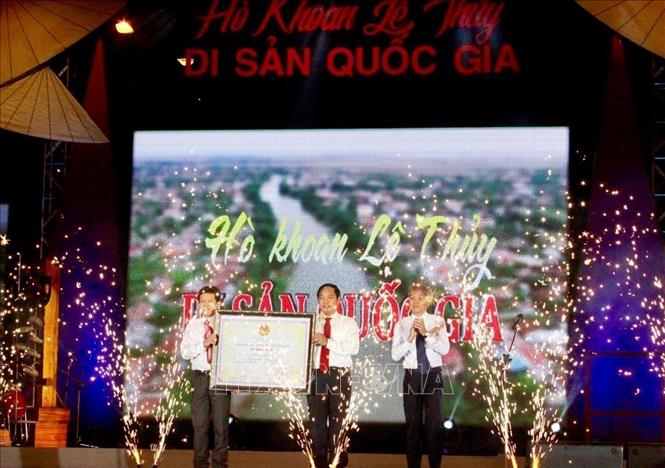 |
| In 2017, Le Thuy folk singing was recognized by the Ministry of Culture, Sports and Tourism as a national intangible cultural heritage. Photo: VNA |
Meritorious Artisan Nguyen Thi Ly and many other artisans and clubs dedicated to traditional cultural heritage hope that the socialization of preserving and promoting intangible cultural values will continue to receive more attention and be strongly promoted. She expects relevant levels and sectors to provide more financial support for the activities of folk singing clubs; and to strengthen the organization of exchange programs, training courses, and workshops to improve performance skills, teaching skills in folk singing, and other forms of national cultural heritage.
In the journey of preserving heritage, the implementation of effective policies on cultural and heritage conservation, along with appropriate specific mechanisms and policies, is crucial to promptly encourage and honor artisans in preserving and transmitting traditional culture. The attention, support, and collaboration from all levels of government, local authorities, organizations, and associations, along with the support of the people and the community, are of paramount importance. This serves as a foundation and support system, empowering artisans and folk culture clubs, fostering greater commitment, responsibility, and effort in their heritage preservation endeavors.
According to VNA/News and Ethnic Minorities Newspaper
Source: https://baoquangtri.vn/van-hoa/202512/giu-hon-cot-dieu-ho-que-huong-ae839ff/

![[Photo] General Secretary To Lam presides over a meeting with the Editorial Teams to summarize 100 years of the Party's leadership of the Vietnamese revolution and 40 years of implementing the National Construction Program.](https://vphoto.vietnam.vn/thumb/1200x675/vietnam/resource/IMAGE/2026/03/04/1772601288977_a1-bnd-8134-7576-jpg.webp)
























![[Photo] Prime Minister Pham Minh Chinh presides over the regular Government meeting in February.](https://vphoto.vietnam.vn/thumb/402x226/vietnam/resource/IMAGE/2026/03/04/1772606688233_ndo_br_42i9852-jpg.webp)













Comment (0)