

A glorious past
It was only 8 o'clock, but Mr. Han was already drenched in sweat, having just finished a pineapple-cutting knife ordered by a neighbor. Wiping away the sweat from his forehead, he held the knife up, carefully examining each detail, just as he had done for nearly 40 years. Mr. Han explained that the traditional blacksmithing trade flourished from the years after liberation until the 2000s. People were reclaiming land and engaging in agriculture , and since there wasn't much machinery at that time, the demand for sickles, knives, hammers, hoes, and scythes was high. Even during harvest season, his father's forge produced thousands of scythes, but still couldn't meet the demand. Many families prospered and became famous from this blacksmithing trade.
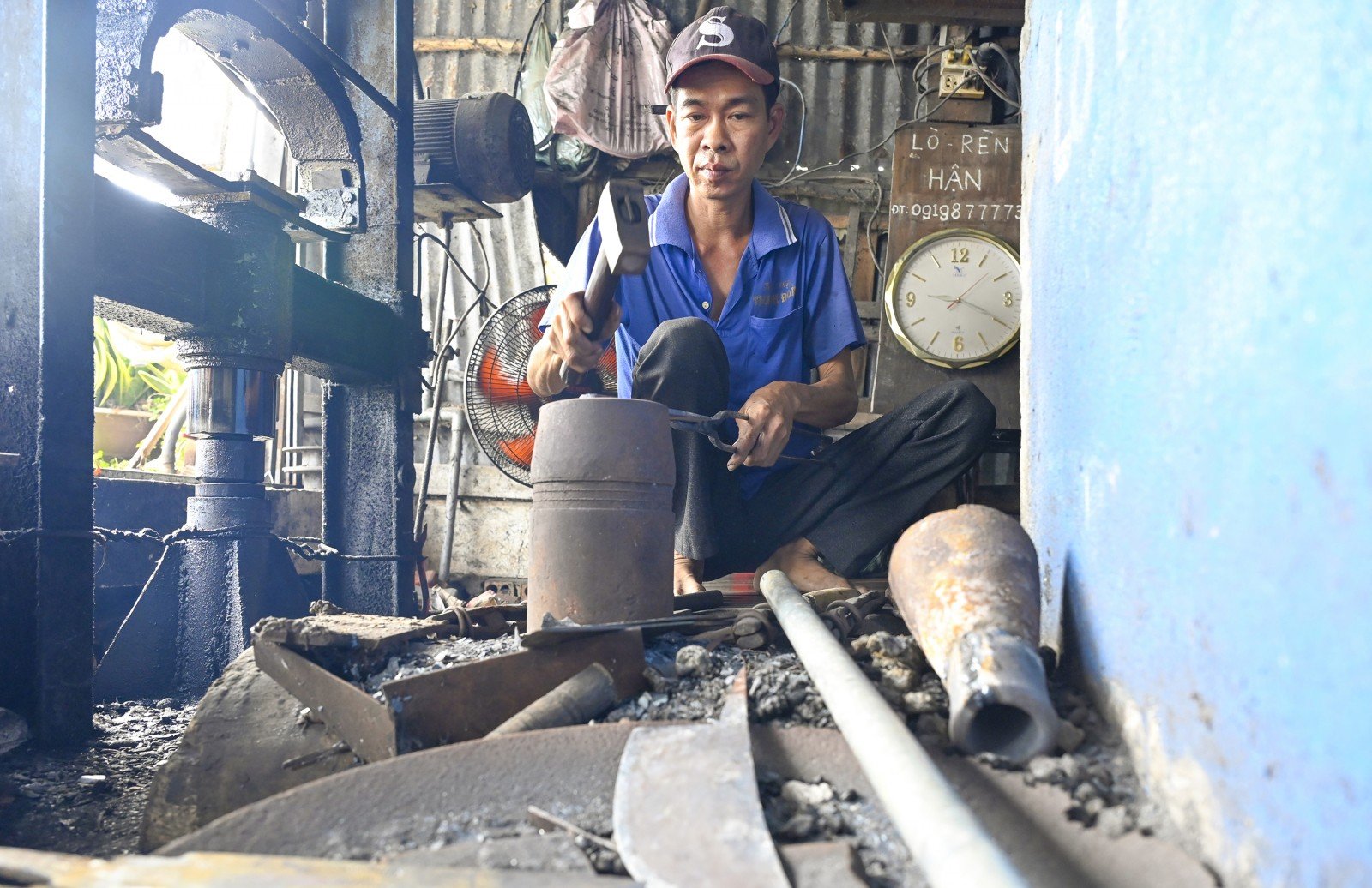
Mr. Do Van Han diligently keeps the blacksmithing craft alive. Photo: PHAM HIEU
“Back then, blacksmithing must have been quite lucrative, right?” I asked. As if reminded of a golden age, Mr. Hận spoke with pride about the craft. He recounted how, to make a sickle or a knife, two blacksmiths had to use two hammers—one large, one small—to continuously strike the heated iron or steel, shaping, cooling, adjusting, striking again, tempering, and grinding… sometimes it took half a day to produce a good product, but in return, the blacksmithing profession provided a decent income.
While chatting, Mr. Han picked up another piece of preheated steel and put it into the stamping machine to shape it. The long, red-hot piece of steel, with just a few tilting movements from the skilled craftsman's hands, quickly took shape into a black, curved knife… “To become a master blacksmith, one must study for 16 years, including 4 years learning to blow fire by hand, 4 years as a hammer maker, 4 years as a shaper, and finally 4 years as a musician. Therefore, the blacksmithing trade is usually passed down from father to son; few people learn this trade,” Mr. Han said.
He said that as a child, he often went to his father's forge to watch him and his uncles forge tools, and he would vandalize them. He was often punished by his father, but he wasn't afraid; instead, he enjoyed the exploration . "Blacksmithing is in my blood, so even if I get scolded, I'm determined to go to the forge and mess things up. At the age of 11, my father introduced me to the craft, and now I have nearly 40 years of experience in the trade," Mr. Han said.
According to Mr. Han, in the past, there were many blacksmiths in U Minh Thuong, including those on land and mobile forges on the river using large boats. Now, however, agriculture is largely mechanized, and even the types of knives and hammers are increasingly diverse. Many products are cold-forged, making them cheaper, thus reducing the income of traditional blacksmiths, leading many to retire. "In U Minh Thuong, there are only three blacksmiths left," Mr. Han said.
Keep the flame burning
In U Minh Thuong commune, Mr. Do Van Tuong, residing in Minh Kien hamlet, is a veteran blacksmith who still maintains his craft. Despite being well over seventy years old, his forge still burns brightly every day. Mr. Tuong says that the traditional blacksmithing trade is no longer as bustling as it once was, but the rhythmic sounds of hammers and anvils still fill his forge each day, a way of preserving the craft he has been involved in for almost his entire life.
Mr. Tuong was both Mr. Han's father and mentor in the traditional blacksmithing trade. Occasionally, Mr. Han advised his father to retire due to his advanced age, but he only received the brief reply: "I'll only retire when I can no longer hold a hammer."
While the conversation with the other "craftsmen" was lively, Mr. Tuong's mood softened, a hint of regret in his voice: "I have Han to carry on the craft, but I don't know what the next generation will do." Then, Mr. Tuong walked towards the forge, picking up the axe head his neighbor had given him the day before to reheat it in the burning fire. As the axe head gradually turned red, Mr. Tuong took it out, adjusted it in a stamping machine, dipped it in a bucket of water, and finally put it on a grinding machine, creating long, bright red sparks that looked incredibly skillful. All of this was completed quickly in just over 10 minutes. "Nowadays, blacksmithing is much easier; the most strenuous tasks, like hammering and blowing the fire, are done by machines, so I can still do it. But if I retire, I'll miss the craft very much," Mr. Tuong said.
However, Mr. Tuong and his son acknowledge that blacksmithing is a hard job, with a hot working environment, exposure to coal smoke, and a lot of noise, so not everyone wants to stick with it. “In my generation, the passion for the craft is deeply ingrained in our minds, so we’re passionate about it. The other day, my youngest son said he would follow in his footsteps when he grows up, but he’s still in middle school, so we don’t know what will happen. We’ll just have to accept it,” Mr. Han said wistfully, his gaze distant…
PHAM HIEU
Source: https://baoangiang.com.vn/giu-lua-nghe-ren-a468415.html







































































Comment (0)