1. "Teacher, is this information correct?" A question from a 7th-grade student during Literature class made me think a lot. That day, the student showed me a short video being shared on social media with conflicting information about a historical event of our nation. What's noteworthy is that below the video there were hundreds of comments and shares, and many people seemed to believe the unverified information.
Looking into my students' worried eyes, I realized that today's classroom is no longer confined within four walls or textbooks. With just a smartphone, they can access a vast source of human knowledge, but they can also face countless pieces of misinformation, distortions, and even subversive rhetoric disguised in many sophisticated and insidious forms.
As a Literature teacher, I have always believed that literature possesses a special power in nurturing the soul, shaping character, and inspiring love for one's homeland. However, in the context of today's rapid digital transformation, I understand that teaching should not be limited to simply transmitting knowledge. Teachers must also help students develop the ability to selectively receive information, to distinguish right from wrong, truth from falsehood, and thereby build resilience and positive confidence in the face of the multifaceted impacts of the online world.
 |
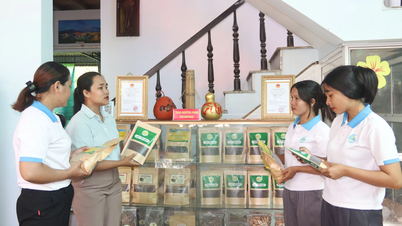
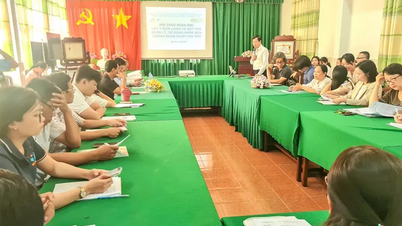
| A Literature lesson at Yen Hoa High School, Hanoi . Photo: THANH TUNG |
These concerns not only follow me in the classroom but are also present in my family life. My husband is a military officer serving far from home. My son is also wearing the green uniform of a soldier. Every day, through video calls, we connect with each other through affection, responsibility, and faith in the good values that our forefathers have painstakingly cultivated and preserved.
It is from the classroom and the warmth of my family that I have come to understand more deeply that the struggle to protect the Party's ideological foundation today is not only taking place in theoretical forums or specialized agencies. It is also a silent but equally fierce struggle in every classroom, every family, and in the online space where the younger generation is present every day.


2. From my teaching experience, I have observed that the classroom is no longer the sole place where students acquire knowledge. The online space is becoming a "second classroom," directly impacting their perceptions, emotions, and views of life. This places a new responsibility on teachers.
While in the past our focus was primarily on imparting knowledge, today we must also help students learn to select information, critically analyze, verify, and defend correct values against diverse sources of information. Therefore, in my Literature lessons, I always strive to ensure that each literary work goes beyond simply analyzing its content or artistic merit, becoming a lesson in patriotism, civic responsibility, and national pride.
To make the lessons more relatable, I incorporate digital media, documentary films, historical images, authoritative articles, and real-life stories from today. Technology does not diminish the value of literature; on the contrary, it brings literary works closer to students, helping them better understand the values that the works convey.
I remember during a lesson on patriotism, while watching images of officers and soldiers on duty at the border and on islands, a student shared: “Before, I thought patriotism was something very grand. Now I understand that patriotism also means studying well, living responsibly, and knowing how to protect what is right.” That answer truly moved me. Because that is exactly what a teacher wants most: to help students understand that patriotism exists not only in glorious historical accounts or beautiful essays and poems, but also in concrete, practical actions every day.
3. In reality, hostile forces are thoroughly exploiting cyberspace to spread false information, distort national history, deny the Party's leadership role, divide national unity, and undermine the people's trust, especially among the younger generation.
In this context, patriotic education for students is not only about emotional education but also about educating their awareness and political character. When students understand the nation's history, the value of independence and freedom, and the achievements the country has attained, they will have a basis to identify distorted narratives, know how to defend the truth and justice, and not be swayed by misinformation on the internet.


I have always believed that every Literature lesson is an opportunity to sow good seeds in the hearts of students. These could be pride in national traditions; gratitude towards previous generations; love for their homeland; and a sense of responsibility in protecting the values that our nation has painstakingly cultivated. These seeds may not sprout immediately, but with the perseverance of the teachers, and the support of families and schools, the students will grow and mature with confidence, resilience, and a healthy sense of civic responsibility.
I believe that when the younger generation is equipped with knowledge, nurtured with patriotism, and trained to withstand the impacts of cyberspace, they will become responsible digital citizens with faith and the ability to protect themselves from false and hostile narratives. This is also an important foundation for us to work together to firmly safeguard the Party's ideological foundation in the new era of national development.
Source: https://www.qdnd.vn/van-hoa/van-hoc-nghe-thuat/giu-lua-yeu-nuoc-tu-nhung-trang-van-so-1043036




![[Photo] General Secretary and President To Lam attends the 13th National Congress of the Ho Chi Minh Communist Youth Union](https://vphoto.vietnam.vn/thumb/1200x675/vietnam/resource/IMAGE/2026/06/25/1782356968989_ndo_br_1-jpg.webp)






























![[Photo] General Secretary and President To Lam attends the Central Public Security Party Committee Conference](https://vphoto.vietnam.vn/thumb/1200x675/vietnam/resource/IMAGE/2026/06/24/1782302063612_a1-bnd-9302-9166-jpg.webp)