
Many of the horizontal and vertical inscriptions in Binh Thien communal house (Bien Hoa city) have been preserved and restored with gold leaf. Photo: L.Na |
Preserving the colors of a century-old heritage.
The preservation and restoration of gilded lacquerware on horizontal plaques, couplets, and inscription boards at many historical sites in Dong Nai province has been a focus of attention for the cultural sector and local authorities.
 Báo Đồng Nai•29/05/2025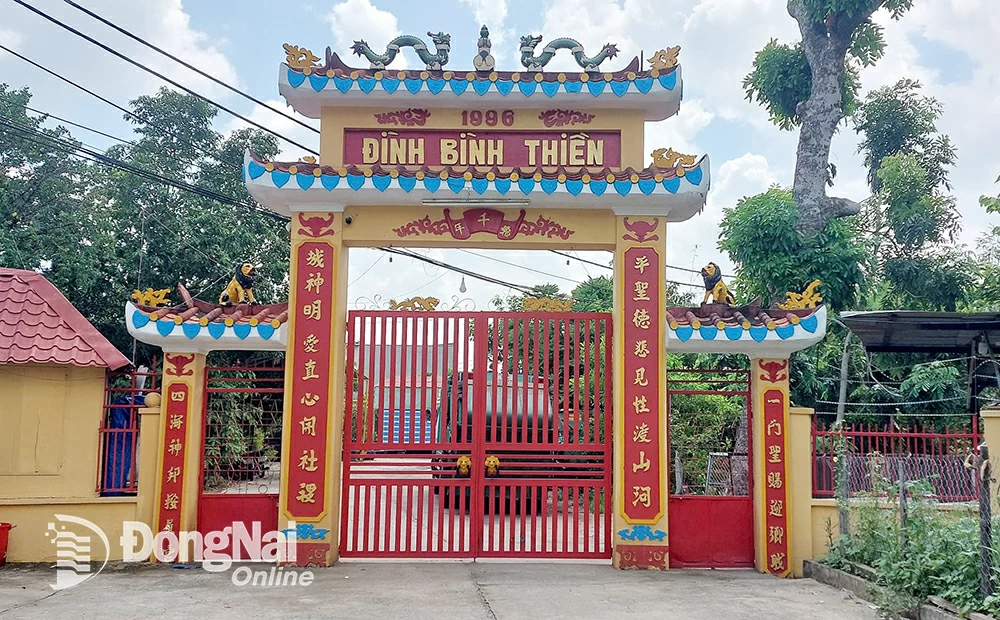
Not only does it revive the original beauty of artifacts and preserve the centuries-old heritage, but through preservation and restoration of gilded lacquer, it also contributes to the conservation and promotion of cultural values of historical sites, connecting them with tourism development.
Efforts to revive the original beauty of historical artifacts.
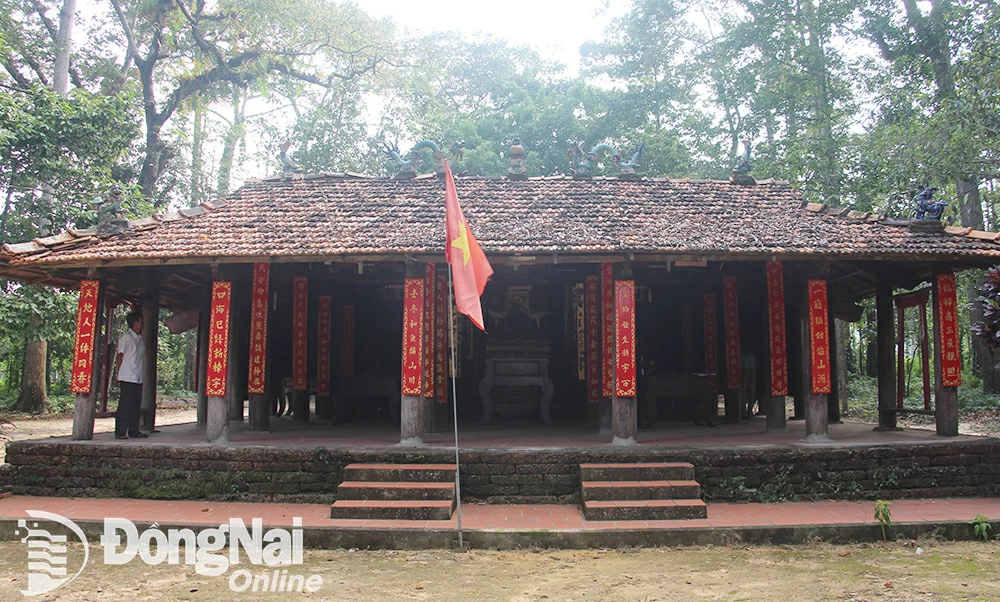
Phuoc Lu communal house is one of the communal houses that has existed and developed for over 200 years, closely associated with the formation and development of Phuoc Lu village, the former Bien Hoa town (now Trung Dung ward, Bien Hoa city). Many of the horizontal plaques, couplets, and inscriptions on the altar have been preserved and restored with red lacquer and gold leaf.
Mr. Nguyen Ngoc Duc, who has been in charge of the Phuoc Lu communal house relic for over 5 years, said that local people are very happy that the horizontal plaques and couplets at the relic have been preserved and restored with gold leaf. Not only has this extended the lifespan of the artifacts, but the preservation and restoration have also revived their beauty, returning them to their original form.
“Besides preserving and restoring the gilded lacquer, some parts of the monument are currently deteriorating, such as damaged eaves causing leaks, and wooden pillars infested with termites… The Monument Management Board hopes to receive approval from the authorities for restoration and renovation soon to prevent further damage,” Mr. Duc shared.
You may also like

From village to museum: A journey of spreading the value of living heritage in Lao Cai.In response to International Museum Day 2026 with the theme “Museums Connecting a Divided World”, the Lao Cai Museum, in collaboration with the Center for Culture, Arts and Sports, is organizing a series of activities titled “Sowing Green on Cloud Peaks”. The program not only introduces the value of heritage and indigenous knowledge but also creates a space for community connection, spreading the message of environmental protection, climate change adaptation, and aiming towards the goal of developing Lao Cai province into a “Green, Harmonious, Distinctive, and Happy” place.
Preserving and promoting the value of the Cham people's pottery art heritage.On the morning of May 27th, Mr. Nguyen Long Bien, Member of the Standing Committee of the Provincial Party Committee and Permanent Vice Chairman of the People's Committee of Khanh Hoa province, chaired a meeting to hear a report on the results of the implementation of the National Action Program on the Protection and Promotion of the Intangible Cultural Heritage of Cham pottery making. Leaders from several relevant departments, agencies, and localities attended the meeting.
Promoting the heritage values of Phong Nha-Ke Bang National ParkQTO - The Phong Nha-Ke Bang National Park Management Board is implementing its tasks for 2025 amidst numerous intertwined difficulties and challenges; at the same time, this is also the year of implementing a revolution in streamlining the organizational structure and rearranging provincial and commune-level administrative units according to the two-tiered local government model. However, with high determination, the Phong Nha-Ke Bang National Park Management Board has implemented comprehensive and effective solutions and achieved the set goals.
The Binh Quan communal house (located in Hiep Hoa ward, Bien Hoa city) was built around the 19th century under the name Binh Quan Temple. It was classified as a provincial-level historical and cultural relic in 2004. Over time, due to the hot, humid climate and heavy rainfall, the wooden horizontal plaques, couplets, altar boards, and ornate doors, painted with red lacquer and gold leaf, have deteriorated, becoming damp, moldy, and infested with termites. The entire surface of these artifacts has been covered with a layer of industrial paint. Some couplets and horizontal plaques are cracked, and the joints are damaged; this includes 6 pairs of couplets in the main hall, the Lady's shrine, and the memorial house, 13 altar boards, 5 horizontal plaques, and 5 sets of ornate doors…
On May 14th, the Department of Culture, Sports and Tourism sent a document to the Provincial People's Committee proposing that the Provincial People's Committee assign the Dong Nai Museum as the investor and implementer of the Project for the Preservation, Restoration, and Rehabilitation of the gilded lacquerware, horizontal plaques, couplets, altar inscriptions, and arched doorways at Binh Quan communal house relic. The funding for this project will come from the provincial budget (recurrent expenditure).
In the coming period, when a decision is made on the reorganization of administrative units according to Conclusion No. 137-KL/TW dated March 28, 2025, of the Politburo and the Secretariat on the Project for Reorganizing Administrative Units at all levels and Building a Two-Tiered Local Government Organization Model, the Department will advise on adjusting Decision No. 13-2023/QD-UBND dated April 6, 2023, on the promulgation of regulations on the decentralization of management of ranked historical and cultural relics and scenic spots in Dong Nai province to suit the actual situation and projects using operational funds and public investment capital in accordance with regulations.
The Provincial People's Committee has just issued a decision to supplement the list of ranked historical sites and scenic spots in the province for the period 2021-2025. According to the decision, Tap Phuoc - Phuoc Hoa communal house (in Long Phuoc commune, Long Thanh district) has been added to the list of ranked historical sites. With this addition, Dong Nai province now has 13 ranked historical sites and scenic spots for the period 2021-2025.
Promoting the cultural value of historical sites.
Dong Nai currently has over 70 classified historical sites, many of which have deteriorated horizontal plaques, couplets, and inscription boards that have been preserved and restored with gold leaf. Notable examples include: Binh Thien communal house, Tan Lan communal house (Bien Hoa city); Phu My communal house (Nhon Trach district); Phuoc Loc communal house (Long Thanh district)...
The horizontal plaques, couplets, and inscription boards at Phu My communal house (Phu Hoi commune, Nhon Trach district) have been restored with red lacquer and gold leaf after a long period of deterioration. |

Vietnam encourages US businesses to expand investment in high technology.On the morning of June 26th, at the Government Headquarters, Deputy Prime Minister Ho Quoc Dung received Mr. Jeff Place, Supply Chain Director of Coherent Group (USA). During the meeting, the Deputy Prime Minister affirmed that Vietnam encourages US businesses to expand investment, especially in high-tech, innovation, and semiconductor industries.

Encourage U.S. businesses to expand investment in high-tech sectors.Deputy Prime Minister Ho Quoc Dung said that Vietnam welcomes US businesses to continue expanding their operations in Vietnam, especially in high-tech industries and sectors with high added value.

Vietnam and the United States strengthen cooperation in addressing the consequences of war.VTV.vn - On June 22, General Secretary and President To Lam received Acting Secretary of the US Navy Hung Cao.
With many years of experience in preserving and gilding artifacts at temples and shrines both within and outside the province, Mr. Le Hoang Vu (residing in Ward 6, Trung Dung Commune, Bien Hoa City) said that restoring gilded artifacts is not simply about returning them to their original state, but also a process requiring a deep understanding of traditional art, materials, and even religious customs. From cleaning the wood and treating it for termites to gilding, every step must strictly adhere to heritage preservation procedures.
"Many ancient temples and shrines, after being restored and repainted, not only shine brightly in appearance but also become community hubs. They are places where local people organize festivals, educate about traditions, and attract tourists from near and far to visit and learn about the culture and history of the nation," said Mr. Vu.
Preserving the vibrant colors of centuries-old heritage is not just the responsibility of the cultural sector or the government, but also stems from the love for heritage of each individual citizen. In Dong Nai, this journey continues at many historical sites. Each restoration, each layer of "golden splendor" recovered, is another opportunity for the past to be called back into existence. It's not just about preserving physical objects, but also about preserving memories and community identity. And this journey continues as persistently as the never-ending flow of cultural heritage.
Ly Na
Source: https://baodongnai.com.vn/van-hoa/202505/giu-mau-cho-di-san-tram-nam-62d509c/



























![[Photo gallery] Tens of thousands of tourists visit and enjoy local specialties at the Long Khánh Fruit Festival.](https://vphoto.vietnam.vn/thumb/402x226/vietnam/resource/IMAGE/2026/06/28/1782662218511_b_20260628224930.jpeg)

















































Dancing and singing during the water festival (Bun Huot Nam) of the Lao people.

LET YOUR DREAMS TAKE FLIGHT.
