

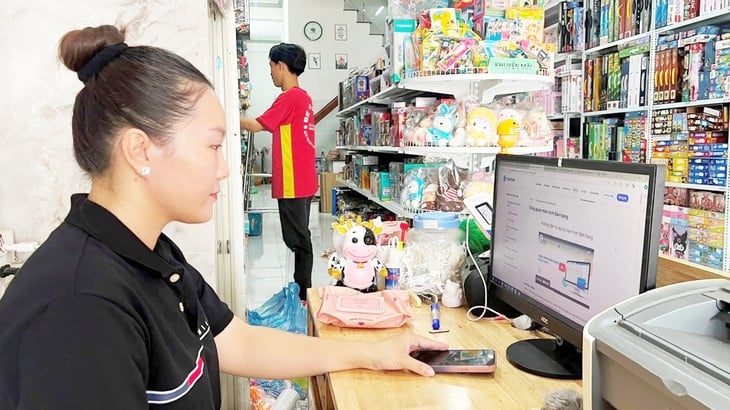
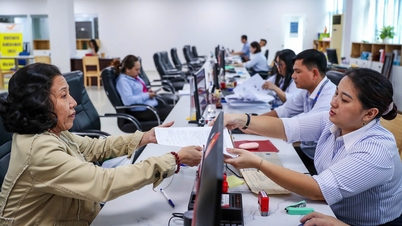
The grocery store owner uses sales software - Photo: KV
Electronic receipts printed from cash registers – small pieces of paper containing the expectations of the new policy – represent a major step forward in management and transparency, and are a prerequisite for the hesitant implementation of the "post-flat-rate tax" era.
Starting a business is always the hardest thing, so it's crucial to quickly identify the bottlenecks to alleviate concerns about electronic invoices in particular and digital transformation in general.
However, in reality, this transformation is not easy, especially for small businesses that are accustomed to manual record-keeping and debt management.
According to the Regional Tax Office 2, in May 2025, more than 3,700 business households applied to cease operations or close down.
Of those, only about 440 households were required to use electronic invoices, which is less than 4%. This figure shows that the majority of people who temporarily stopped trading did so not because they were bound by the policy, but because... they were afraid of being bound by it.
Anxiety leading to "fear" is real, but it manifests in many ways: fear due to lack of information, fear due to misunderstanding of policies, and above all, fear of change.
Ms. H., a small business owner selling household goods in Ho Chi Minh City, installed the sales software she received as a gift, but when it came to printing out the records, she didn't know what to do with them. She wondered if she would be fined since the origin of her goods was still being managed using the old methods! Many people are still hesitant about the "old ways."
What happens to goods imported before June 1, 2025, that lack invoices? Will inventory without sufficient documentation be subject to back taxes?
Would recording debt sales from last year in the software now lead to scrutiny? These questions may seem minor, but they represent a significant obstacle to the successful implementation of a good policy.
And for electronic invoices to become a reality for household businesses, perhaps we should remove the "old ways" bottleneck by viewing them as a form of "transitional goods," and not place too much emphasis on handling goods without complete invoices before the transition period.
Perhaps we should focus on cracking down hard and showing no tolerance on goods of illegal origin, counterfeit goods, smuggled goods, and stolen goods.
This will encourage and reassure hesitant business owners to embrace digital transformation in their businesses with management software and electronic invoices.
Once regulators have identified the need to facilitate compliance, technology solution providers must actively engage, reach out, and even provide hands-on training so that all businesses can quickly become proficient in using the new technology.
This is a great opportunity for competition; whichever unit offers the best solutions and provides thorough guidance will gain more customers, not only in the short term but also in the long term.
With the right and timely approach, technology companies will act as a bridge between household businesses and regulatory agencies, between traditional markets and modern management, helping household businesses confidently enter the new playing field.
Demonstrate that digitalization does not equate to control, but rather to enhancing autonomy, management, and transparent growth.
Implementing electronic invoices from cash registers is not only a tax management tool but also a "right hand" that helps business owners manage sales, inventory, accounts receivable, and accounting records more transparently—things they previously lacked the tools or skills to control.
Once we help small businesses overcome their anxieties about cash registers generating electronic invoices, and they see the benefits of applying technology, then the digital transformation process will accelerate.
The lessons learned from the development of the Internet, smartphones, etc., show that if businesses overcome their initial hesitations, they will soon embrace digital transformation.
NHU BINH
Source: https://tuoitre.vn/giup-ho-kinh-doanh-me-chuyen-doi-so-20250620085943129.htm

![[Photo] General Secretary and President To Lam meets with National Assembly delegates from ethnic minorities.](https://vphoto.vietnam.vn/thumb/1200x675/vietnam/resource/IMAGE/2026/04/20/1776696701056_a1-bnd-8331-3342-jpg.webp)

![[Image] National Assembly discusses the implementation of the socio-economic development plan.](https://vphoto.vietnam.vn/thumb/1200x675/vietnam/resource/IMAGE/2026/04/20/1776696707422_ndo_br_img-20260420-185419-jpg.webp)
























































































Comment (0)