

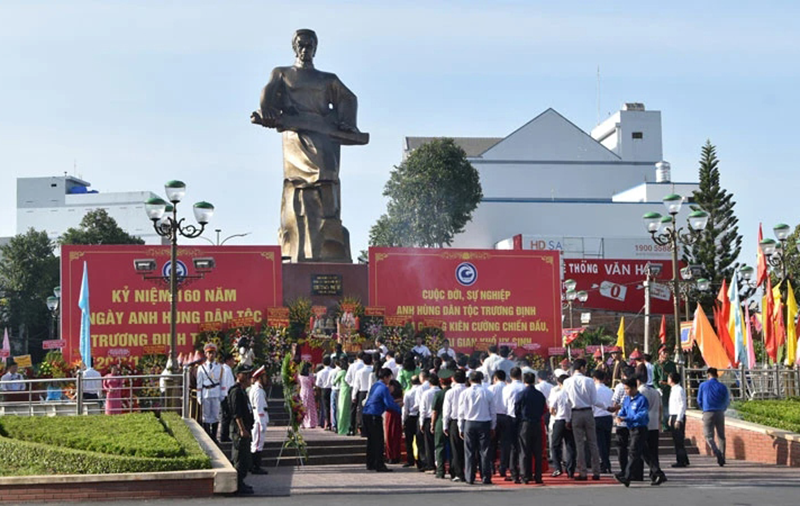
Officials and citizens offer incense and flowers at the monument of national hero Truong Dinh in Go Cong city, Tien Giang province. Photo: nhandan.vn
"Dragon's head, phoenix's tail, gracefully swaying"
The center of Go Cong City is located 35km east of My Tho City and 60km south of Ho Chi Minh City. National Highway 50 connects Go Cong City to My Tho City to the west near the Trung Luong interchange and to Ho Chi Minh City to the north via Long An province. The route to Go Cong via My Tho or Long An is convenient. And every time I wander through this land, my heart resonates with poignant melodies:
"Under the rosy sunlight, I walk through Go Cong."
The earth seems high, the sky seems low.
In the space above the undulating waves
Only the image of the kind mother from Go Cong remains."
("Mother of Go Cong")
From the mid-1980s, the name Go Cong suddenly resonated throughout the country through the sweet, lyrical voices of singers Bao Yen and Nha Phuong in a cassette tape compiled, arranged, and orchestrated by musician Quoc Dung, featuring 15 bolero love songs by composer Hoang Phuong. Among them, I still remember:
"At the end of the Mekong River, facing the East Sea."
My hometown, Gò Công, is located by the mouth of the Tiền River.
This is the homeland of Truong Dinh's struggle.
"Sacred land, etched with glorious history for millennia."
("Gò Công's glorious history")
As young people in Central Vietnam, we learned about Go Cong through books about the national hero Truong Dinh. Now, we know more about Go Cong through the lyrical songs of composer Hoang Phuong, sung by Bao Yen. It was these love songs by composer Hoang Phuong that inspired us to return to this sacred land. And after our first visit, Go Cong beckons us to return many times afterward…
In the past, Go Cong was known by its Sino-Vietnamese name, Khong Tuoc Nguyen, colloquially as "the hill where peacocks live." Accompanying us, journalist Bich Thuy explained that compared to the vast Southern Delta, Go Cong was once a small piece of land, with an area of only about 58,000 hectares. This is only about one-third of the land owned by the wealthy landowner Tran Trinh Trach – the father of the Bac Lieu prince Tran Trinh Huy (180,000 hectares). Situated in the basin between the Tien and Hau rivers, Go Cong held a unique position as a land of "dragon's head and phoenix's tail." The people of Go Cong also passed down two folk verses:
"Dragon's head, phoenix's tail, le the
"The eggs are incubated in spring, and the chicks hatch in summer."
Some say this is a folk riddle about the betel nut tree, because "dragon's head" refers to the large, long betel nut leaves that branch out into many twigs, while "phoenix's tail" refers to the sparse, sparsely woven betel nuts with very few fibers, slightly elongated. Betel nuts bear fruit in the spring, but the nuts only ripen to a golden yellow in the summer. However, others say "le the" refers to the teal, a wild bird that was not only a rich food source but also helped protect the rebel army's base when intruders appeared.
A blessed land
Perhaps it was thanks to its fertile land that Go Cong suffered less damage from bombs and bullets during the war. Because of its fertile land, Go Cong was blessed with many unique brackish and saltwater specialties, resulting in both traditional folk dishes and those fit for royalty. And because of its fertile land, Go Cong sheltered and protected General Truong Dinh and his resistance fighters against the French, and was the homeland of his two wives, Le Thi Thuong and Tran Thi Sanh, who wholeheartedly supported their husband's cause of national salvation.
At the same time, Go Cong also produced many high-ranking figures during the feudal era of Vietnam, such as: Luong Nang Ba Nguyen Van Hieu, Duc Quoc Cong Pham Dang Hung, Long My Quan Cong Nguyen Huu Hao, District Chief Do Trinh Thoai, Binh Tay Nhi Lang Nguyen Soai Truong Quyen, Empress Dowager Tu Du, Concubine Dinh Thi Hanh of Emperor Thieu Tri, and Empress Nam Phuong of Emperor Bao Dai… Among them, Duc Quoc Cong Pham Dang Hung was the father of Empress Dowager Tu Du, and Long My Quan Cong Nguyen Huu Hao was the father of Empress Nam Phuong.
In terms of literature, people from Go Cong who left their mark include the writer Ho Bieu Chanh, a prose writer who made a significant contribution to the early development of the novel genre in Vietnam. Meanwhile, the female writer Nguyen Thi Manh Manh, the first woman to publish poetry, write articles, and give speeches advocating for the New Poetry movement, was also active in journalism at the time, while her father, District Chief Nguyen Dinh Tri, also known as Huyen Tri, was a prolific writer.
From 1885, Go Cong province established Thanh Pho village as its provincial capital. This is considered the first city in Southern Vietnam. Researcher Phan Thanh Sac argues that Thanh Pho village is a unique model, with a city built within a village. Besides its bustling streets, bridges, and markets, Thanh Pho village also boasts diverse and distinctive architecture. The houses are low-rise, with French-style entrance halls, and inside they have three bays and double wings. Typical examples include the houses of Doc Phu Hai, Ba Ho Muu, Councilwoman Anna, Ca Truong, Councilwoman Dat, Hao Be, and Mrs. Lam To Lieng…
Along with Thanh Pho village, Go Cong also boasts many other historical and cultural relics from a time when our ancestors pioneered, settled, and fought to defend the country. These include the tomb of national hero Truong Dinh in the city center and Dam La Toi Troi - Gia Thuan, along with the Truong Dinh Fortress historical site. Other notable sites include the Royal Mausoleum, the Vo Thanh Mausoleum, the Temple of Literature, the Trung Temple, the Tham Bien Palace; and numerous other communal houses, temples, shrines, and churches. Furthermore, there are folk festivals to honor and commemorate the deities and spirits who contributed to the homeland and the nation.
PHAN TAN HUNG
Source: https://baocantho.com.vn/go-cong-dat-lanh-ben-cua-song-tien-a185550.html


![[Photo] “Red Journey” 2026: Vietnamese Youth Continue Building the Bridge of Friendship Between Vietnam and China](https://vphoto.vietnam.vn/thumb/1200x675/vietnam/resource/IMAGE/2026/04/20/1776629730866_4055880775670638308-9618-4200-jpg.webp)


















































Comment (0)