

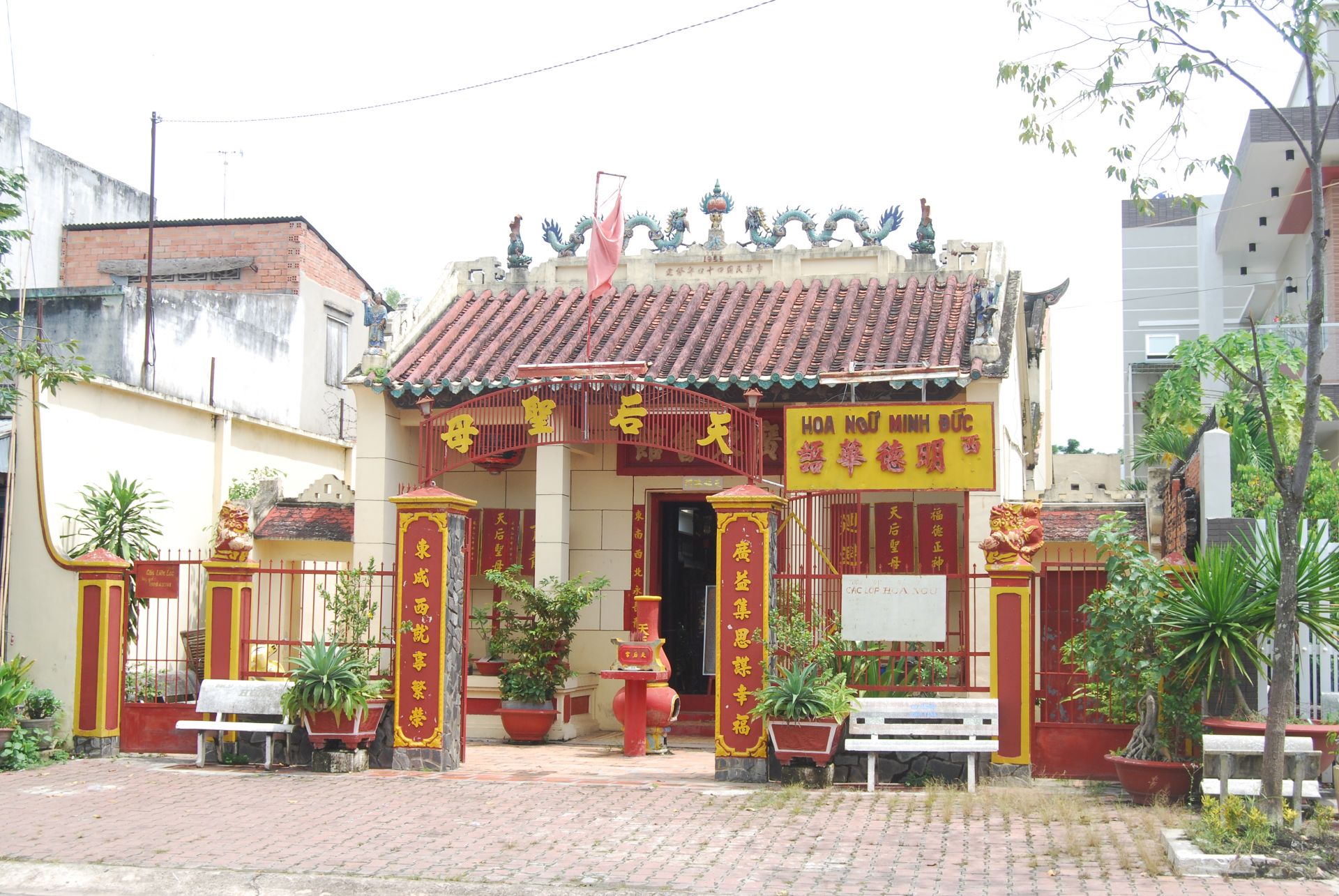
Thien Hau Temple - Ward 2
Many people in Tay Ninh city only know of one temple dedicated to the Goddess Thien Hau in the area. This is to correct the information: there are actually two temples dedicated to the Goddess Thien Hau in Tay Ninh city and surrounding communes.
The first temple is located on Tran Hung Dao Street, in Ward 3, Precinct 2; the second is in Thanh Dien Commune, Chau Thanh District - a commune adjacent to Precinct 1, Tay Ninh City. This latter temple is less well-known, possibly due to its name, traditionally known by the locals as Gia Gon Ancient Temple.
It should be noted immediately that the book "Historical and Cultural Relics and Scenic Spots of Tay Ninh Province," published by the Department of Culture, Sports and Tourism in 2014, contains the following passage in the article about Thien Hau Temple: "a temple built by a group of people of Guangdong, Guangxi, and Beijing origin to worship the goddess Thien Hau…".
This needs correction, because… it's wrong. The correct version should be as written in the Tay Ninh Gazetteer (Tay Ninh Provincial People's Committee, 2005, page 105) regarding the Chinese community: In Tay Ninh town, the Fujianese people gathered into an independent group within their socio-religious base, the Quan Thanh De Quan temple.
Meanwhile, the Teochew, Cantonese, Hakka, and Hainanese people gathered under the roof of the Thien Hau Temple. The book "Tay Ninh: Land and People" (Thanh Nien Publishing House, 2020) also has an article about the beliefs and religions of the Chinese people in Tay Ninh. However, the authors do not mention the Gia Gon Temple.
Regarding the section on the Thien Hau Temple, while the details are quite accurate, including its origin as being built by groups of Chinese people from Guangdong, Teochew, Hainanese, and Hakka; there seems to be a mistake in stating: "Initially, the temple was built simply with wood in 1903…".
If so, how could the temple have a granite incense burner that was "donated" by the people in the "13th year of Guangxu (1887)" as the Chinese characters carved on one of the handles of the burner indicate?
Thanks to this detail, the book "Historical and Cultural Relics and Scenic Spots of Tay Ninh Province" has determined that the temple was built around 1887. "Initially, it was a makeshift structure with thatched roof, bamboo, and leaves. By 1905 (the 31st year of Quang Tu's reign), the temple had been rebuilt with precious wood pillars and tiled roof."
"By 1955, the temple underwent major renovations… These years left behind tangible traces. Besides the stone incense burner, there is also a carved wooden plaque hanging in the front hall. The exquisite wood carving depicts the social strata according to Chinese Confucianism…"
Additionally, there is a pair of red-painted wooden couplets with gold lettering. One side reads: "Hao dan truong luu thuy"; the other: "Han kim cao nga son." This means: "As vast as the Yangtze River; as majestic as Mount Nga Son." This is a tribute to the virtues of the Goddess Thien Hau. Both the sculpture and the couplets were donated in the 31st year of the Guangxu reign (1905).
So who was she? We can find the answer from reputable researchers in Southern Vietnam such as Huynh Ngoc Trang and Truong Ngoc Tuong in the book "Southern Vietnamese Temples Past and Present" ( Dong Nai Publishing House, 1999).
According to the text: “The Goddess of Heaven is the patron goddess of seafarers for the Chinese community. She was originally the daughter of the Lin family, from Fujian Province during the reign of Emperor Huizong of the Song Dynasty. She was born in 1104 and died in 1119 at the young age of 16. Legend says her family made their living by trading on the sea.”
She attained enlightenment through ascetic practice, displaying her divine powers to save her two brothers and many others from a storm. She was deified three years after her death. Because Chinese people migrating from the mainland to establish themselves overseas often traveled by sea, she was revered throughout Southeast Asia.
For the Vietnamese people, she is also believed to be the goddess who protects the female deity YA Na or the Lord of the Land…”. Notably, on the main altar, besides the statue of the Goddess, nearly 1.5 meters tall, wearing a shimmering red robe and a crown shaped like a phoenix made from many precious stones, there are also two young boys on either side, holding babies in their arms.
This image is reminiscent of the Cham goddess Thien YA Na, often accompanied by two attendants called Cau Tai and Cau Quy. However, at the ancient temple in Gia Gon, there are no statues of the two attendants; only the statue of Thien Hau in the middle, with statues of Cuu Thien Huyen Nu and Linh Son Thanh Mau (from Ba Den Mountain) on the right and left.
A paradox has emerged: the place called the ancient temple does not have the same ancient origins as the Thien Hau Temple. Previously, there was an article in the Tay Ninh Newspaper about the Gia Gon ancient temple, but it did not specify the construction date. Now, according to Mr. Luong Hue Linh, who used to manage the Thien Hau Temple, the Gia Gon temple only dates back to around 1940.
The reason is that in Thanh Trung hamlet at that time, there was a sugar factory that Mr. Quach Dam bought in the 1920s. A large number of Chinese workers came to live and work in Thanh Dien. The Gia Gon Temple was built to serve the religious needs of these Chinese workers.
Judging by the structure of the altars, such as the main statue of the Goddess Thien Hau, or the model of a ship placed in a prominent position, it's clear that this is a shrine dedicated to her. However, according to the elders of the former shrine committee, there was already a small shrine here when the Truong family from Thanh Dien settled here more than a hundred years ago.
Therefore, it cannot be ruled out that before the arrival of the Chinese in the 1920s, there was a shrine dedicated to Ông Tà or Bà Linh Sơn, or Bà Chúa Xứ. When the sugar factory was built, the shrine was renovated and restored to incorporate the two deities.
In other words, this result may be due to the cultural exchange and assimilation of Vietnamese folk beliefs with those of the Chinese. This is even more evident when considering that around the main temple in Gia Gon, Thanh Dien, there are many other shrines dedicated to deities such as the God of Wealth, the Earth God, the Mountain God, the Six Evil Spirits, the Twelve Evil Spirits, and even a shrine for soldiers and warriors.
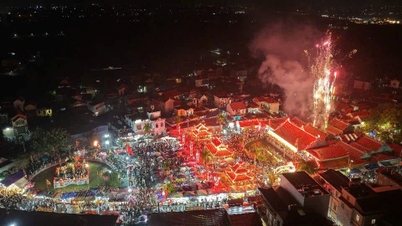
Thus, from the city center to the outskirts of Tay Ninh, there are at least two temples dedicated to the Goddess Thien Hau. Upcoming, on the 16th and 17th of the third lunar month, there will be major annual ceremonies at the Gia Gon temple and on the 23rd of the third lunar month at the Thien Hau temple in Ward 2.
Those who enjoy the vibrant, ancient atmosphere of religious ceremonies in a purely Chinese architectural setting should visit Thien Hau Temple. Those who prefer a more open setting, surrounded by lush greenery and the sight of lotus flowers and rice paddies, should go to Gia Gon Temple. Both offer a solemn space with dignified traditional rituals of this region, passed down through generations for over 100 years.
Tran Vu
Source link



























































Comment (0)