The South Korean National Security Strategy under Yoon Suk Yeol shares similarities with the document from 15 years ago, but also includes several noteworthy new features.
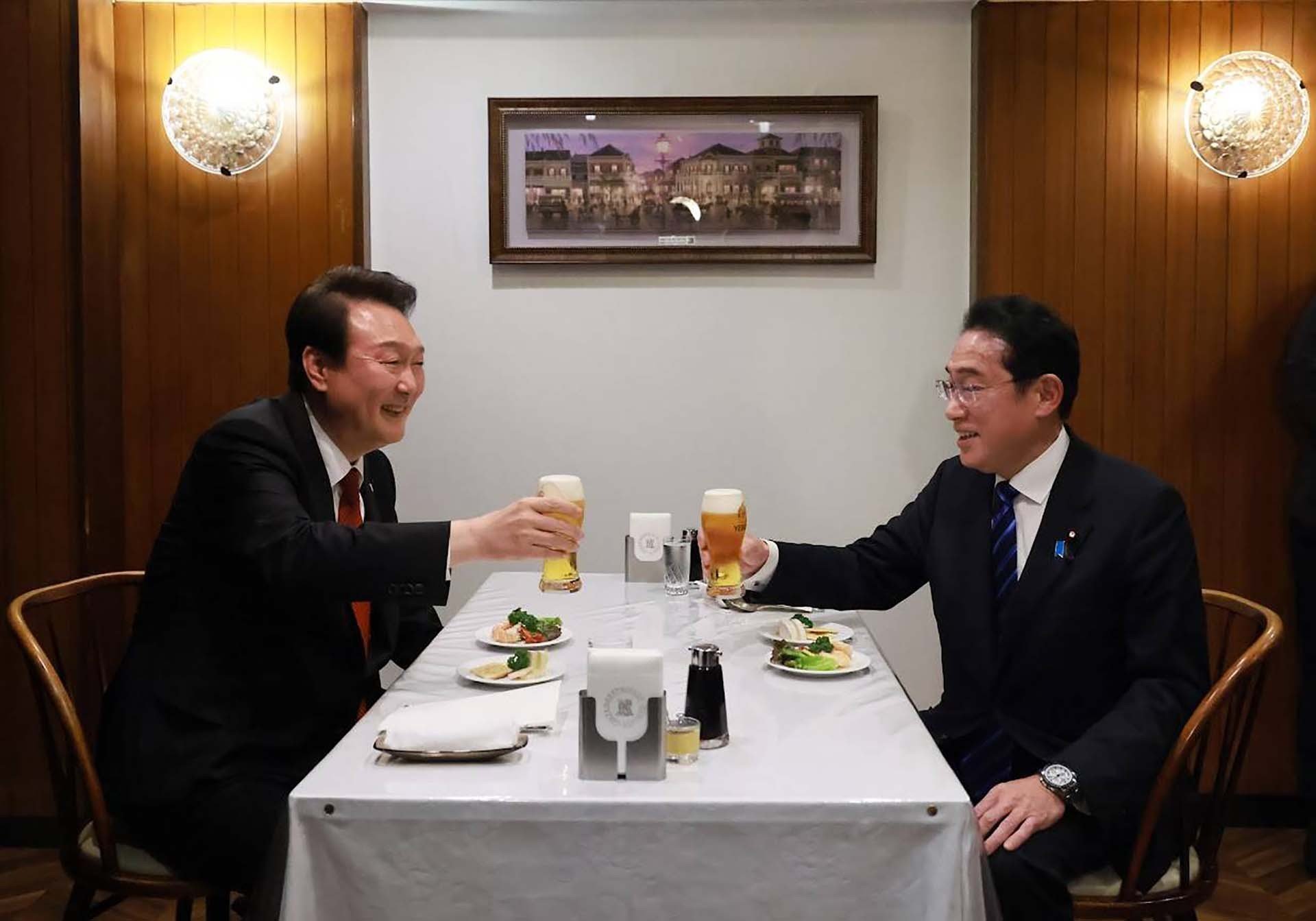 |
| South Korea's new National Security Council views Japan as an important neighbor and seeks cooperation in areas such as national security and the economy. (Source: Japanese Cabinet Office of Public Relations) |
Last week, South Korea released its first National Security Strategy (NSS) under President Yoon Suk Yeol. Unlike its neighbor Japan and ally the United States, this is not an annual document that only appears once during each presidential term, as was the case with Lee Myung Bak (2008), Park Geun Hye (2014), Moon Jae In (2018), and now Yoon Suk Yeol (2023).
With a gap of 4-5 years between versions and often appearing at the beginning of a term, this document is consistent in nature, aiming to define the issues and goals for the single term of the South Korean president.
Among them, one issue, a recurring theme throughout the NSS editions, is the security situation on the Korean Peninsula. That story remains more important than ever. But South Korea's 2023 NSS is more than just that.
Old echoes, new approaches.
First, the title of this document is "A Globally Important Nation for Freedom, Peace, and Prosperity," reminiscent of the title of South Korea's National Security System (NSS) under the late President Lee Myung-bak, "One Korea Globally." This 2009 document is only 39 pages long, significantly shorter than the recently released 107-page text. However, it has become a guiding principle for Seoul to play a more active and influential role internationally on issues such as free trade, multilateralism, peacekeeping, and climate change.
In that respect, the new NSS aims to do the same, clearly reflected in the priorities outlined in the security environment assessment. Instead of following the traditional approach and starting with the situation on the Korean Peninsula, Chapter Two of the NSS addresses this issue last.


Instead, this section begins with a preliminary assessment of global security, noting that “crises that once occurred only once every few hundred years are now happening simultaneously.” Recognizing the increasingly blurred lines between “national” and “international,” and the growing link between security and development, the document cites several key external challenges such as US-China competition, supply chain disruptions—which are crucial for trading nations like South Korea—and non-traditional security challenges.
Meanwhile, Chapters Three, Four, and Five outline Seoul's plan to address these challenges by strengthening alliances with Washington and strategic partners; reinforcing the international order; and enhancing its defense capabilities.
These sections share many similarities with content already mentioned in policy documents released several months ago, including the Strategy for a Free, Peaceful and Prosperous Indo-Pacific (December 2022) and the 2022 Defense White Paper (February 2023). From semiconductors to defense and low-emission energy production, South Korea's role in the Indo-Pacific and the global balance of power is becoming more important than ever.
However, Chapters Seven and Eight on economic security and addressing emerging security challenges acknowledge that recent incidents involving “economic coercion” and supply chain disruptions suggest that South Korea’s rise may be hampered. This compels Seoul to strive to build relationships with new partners while maintaining ties with traditional ones.
Value-based diplomacy
Specifically, South Korea's new NSS states that the focus of future diplomacy will be on "simultaneously implementing value-based diplomacy and pragmatic diplomacy for the benefit of the nation."
However, the contrast between these two objectives is not difficult to see, and Chapter Six on inter-Korean relations is the clearest evidence of this. Yoon Suk Yeol's victory in the presidential election a year ago stemmed, to some extent, from the previous administration's unsuccessful attempts at reconciliation between the two Koreas. This chapter addresses military deterrence and human rights issues. However, the remainder of the chapter primarily focuses on South Korea's unrewarded efforts to engage more substantively with North Korea.



Similarly, Seoul's stance on relations with Beijing and Moscow is noteworthy. As usual, the NSS repeatedly mentions the solidarity between South Korea and its partners and allies who share similar values, such as the United States. However, this does not mean that Seoul denies its relationship with Beijing and Moscow. The document emphasizes that Sino-Korean relations can develop through "respect and mutual support," although the Blue House will "prevent excessive dependence on certain countries for key coal resources." On the one hand, South Korea "strongly criticizes" Russia for the conflict in Ukraine. On the other hand, Seoul wants to "maintain stable relations" with Moscow.
Finding a balance between pursuing national interests and acting in accordance with one's own values is a difficult challenge for any country, especially for a middle-sized nation in a complex neighboring region like South Korea.
Nevertheless, President Yoon Suk Yeol's administration has outlined an ambitious vision, aiming to establish Seoul's position on the world map, rather than focusing solely on what is happening in Northeast Asia. However, in a volatile world, with once-in-a-century crises unfolding simultaneously, as the NSS has pointed out, realizing that dream is certainly not simple.
Source


![[Photo] "Hanoi Lotus Festival" honors the lotus flower that has been associated with Vietnam for thousands of years.](https://vphoto.vietnam.vn/thumb/1200x675/vietnam/resource/IMAGE/2026/06/27/1782516943048_sen-ha-noi-2026-minh-duy-1-jpg.webp)