

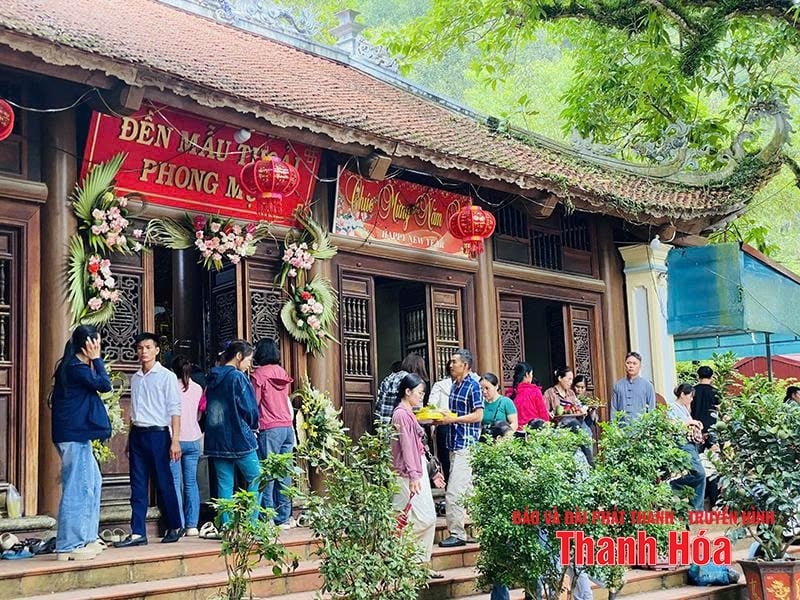
The beauty of the Mother Goddess temple in Phong Muc village (Trieu Loc commune).
Han Temple is located in Phong Muc village, a land where mountains meet and water converge, boasting beautiful and peaceful natural scenery. On one side are the deep, silent mountains and forests, and on the other is the Len River, which has flowed for generations, witnessing countless changes throughout history.
This area is also a place where historical, cultural, and spiritual values converge and are preserved. Han Temple is located about 3km from Bong Junction. Bong Junction is known for its dense system of historical sites, forming a scenic route: the temple of General Ly Thuong Kiet, Cay Thi Temple, Chau De Tu Temple, Duc Ong Temple (also known as Han Son Temple), Co Bo Temple... The road leading from National Highway 1 to Han Temple also bears the strong imprint of typical historical sites such as: the tomb complex of Lady Trieu, the historical and architectural complex of Lady Trieu Temple, Co Doi Temple, Quan Giam Sat Temple, Co Tam Temple... From the beauty of the natural landscape to the diverse and unique system of historical sites and religious and spiritual activities, the Han Temple complex has become attractive to numerous visitors from all over, just as the saying goes: "Han Son, a wondrous encounter with heavenly beauty / Visitors are reluctant to leave."
Ancient legends guide the path of "mortal beings." According to tradition, during the Le Dynasty, Mother De Tam received orders to assist General Le Can Thanh, the second son of Grand Marshal Le Tho Vuc, in repelling the Champa invaders on the Ma Giang River, right in the Dong Han area of Phong Muc village. With her strategic brilliance, unwavering determination, and the help of Mother De Tam, the enemy suffered a defeat, with many ships sinking in the swirling waters. After the victory, Mother De Tam held a celebratory feast for the troops right in Phong Muc village. Although she was a meritorious person who wholeheartedly served the country and its people, Mother De Tam's life was fraught with hardship and misfortune due to the treacherous and envious people who sought to falsely accuse and frame her, causing her to suffer unjustly. She was executed by burning at the summit of Chan Tien Mountain (now Da Bac Mountain). In remembrance of her contributions and out of compassion for her fate, the people of Phong Muc village erected a temple in her honor on this mountain.
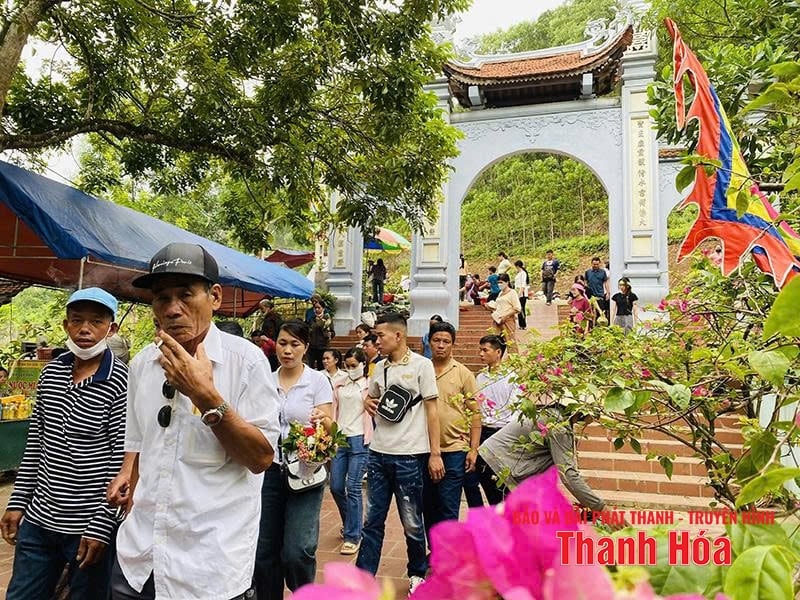
Numerous tourists flocked to Han Temple during the first few days of the sixth lunar month.
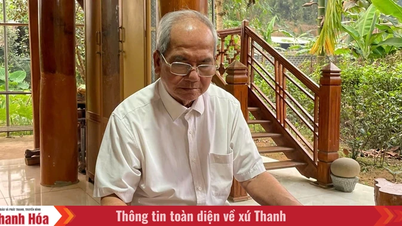
Amidst the lingering scent of incense and the stirring melodies of folk songs from the spirit medium rituals, Mr. Le Ba Mon (67 years old) calmly connects historical facts and folk tales about the formation and development of the temple, and the lives and achievements of the saints and deities worshipped there. Mr. Mon's family has served the temple for three generations, and he himself has been involved with it for over 10 years.
According to Mr. Mon's account: The ancient Han Temple was built entirely of ironwood. Each deity was worshipped separately in a shrine, with the innermost shrine being where the Mother Goddess was worshipped. Over time, due to the vicissitudes of history, the Han Temple was destroyed. "Despite this, the practice of offering incense to the Mother Goddess and other saints and deities here has always been maintained by the people. The villagers erected a temporary stone altar on the mountain. Right near the altar is a well, often called the 'heavenly pond'," Mr. Mon said.
Since 1993, in order to preserve and promote the historical and cultural values of the traditional culture, and to fulfill the aspirations of generations of people, Han Temple began to be rebuilt. To date, after many renovations and restorations, Han Temple still retains many ancient and solemn features. Han Temple currently has three main halls: the rear hall where the Mother Goddess is worshipped, the second hall where the King and the Jade Emperor are worshipped, and the third hall where the assembly is worshipped. The temple still preserves a number of ancient artifacts such as bronze jars and two stone steles.
Besides the Mother Goddess Temple, the cultural and spiritual space here leads visitors to the Quan Giam Sat Temple (with 4 shrines dedicated to the Four Palaces of Quan Hoang); the temple of Ong Hoang Ba (also known as Ong Hoang Bo); the Co Tam Temple, dedicated to the handmaiden of the Holy Mother, a sacred deity specializing in healing and saving people; and the Co Doi Temple, dedicated to the two young women who served the Holy Mother.
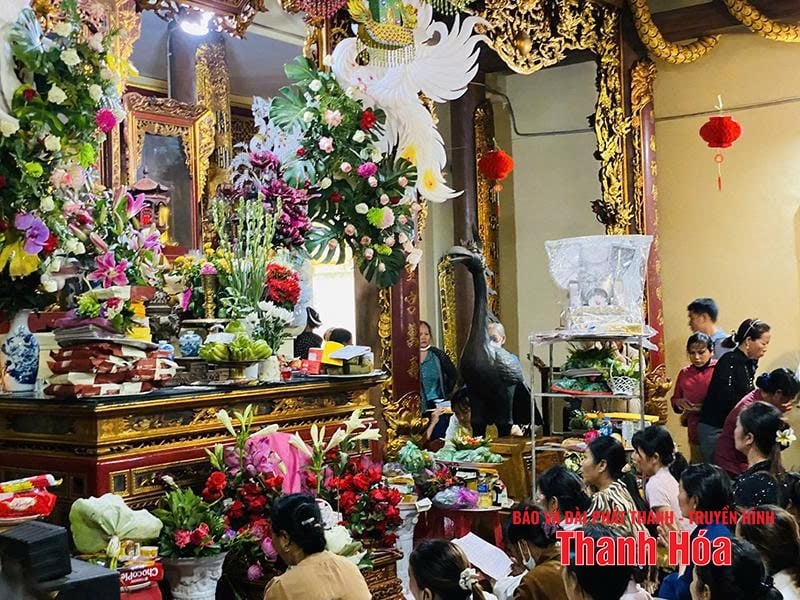
In the temple grounds during the festival days.
For a long time, the Han Temple complex has been a center of spiritual and cultural activities for people in and outside the region. Besides that, the site is also a valuable source of historical information, a typical cultural and religious landmark, a witness to history, and has accompanied the development of the village and commune. The saying, "June is the Gai Festival, February is the Mia Festival" (Gai Festival is another name for the Han Temple festival), seems to have left a lasting impression on many people.
The Han Temple Festival is held annually from the 1st to the 12th of June in the lunar calendar with many activities: offering incense, presenting ceremonial prayers, beating drums to open the festival, and artistic performances... The most distinctive event is the procession of the palanquin on the 12th of June in the lunar calendar. The palanquin of the Mother Goddess is carried from the village communal house to the Han Temple. Mr. Mon shared: "This is the most important ritual in the festival, so it is prepared very carefully and meticulously. Accordingly, the village will select 12 young, strong, unmarried men from families without mourning or other reasons, with good family backgrounds..."
From the very first days of the sixth lunar month, a large number of visitors from all over have flocked to Phong Muc and Han Temple to celebrate the festival. Depending on their circumstances, visitors prepare offerings to present to the Mother Goddess, expressing their wishes for health, happiness, success, and wealth. Ms. Thieu Dinh Tinh (from Thieu Tien commune) shared: “Every year, during the festival, I and some close friends come to the temple to offer prayers and incense. When entering the Mother Goddess's shrine, we don't prepare elaborate offerings; what matters most is our sincerity. The beautiful, peaceful natural scenery and the festive atmosphere always make us feel excited and delighted whenever we come to the temple.”
The Han Temple Festival has officially begun. Guided by spiritual beliefs and with the mindset of "travel to understand - arrive to love," visitors flock to Han Temple to freely explore, admire the scenery, enjoy a cup of green tea infused with the scent of the earth, experience the warmth of human connection, and immerse themselves in the cultural and spiritual colors of this place...
Text and photos: Nguyen Anh
* This article uses material from the book "Hau Loc Gazetteer" (Social Sciences Publishing House).
Source: https://baothanhhoa.vn/han-son-ky-ngo-duyen-thien-sac-254043.htm
![[Image] National Assembly discusses the implementation of the socio-economic development plan.](https://vphoto.vietnam.vn/thumb/1200x675/vietnam/resource/IMAGE/2026/04/20/1776696707422_ndo_br_img-20260420-185419-jpg.webp)

![[Photo] General Secretary and President To Lam meets with National Assembly delegates from ethnic minorities.](https://vphoto.vietnam.vn/thumb/1200x675/vietnam/resource/IMAGE/2026/04/20/1776696701056_a1-bnd-8331-3342-jpg.webp)





![[Podcast] 5D Ham Long - A "red flame" spreading historical value in the heart of the capital city.](https://vphoto.vietnam.vn/thumb/402x226/vietnam/resource/IMAGE/2026/03/26/1774512249069_hnm-1cdn-vn-2026-03-26-2e02d99430-_ham-long-10.jpeg)



![[Infographics] Hai Tien Beach Tourism Festival 2026 and celebratory activities](https://vphoto.vietnam.vn/thumb/402x226/vietnam/resource/IMAGE/2026/04/20/1776687221715_infographics-le-w1200t0-di2616d199d1165828t11358l1-2026-029.webp)











































Comment (0)