

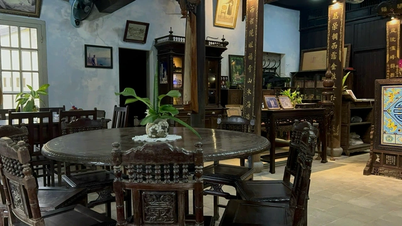
The first impression upon entering the communal house is the sight of two stone pillars inscribed with the words "dismount." According to ancient custom, those traveling by palanquin or on horseback must dismount and walk past the communal house as a sign of respect. This seemingly simple custom highlights the important role of the communal house in village life. The Vòng communal house was not only a place of worship but also a center of community activity. Through the vicissitudes of time, its imposing architecture, in the style of Northern Vietnamese communal houses with its crescent-shaped pond and eight-roofed pavilion, has been preserved relatively intact, creating a tranquil and solemn atmosphere.
 |
| A corner of Vong communal house. |
In the main hall, Vong Temple is dedicated to two celestial deities, Hung Luoc Dai Vuong and Cuong Luoc Dai Vuong, revered village guardians for generations. Legend says that during the Mac Dynasty, King Le Chieu Tong fled to this area and stopped at Vong Temple. The villagers welcomed him and offered gifts to show their loyalty. This story has been recounted from generation to generation as a part of the history of the Ke Moc region.
Besides worshipping gods and venerating the king, the people here also dedicate a prominent place in the communal house to honor the nine scholars of Ha Dinh, from doctorates and imperial degrees to associate degrees and bachelor degrees, as a way to remind their descendants of the tradition of studiousness.
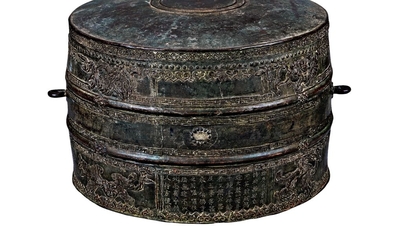
In addition, the temple also preserves a number of valuable artifacts from the Le Trung Hung and Nguyen dynasties. These include eight royal decrees (the earliest dating back to 1847 and the latest to 1924) and a bronze bell cast in 1882, along with a system of stone steles, stone statues, eight-sided palanquins, porcelain jars, etc.
There was a period of war and the harshness of time that caused Vong communal house to seriously deteriorate. In 1992, thanks to the collective contributions of the people, the monument was restored to a dignified state. On January 18, 1993, the communal house was honored to be recognized as a National Historical and Cultural Monument, simultaneously marking the restoration of the traditional festival after more than 40 years of interruption.
Mr. Tran Quang Dung, Deputy Head of the Temple Management Subcommittee, who has been associated with the temple for over 20 years, shared: “The Vong Temple Festival is held every three years in the years of the Tiger, Monkey, Snake, and Pig on a large scale. On the 1st day of the 2nd lunar month, there is a procession carrying the incense burner of the deity from the shrine to the temple. Following that are traditional rituals and processions lasting for two main days of the festival, with male ritual teams, female incense offering teams, male and female drum teams, coin-ringing teams, palanquin processions, sword-wielding teams, etc.”
Along with the February festival, the temple also maintains the tradition of offering "new rice" on the 10th day of the 10th lunar month. According to Mr. Dung, this tradition subtly reminds us of the ancient Ke Moc region, which was prosperous in agriculture and skilled in trade with the capital city of Thang Long. Thanks to the efforts of the people of Ha Dinh to restore and maintain the old tradition, by 2025, the Vong Temple festival will be officially inscribed on the list of National Intangible Cultural Heritage.
Time may change the appearance of old villages and streets, but in the tranquil space of Vong communal house, layers of cultural memories are quietly preserved. The ancient communal house by the To Lich River is therefore not only a historical relic but also a place that reminds us of the origins and identity of the Ke Moc region in the heart of Hanoi today.
Source: https://www.qdnd.vn/van-hoa/doi-song/khong-gian-van-hoa-lang-co-ke-moc-1033456

![[Image] "Journey of Hope" promotes the organ and tissue donation movement in Vietnam.](https://vphoto.vietnam.vn/thumb/1200x675/vietnam/resource/IMAGE/2026/05/20/1779294400833_1-8910-jpg.webp)
![[Photo] National Assembly Chairman Tran Thanh Man working with the Standing Committee of the National Assembly's Ethnic Council](https://vphoto.vietnam.vn/thumb/1200x675/vietnam/resource/IMAGE/2026/05/21/1779337435930_ndo_br_1-jpg.webp)























































Comment (0)