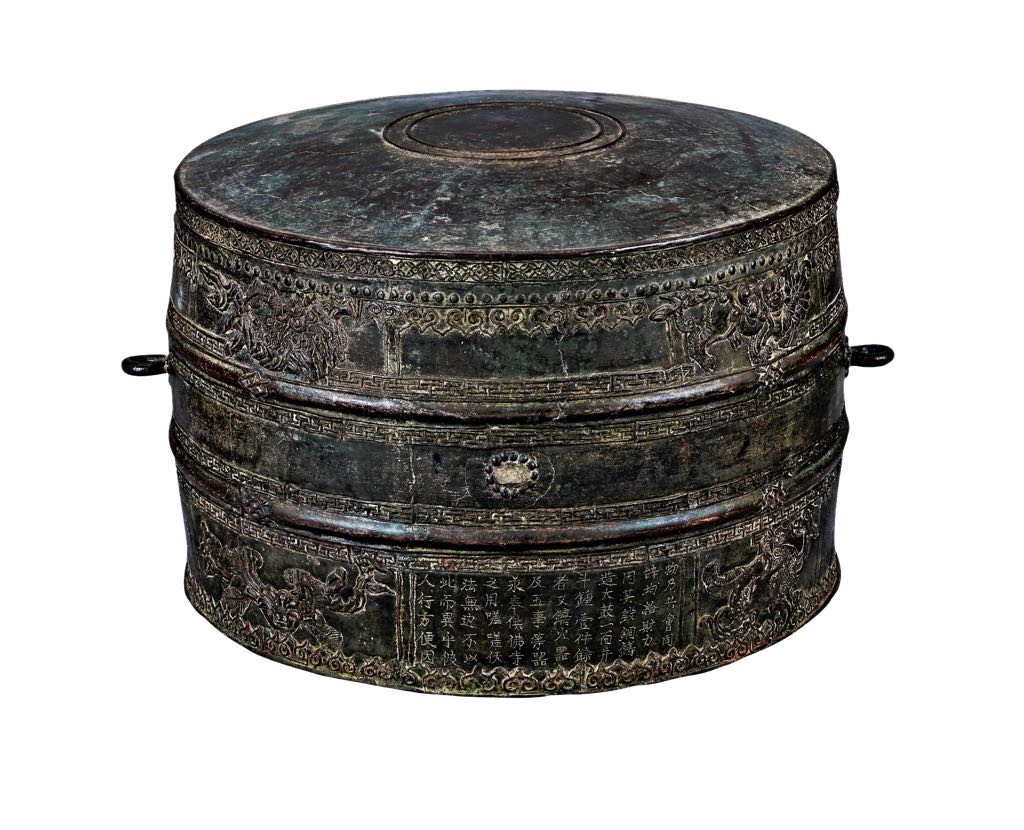
The Cảnh Thịnh bronze drum was cast using the wax mold technique, weighing 32 kg, 37.4 cm high, and approximately 49 cm in diameter. The drumhead is curved in a dome shape, with a raised double circle at the center. The drum body is cylindrical, slightly bulging in the middle and divided into three equal parts, separated by two raised ridges resembling buffalo horns. Each part corresponds to a band of decorative patterns. Besides secondary designs such as lemon blossom bands, studs, T-shaped patterns, and auspicious symbols, the main decorative themes on the drum appear in two bands: the top band features a raised depiction of the Four Sacred Animals (Dragon,麒麟, Turtle, Phoenix), symbolizing a peaceful and prosperous nation and a harmonious society. The bottom band is decorated with a Dragon-Horse carrying the River Diagram and a Divine Turtle carrying the Luo Shu. The River Diagram (Pre-Heaven Eight Trigrams Diagram) and the Luo Shu (Post-Heaven Eight Trigrams Diagram) are two primordial symbols of the I Ching – the philosophical thought of East Asians about the laws of change. It is applied to many areas of life such as cosmology, astronomy, geography, feng shui, human destiny, social management, etc. This pattern also features the Taotie (a mythical creature). The Taotie motif appeared in ancient Vietnamese art from the early centuries AD. According to legend, Taotie was an insatiably gluttonous creature, capable of even devouring its own body. Initially, this decorative motif was intended as a reminder of proper eating habits; later, it became a symbol of power, authority, or abundance and stability.

The Cảnh Thịnh bronze drum is a unique artifact within the complex of Vietnamese bronze drums. Male. While the Dong Son bronze drums (Type I Heger, dating back approximately 2,000-2,500 years) and the Muong drums (Type II Heger, 1st-15th centuries) have a bulging, constricted body forming three distinct parts: the rim, back, and base, the Canh Thinh bronze drum is shaped like a traditional drum with a leather drumhead. This design means the drum body consists only of the rim. In other words, the drum body is the rim itself. Besides its unique shape, the decorative patterns also clearly reflect the artistic characteristics of the era. We see the Four Sacred Animals and the Dragon-Horse and Divine Turtle, if considered as individual mythical creatures, appeared very early in ancient Vietnamese art. However, arranging them as a set of Four Sacred Animals and a pair of Dragon-Horse and Divine Turtle, carrying the symbols of the Ha Do and Lac Thu on the same artifact, seems to mark the beginning of a period of strong development in the art of the Nguyen Dynasty (1802-1945). Notably, the way these themes are expressed is through stylization, as seen in designs of leaves transforming into dragons, turtles, and Taotie (a mythical creature). Stylization is the ability to create, adapt, and enhance reality. The use of flowers, leaves, and plants to stylize into mythical creatures, as seen on this drum, can be considered a first in ancient Vietnamese art, creating a sense of openness, naturalness, and intimacy.

Besides its uniqueness and distinctive features, we can still recognize elements of inheritance, reflecting the continuous development in ancient Vietnamese art. The floral patterns, such as the lime blossom, the T-shaped motif, and the auspicious symbolism, are common motifs in the art of the Ly, Tran, and early Le dynasties (11th-15th centuries). The image of a phoenix flying horizontally, head facing forward, with its wings spread wide, evokes the image of the mythical Lac bird on the Dong Son bronze drums. The double circle on the drum's surface is a modified, conventional representation of the multi-rayed sun on the traditional bronze drums, transforming it into a halo. Even the drum's body, divided into three parts separated by raised ridges, subtly suggests the three-part structure of the Dong Son bronze drum. This development was previously seen on the Muong drums. Specifically, the back and base of the Muong drum are formed by a continuous, evenly flared line, separated by a raised ridge, so the separation is no longer as clear as on the earlier Dong Son bronze drums.

Another special value of the Cảnh Thịnh bronze drum lies in its historical documentation. The inscriptions on its body indicate that the drum was cast in the leap month of April of the 8th year of Cảnh Thịnh during the Tây Sơn dynasty (1800) at Chùa Cả (Linh Ứng Temple), also known as Chùa Nành, in Ninh Hiệp commune, Gia Lâm district, Hanoi today. Notably, a long inscription of 222 characters explains the reason and purpose of casting the drum, mentioning that Mrs. Nguyễn Thị Lộc, wife of the Grand Eunuch Giao Quận Công, in the 2nd year of Vĩnh Hựu during the reign of King Lê Ý Tông (1736), contributed to the construction of Linh Ứng Temple. In remembrance of her contributions, the people of the commune collectively contributed their labor and money to cast the drum and other religious artifacts to offer to the Buddha, preserving them and reminding future generations to always remember the merits of their ancestors.

With its unique form and special historical, cultural, and artistic values, particularly its representation of the preservation and development of the Vietnamese tradition of casting and using bronze drums over more than two thousand years, the Canh Thinh bronze drum was recognized as a National Treasure of Vietnam by the Prime Minister in 2012.
Source: https://heritagevietnamairlines.com/trong-dong-canh-thinh-tieng-vong-ngan-nam/Di sa



![[Image] Hanoi's urban life under the challenge of a "scorching hot" environment](https://vphoto.vietnam.vn/thumb/1200x675/vietnam/resource/IMAGE/2026/05/25/1779706979265_nang-nong-t5-2026-minh-duy-7-4636-jpg.webp)


![[Image] Close-up view of the interchange connecting the two expressways and Long Thanh Airport.](https://vphoto.vietnam.vn/thumb/1200x675/vietnam/resource/IMAGE/2026/05/25/1779703378210_ndo_br_z7863716673926-224453a31600126cce10622af6290afd-4549-jpg.webp)



































































Comment (0)