

In the 19th century, astronomers calculated the location of a planet in the solar system and named it Vulcan, but no one had actually observed it.
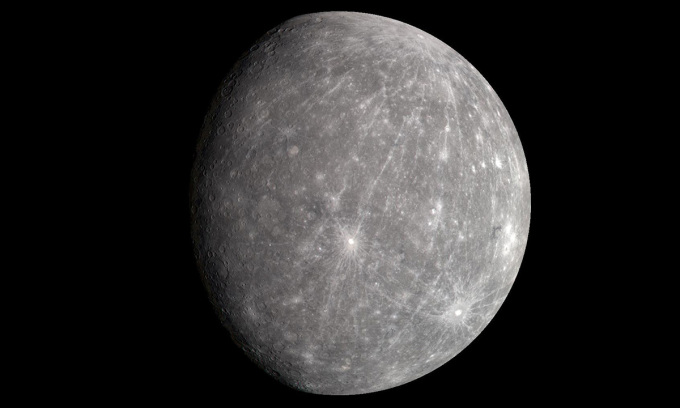
Mercury, the planet closest to the Sun in the solar system. Photo: NASA
Hundreds of years ago, scientists noticed that Uranus's orbit differed slightly from the predictions of Newton's theory of gravity. In July 1846, the French astronomer and mathematician Urbain Le Verrier suggested that the difference could be explained by another planet and made a prediction about the orbit of this unknown celestial body.
Le Verrier wasn't particularly interested in discovering the new planet with a telescope, as he had already found it mathematically. The task of observation was assigned to the German astronomer Johann Gottfried Galle. On September 23, 1846, Galle looked at the location where Le Verrier predicted the new planet would appear. However, to his surprise, Galle didn't see the mysterious planet but instead discovered Neptune within a one-degree radius of that location.
Later, Le Verrier was asked to observe another planet, Mercury. So close to the Sun, Mercury was one of the most difficult planets to observe in the solar system. Le Verrier was tasked with applying Newtonian physics to determine the planet's orbit.
However, Le Verrier was unsuccessful. He tried hard, but Mercury's eccentric orbit was perplexing. According to Newton's theory, planets move in elliptical orbits around the Sun, but observations showed that Mercury's orbit fluctuated more than the gravitational influence of known planets.
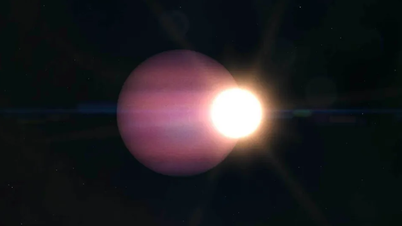
As with Uranus, Le Verrier believed the cause was another planet altering Mercury's path. Ultimately, he named the mysterious planet Vulcan after the Roman god of fire.
Soon after, astronomers began reporting observations of Vulcan. The first report was made by amateur astronomer Edmond Modeste on March 26, 1859. Based on Modeste's observations, Le Verrier calculated the orbit of the new planet. He believed it would make transits (planets passing between their host star and the observer, similar to Mercury transiting between the Sun and Earth) 2-4 times per year.
Le Verrier refined his calculations based on other observations, but Vulcan had never been definitively observed. Many observations of the planet could be explained by sunspots, known planets, and nearby stars.
Nevertheless, Vulcan survived for 70 years. In 1879, the media even reported that Vulcan would transit the Sun based on calculations by astronomer Theodor von Oppolzer. However, no one saw the planet. People searched for it during most solar eclipses around that time, but were unable to observe it.
Ultimately, the planet born from Le Verrier's mathematics was "wiped out" by a new physical theory: General Relativity. Einstein's theory could predict Mercury's trajectory without any additional planetary interference.
General relativity posits that gravity is a result of the curvature of spacetime caused by massive objects, with objects closer to massive objects being more affected. Therefore, this theory could explain the oscillations of Mercury's orbit, the planet closest to the Sun. Planets further out in the solar system are less affected due to their greater distance from the Sun.
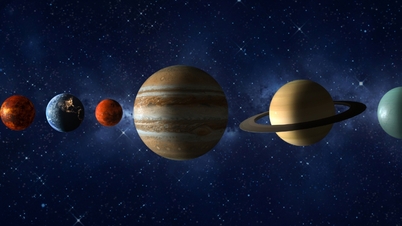
Thus, Einstein's theory could explain the orbits of Mercury, Earth, Mars, Jupiter, and many other planets without needing to refer to other planets. The emergence of this new theory also rendered Vulcan a thing of the past.
Thu Thao (According to IFL Science )
Source link
![[Photo] General Secretary and President To Lam meets with National Assembly delegates from ethnic minorities.](https://vphoto.vietnam.vn/thumb/1200x675/vietnam/resource/IMAGE/2026/04/20/1776696701056_a1-bnd-8331-3342-jpg.webp)
![[Image] National Assembly discusses the implementation of the socio-economic development plan.](https://vphoto.vietnam.vn/thumb/1200x675/vietnam/resource/IMAGE/2026/04/20/1776696707422_ndo_br_img-20260420-185419-jpg.webp)



























































































Comment (0)