


From defeating the enemy to conquering poverty.
Cao Viet Duc, born in 1954, enlisted in Company 6, Battalion 41, Division 305 (Special Forces) in February 1974. After completing his combat duties in the Ho Chi Minh Campaign, he continued to serve with his unit on international missions in Cambodia. In August 1981, Cao Viet Duc was sent to study political officer training and then worked at the Armored Forces Officer School (Armored Forces). After more than 10 years in the military, in December 1986, Cao Viet Duc requested to be discharged and returned to his hometown. Returning to civilian life amidst difficult family economic circumstances, but with the courage and determination of a soldier of Uncle Ho's army, Mr. Duc did not lose heart. He discussed with his wife and accepted over 9 acres of leased land to meet their immediate food needs.
Once he had enough to eat and wear, he began to think about getting rich. Following the old adage, "We conquered the enemy, now we conquer poverty," on 1.5 hectares of hilly land in Yen The, he dug holes and planted over 300 lychee and longan trees. He invested in building 3,000 square meters of livestock pens on the remaining land. After many years of hard work, his family, once poor, became sustainably wealthy thanks to stable income from farming, livestock breeding, and business. On average, his family sells over 5 tons of live pigs annually; raises over 20,000 free-range chickens; and supplies hundreds of thousands of chicks to other households. Thanks to good care techniques and disease prevention, the quality of his chicken meat is excellent and trusted by markets near and far. Each year, he introduces and sells 100 tons of commercial chicken. He is the one who built the "Yen The Hill Chicken" brand that exists today.
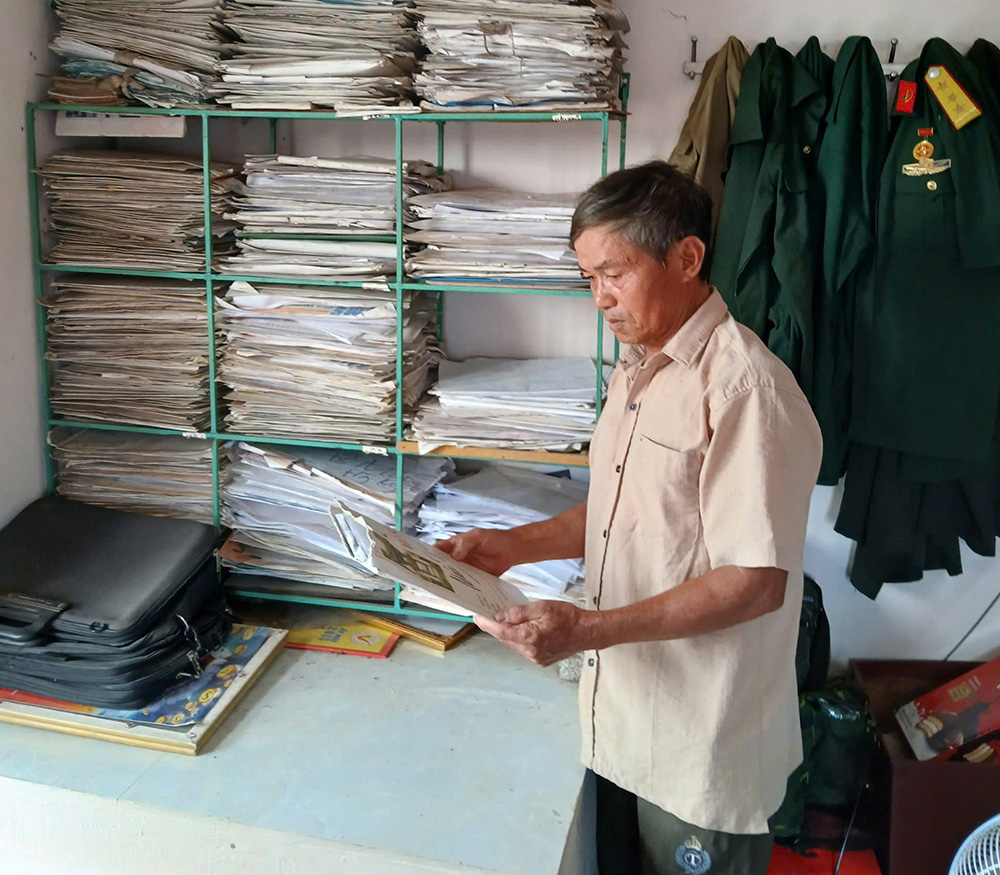 |
Veteran Cao Viet Duc stands beside a archive of documents about fallen soldiers. |
Besides livestock farming and crop cultivation, Mr. Duc also opened a feed agency to ensure a steady supply of feed for his family's farm and to provide over 700 tons of animal feed to local farmers. After deducting expenses, Mr. Duc's family earns 600-700 million VND per year. Veteran Cao Viet Duc has become a prime example of overcoming difficulties, daring to think and act, and rising to prosperity right in his homeland. He was awarded certificates of merit by the People's Committee of Bac Giang province (formerly); the Vietnam Poultry Association; and the Ministry of Agriculture and Rural Development , and was honored as one of 63 veteran families recognized nationwide for their outstanding economic achievements in 2018.
The journey to find teammates.
Speaking with us, veteran Cao Viet Duc fondly recalled: On June 10, 1977, as deputy company commander, he led his unit in a fierce battle against the enemy. In this battle, 17 soldiers bravely sacrificed their lives, and he and his comrades buried them in a field near Ben Soi (near Xa Mat Border Gate, Tay Ninh ).
In April 2002, he returned to his old battlefield. Upon arrival, his first act was to search for the graves of his comrades. At the Chau Thanh District Martyrs' Cemetery (Tay Ninh Province), Mr. Duc embraced each of his comrades' graves, weeping and calling out their names. Seeing the shared grave of five whose identities remained unknown, he felt a deep sense of unease. After returning from his visit to the old battlefield, he sent letters to inform the families of 12 fallen soldiers whose names had been identified and helped them with the procedures to exhume and rebury the 12 remains in their hometown cemetery.
After that trip, Mr. Duc couldn't sleep soundly any night, burdened by the camaraderie and affection for his fellow soldiers. His reputation spread far and wide, and many families contacted him to help locate the graves of their fallen comrades. As a soldier who had faced life and death situations, Mr. Duc understood the longing and hope of families and loved ones to find and bring their fallen soldiers home. This motivated him to embark on a journey of self-discovery to find his comrades.
From then on, the number of applications sent to Mr. Duc increased steadily. To facilitate receiving information, he created Zalo and Facebook accounts to communicate with families. On average, 20-30 families send information about fallen soldiers each month, asking him to find their graves, so he is constantly busy, often working through the night, and sometimes only staying home for 3-4 days a month. His wife and children have to handle all the family matters. Meanwhile, he travels to cemeteries throughout the country and even to cemeteries in neighboring Laos and Cambodia to search for information, draw grave maps, and look up records. Upon returning, he dedicates time to sending notifications to relevant authorities and the families of the fallen soldiers.
For over 20 years, Mr. Duc has written more than 10,000 letters to connect information about the graves of fallen soldiers and provided 10,000 pieces of information about fallen soldiers to the "Information about those who sacrificed for the Fatherland" program broadcast on VOV2, Vietnam National Radio. Mr. Duc shared: "My search for the remains of my comrades is entirely voluntary, driven by emotion, a heartfelt urge, and based on science, not on psychic abilities or fortune-telling..." According to him, the first step is to decipher the unit designations, codes, and symbols from the fallen soldier's death certificate. This method is highly accurate because by looking at the death certificate, one can determine which unit the soldier belonged to, where they were stationed, and on which battlefield they died. To accurately determine the various symbols, codes, and numbers of military units, Mr. Duc spent nearly three years visiting different units to gather information.
Whenever he receives a file, his first task is to analyze the codes and symbols to determine the place of sacrifice and the original burial place of the fallen soldier; then he compiles the file, connects with relevant agencies to conduct verification, review, and inspection. Once he receives accurate feedback, he coordinates with the local fallen soldiers' families support association, the local Veterans' Association, and the fallen soldier's relatives to begin the search. "Some trips involve scorching hot winds from Laos, while others endure bone-chilling northeast monsoon winds. In some cases, we find the grave in just 2-3 days, but in others, it takes up to 3 years due to incomplete information, but I never give up," Mr. Duc shared.
He recounted the story of martyr Dương Xuân Hỷ, from Thiệu Dương, Thiệu Hóa, Thanh Hóa (now Hàm Rồng ward, Thanh Hóa province). His family had searched for his grave for many years, only to find three graves in three different locations. The family was distraught and, upon learning of Mr. Đức, sought his help again. Holding the death certificate in his hand, Mr. Đức predicted that martyr Dương Văn Hỷ had died in Sơn Lập commune, Sơn Tây district, Quảng Ngãi province (formerly). And indeed, after finding the grave and excavating the remains for DNA testing, the results were accurate. The family was overjoyed and from then on considered Mr. Đức as a member of their family.
Mr. Duc also searches for the remains of fallen soldiers using DNA testing of large groups of graves and comprehensive testing of several cemeteries. He affirmed: “This is a scientific method; finding the graves of fallen soldiers using genetic sources requires extreme accuracy in information, the genetic source of the fallen soldier, and the genetic source of their relatives. Therefore, when accurate information is available, I will send the application form and request the local Veterans Association where the fallen soldier died to guide the relatives in preparing the application for DNA sampling.” Veteran Cao Viet Duc also, on behalf of the relatives of fallen soldiers, submitted a request to the Department of War Invalids and Martyrs (Ministry of Interior) to develop a plan for DNA sampling of the remains of fallen soldiers in five cemeteries: Viet-Lao, A Luoi, Phong Dien, Huong Thuy, and Loc Ha (formerly Thua Thien Hue province). Out of approximately 7,000 graves, nearly 500 cases have been analyzed and compared with accurate results. This initiative has contributed to helping many families find the remains of fallen soldiers in recent times.
Veteran Cao Viet Duc is not a person with extraordinary abilities, nor is he driven by economic gain; everything he does is voluntary, stemming from a pure heart for his fallen comrades. He accepts no remuneration, and all travel expenses are covered by his personal funds. He says, "I do this to show gratitude to my comrades, not to receive favors." For the past 23 years, this veteran has quietly traversed mountains and forests, coordinating the search for thousands of martyrs' graves in cemeteries and 24 remains of martyrs on the battlefield. Among these, he has assisted with the procedures and funding for the safe and respectful relocation of 1,684 graves back to their hometowns, bringing comfort to countless families of fallen soldiers.
With outstanding achievements in volunteer work, veteran Cao Viet Duc was awarded a Certificate of Merit by the Prime Minister for his achievements in social welfare and active participation in community activities in 2020; and a Certificate of Merit for outstanding achievements in studying and following the ideology, ethics, and style of Ho Chi Minh in 2024. Currently, veteran Cao Viet Duc is a volunteer searching for information and the graves of fallen soldiers throughout the army. His journey to find his comrades has not stopped because many families of fallen soldiers are still waiting for his help. I was deeply moved when I heard him share: "As long as I live, I will continue to search for my comrades. For me, the greatest happiness is bringing my comrades home, seeing the relatives of fallen soldiers welcome them back after so many years of separation."
Source: https://www.qdnd.vn/phong-su-dieu-tra/cuoc-thi-nhung-tam-guong-binh-di-ma-cao-quy-lan-thu-17/hanh-trinh-lang-le-1013860
![[Photo] General Secretary To Lam presides over a meeting with the Editorial Teams to summarize 100 years of the Party's leadership of the Vietnamese revolution and 40 years of implementing the National Construction Program.](https://vphoto.vietnam.vn/thumb/1200x675/vietnam/resource/IMAGE/2026/03/04/1772601288977_a1-bnd-8134-7576-jpg.webp)





















































Comment (0)