Mr. Tran Xuan Vinh, from Yen Hop village, Kim Phu commune (Quang Tri province), said: "Since my grandparents' time, we've only seen the Chut people wearing loincloths and wrapped in black cloth. The lack of a distinctive identifying costume not only creates a gap in cultural identity but also causes many obstacles for the Chut people in community cultural exchange activities."
The Chứt people belong to the Viet-Muong language group, part of the Austroasiatic language family, and currently reside primarily in the high mountainous regions of Quang Tri, Ha Tinh, Dak Lak, and Lam Dong provinces. This community comprises five local groups: May, Ruc, A Rem, Ma Lieng, and Sach, living in rugged terrain and closely connected to the Truong Son mountain range.
In the past, the Chứt people had rudimentary clothing made from tree bark, forest leaves, and animal skins. Some groups, such as the Mày and Mã Liềng, even used skirts made from palm leaves and animal hides. Over time, these traditional garments have almost disappeared. Nowadays, most Chứt people wear clothing similar to that of the Kinh people or borrowed from neighboring ethnic groups.
According to Dr. Bui Thi Bich Lan, Deputy Director of the Institute of Ethnology and Religious Studies , the lack of a distinctive traditional costume has long been a concern for both researchers and the Chut community. In many cultural events, the Chut people often lack confidence without a unique costume to showcase their ethnic identity. A survey by the research team showed that 97.7% of respondents desired a traditional community costume reflecting the Chut people's identity.
Ms. Pham Thi Lam, a Ma Lieng woman from Cao village, Tuyen Lam commune, also expressed her desire to soon have her own traditional costume developed.


To realize this goal, the research team conducted surveys in the residential areas of the Chứt people, including the communes of Thượng Trạch, Kim Phú, Dân Hóa, and Tuyên Lâm.
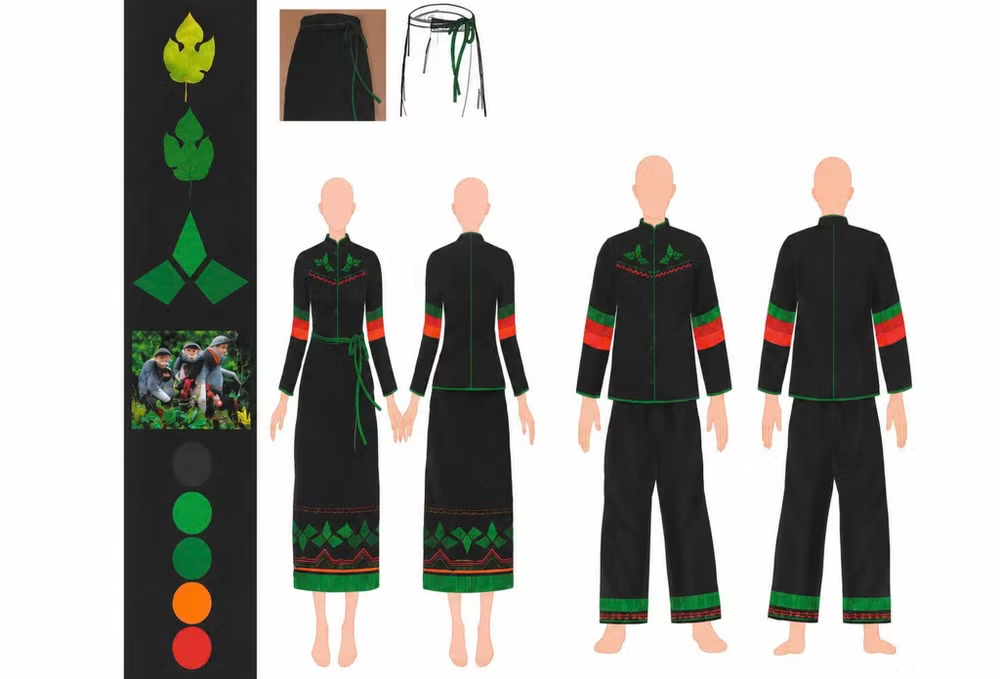
Dr. Bui Thi Bich Lan stated that, based on research results and consultations with local people, the project team has developed six community attire designs, including three for men and three for women. The designs are based on familiar styles commonly used by the people in their daily lives. For women, it's a blouse combined with a wrap skirt, while for men it's a shirt and trousers. The preferred materials are natural fabrics, preserving the rustic traditional style while also being suitable for modern living conditions. The designs are built on three main foundations: cultural foundation, linguistic and historical foundation of the ethnic group, and foundation of natural conditions and living environment. The colors, patterns, and decorative composition all reflect the distinctive cultural values of the Chut people.
Taking on the role of transforming research results into design products, Master's student Nguyen Thi Phuong Tu drew inspiration from memories of the Truong Son mountain range to create the community's traditional attire. The attire uses five main colors: red symbolizing the sun; orange and earthy brown representing the caves; and various shades of dark and light green evoking the image of the ancient forest. The green of the border guards is also incorporated as a symbol of solidarity and close ties between the Chut people and the soldiers on the border.
Dr. Bui Thi Bich Lan believes that successfully developing the new community costume is only the beginning of the process of preserving and promoting the cultural values of the Chut ethnic group. For the costume to truly become a part of daily life, close cooperation between the government and the community is needed; promotion of awareness campaigns, teaching of crafting skills, establishment of garment-making clubs, and encouragement of the younger generation to participate in preserving the heritage are essential. Simultaneously, organizing performances, exhibitions, cultural festivals, and movements promoting the wearing of ethnic costumes, along with the application of technology and social media, will contribute to promoting and spreading the cultural values of the Chut in contemporary life.
According to Mai Xuan Thanh, Deputy Director of the Quang Tri Department of Culture, Sports and Tourism, restoring the traditional costumes of the Chut people is not only about creating a new set of clothing but also a journey to rediscover cultural memories, awaken national pride, and contribute to preserving the cultural diversity of Vietnam.



At upcoming cultural festivals in Truong Son, the Chut people may appear for the first time in traditional costumes bearing the distinctive mark of their community. These are not just costumes, but also a return to a unique part of their cultural memory.
Source: https://nhandan.vn/hanh-trinh-tim-lai-ky-uc-van-hoa-post972142.html
![[Photo] General Secretary and President To Lam works with the Party Committee of the Government on the work of preventing and combating storms, floods, extreme natural disasters and climate change.](https://vphoto.vietnam.vn/thumb/1200x675/vietnam/resource/IMAGE/2026/06/29/1782729441945_a1-bnd-0385-9454-jpg.webp)



![[Image] A look back at the capital's preparations for the century-long master plan.](https://vphoto.vietnam.vn/thumb/1200x675/vietnam/resource/IMAGE/2026/06/29/1782750453122_quy-hoach-100-nam-minh-duy-1-2118-jpg.webp)