


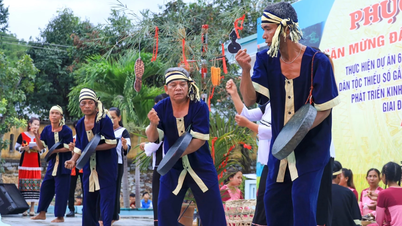
Singing folk songs during the spring festival in Thach Lap commune.
In the cultural life of the Muong people of Thanh Hoa province, the "sac bua" singing tradition has long been an indispensable part of spring festivals and celebrations. Arriving in Thach Quang commune, from afar, the deep, resonant sounds of gongs awaken the mountain and forest landscape after the year-end rest. Following the sound of the gongs, we found the house of Ms. Bui Thi Thao in Dang Thuong village – the venue for the "sac bua" singing. Inside the stilt house, a group of people in traditional costumes stood in a semicircle. The lead singer's voice rang out clearly, the singing blending with the rhythmic gongs and drums, and the harmonious accompaniment of the entire group. Ms. Thao shared: "The most anticipated thing all year is hearing the sound of gongs and drums in front of our house during the first few days of spring. When the 'sac bua' singing begins, I naturally feel more at peace, as if I'm being given renewed hope for the new year."
Mr. Nguyen Tai Nang, from Dang Thuong village - one of the people who have been involved with the "sac bua" singing tradition in Thach Quang for many years - shared: "In the past, every New Year's Eve, the "sac bua" singing troupes would gather, adjust their gongs and traditional costumes, and then spread out throughout the village to wish each family a happy new year. The sound of the gongs led the way, followed by the singing, both solemn and lively, carrying a message of good fortune for the new year."
Following the traditional New Year's ritual troupe, one can fully appreciate the vibrant atmosphere of a custom deeply ingrained in community life. Upon arriving at each house, the group pauses, adjusts their attire, and the gong-bearer steps forward. A series of gong sounds, like a request for permission. The doors open wide, the host smiles and welcomes the guests, and the lead singer begins singing the first verses of the blessing: "May the land be fertile, the barns full of cattle, the granaries full of rice, and the family harmonious." The lyrics are sometimes rhythmic, like a story, sometimes rapid, accompanied by the gongs, creating a particularly joyful atmosphere of the spring season. The singing then begins outside the gate and continues into the courtyard. After entering the house, exchanging greetings and offering blessings to the host, the troupe continues to beat the gongs in farewell. The simple sounds of gongs and singing linger in the mountain forest.
Leaving Thach Quang commune, we continued our journey to Thach Lap commune – where the custom of singing folk songs is still preserved by the Muong people as an integral part of their heritage. The road wound through the dark green hills, the spring atmosphere still thick in every house, every courtyard bearing the footprints of the folk singers.
In Thuan Hoa village, Thach Lap commune, artisan Pham Vu Vuong welcomed us with a gentle smile and a set of gongs and drums proudly displayed on the wall of his stilt house. He is over 80 years old, but his voice is still strong and his eyes light up when he talks about the "sac bua" songs. According to Mr. Vuong, in the past, the "sac bua" singing group usually had 12 people. Now, the number of participants is unlimited; the more the merrier. Anyone of Muong ethnicity, young or old, male or female, participates in the "sac bua" group to send New Year's greetings, festival wishes, and spring wishes to everyone. It's worth noting that the lyrics of the "sac bua" songs are not entirely fixed. Besides traditional melodies, singers can improvise depending on the circumstances of each family. For families with children studying far away, the wishes will focus on academic success. For newly built houses, the lyrics emphasize stability and warmth. Sắc bùa singing is a form of blessing singing, not only performed during Tet (Lunar New Year), but also during spring festivals, housewarming celebrations, and other events. This flexibility keeps sắc bùa vibrant, avoiding rigid repetition and instead connecting it closely to the real-life experiences of the community.
What gives the folk singing tradition its vitality lies not only in the lyrics or the rhythm of the gongs, but in the community connection it fosters. It's not just a simple stage performance, but a gathering of people, between the folk singers and the host. After each performance, the host offers a glass of wine, a piece of cake, and lively conversations about the new year. Laughter blends with the sound of the gongs, creating a warm rhythm that spreads from house to house. Each gong beat is like a call to memory, a call to reunion.
However, the pace of modern life poses numerous challenges to preserving this beauty. Strong cultural exchange and the emergence of new forms of entertainment have led many young people to become indifferent to traditional values. In some areas, the traditional Muong folk singing tradition sees little participation from young people, and the number of those who know the ancient lyrics is dwindling. Artisan Pham Vu Vuong laments: "If the younger generation doesn't learn and participate, in a few decades, who will still remember all the ancient folk songs?" This question is not only his concern but also a shared worry among those dedicated to Muong culture.
As spring arrives in the Muong villages of Thanh Hoa province, the melodies of the traditional folk songs act as a bridge connecting the past with the present. They remind each person of their roots, the value of unity and sharing, and faith in the future. Amidst the whirlwind of change, these spring songs quietly preserve the cultural essence of the Muong people, ensuring that each spring is not only a transition of nature but also a lasting continuation of tradition.
Text and photos: Thùy Linh
Source: https://baothanhhoa.vn/hat-sac-bua-giua-ngay-xuan-280576.htm




































































Comment (0)