

Ms. Cao Xuan Thu Van, President of the Vietnam Cooperative Alliance :
Building a long-term value chain.
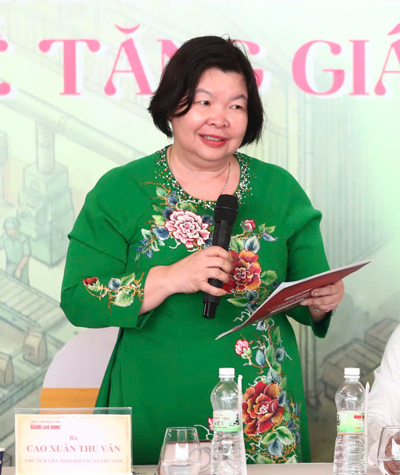
The current coffee industry's supply chain is managed through contracts. However, the problem isn't the lack of contracts, but rather that those contracts aren't strong enough, durable enough, or disciplined enough to create value.
Therefore, for the supply chain to be truly effective, it's not enough to simply sign contracts; more importantly, it's crucial to design a binding contract system that includes shared benefits and a robust enforcement mechanism. Within that structure, cooperatives need to be identified as a very important entity.
From the business perspective, there's a need to shift from a short-term buying and selling mindset to building long-term value chains. Banks also need to develop credit models based on output contracts, treating contracts as a form of collateral, rather than relying solely on physical assets. And from a policy perspective, it's necessary to continue improving the legal framework to protect economic contracts within the value chain.
The Vietnamese coffee industry has made significant progress in terms of production volume, but to achieve even greater value, we must change the way we organize the supply chain. Supply chain integration is not just a slogan, but a contractual discipline. And that discipline can only be formed when all stakeholders in the chain, from farmers and businesses to banks, share benefits and respect long-term commitments.
Ms. BUI HOANG YEN, Head of the Trade Promotion Department Office, Ministry of Industry and Trade in Ho Chi Minh City:
Building a brand through storytelling.

A key factor in promoting coffee is building a compelling product "story" that attracts consumers on international shelves. Vietnam has the advantage of its unique cultural identity, and this is a crucial source of material for building a product story. In reality, when competing purely on quality with Latin American countries like Brazil, Vietnamese coffee faces many challenges. However, cultural factors can make a difference. If Vietnamese coffee is positioned in the premium segment and simultaneously "dressed" in a story connected to its people, history, and geography, the product can completely conquer the international market with its unique identity.
The next goal is to elevate Vietnamese coffee to a new level, shifting from exporting bulk and containerized coffee to exporting specialty coffee with its own unique identity. To achieve this, coordination is needed between the Vietnam Coffee and Cocoa Association, key growing regions such as Dak Lak, Lam Dong, and Gia Lai, along with media coverage and financial support from banks to promote the export of processed coffee.
Mr. NGUYEN THIEN VAN, Vice Chairman of the People's Committee of Dak Lak province:
Making Dak Lak a center for deep processing.
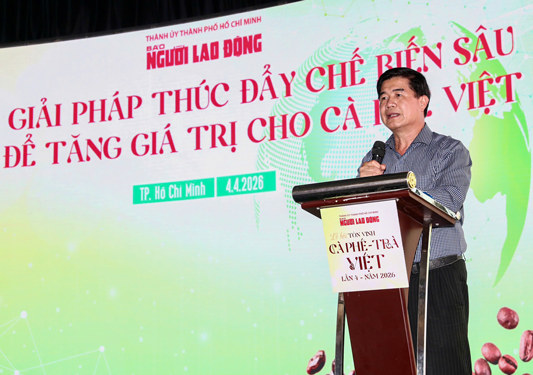
Dak Lak currently has significant potential for developing deep processing. This potential stems from its large and relatively stable raw material resources; increasingly improved quality; a maturing business ecosystem; the need for technological innovation; new consumer trends both domestically and internationally; and especially the aspiration to shift from exporting raw materials to exporting high value-added products.
The market now demands not only better, more consistent, and more traceable coffee, but also convenient, diverse products that suit modern lifestyles. Product lines such as high-quality roasted and ground coffee, next-generation instant coffee, coffee extracts, RTD (ready-to-drink) coffee, or specialized products for specific segments are opening up new growth opportunities. Dak Lak has the potential to become a center for deep processing of coffee in Vietnam and the region. The province's orientation is to develop the coffee industry in a modern, green, and sustainable direction; linking deep processing with high-quality raw material areas; linking technology investment with management innovation; and combining economic value with cultural value...
Mr. NGUYEN QUANG BINH, coffee market expert:
We need the support of banks.

Through numerous workshops, a major issue has been identified: Vietnamese coffee is still primarily sold in an informal, unregulated manner, lacking a clear and well-structured supply chain. Domestic businesses also haven't received adequate support, particularly from the banking system, a crucial force in connecting and maintaining the supply chain.
This reality highlights the need for closer collaboration between banks and domestic businesses, thereby promoting the development of specialty coffee, building supply chains and brands. At the same time, support is needed for specialty coffee farmer groups to participate in the market in a more systematic way.
Once the market is organized and a clear value chain is established, Vietnamese coffee can build a sustainable brand.
Mr. NGUYEN VAN KHOI, Deputy Director of Corporate Customer Division, Nam A Bank:
Many preferential credit policies

It can be said that the tea and coffee sectors are enjoying many preferential credit policies. Recently, the Prime Minister has requested banks to focus capital on the agricultural, forestry, and fisheries sectors, with a scale of approximately 100,000 billion VND.
To access incentives in the coffee and tea sector, businesses need to meet several basic conditions. First and foremost, they must have production capacity, invest in machinery, and participate in the value chain from cultivation and processing to trade and export. Businesses that own their own raw material areas are given priority.
Furthermore, the business plan must be feasible, demonstrated through transparent finances, a good credit history (no bad debts on the CIC system), and clear output such as export contracts, market information, prices, production volume, and transaction history. Collateral is one of the important conditions when considering credit approval.
Mr. THAI ANH TUAN, General Director of Simexco Daklak (2-9 Dak Lak Import-Export Company Limited):
3 core elements

To develop deep processing, three core elements are necessary: capital, technology, and market. Businesses must closely monitor market demand while ensuring a stable supply from cooperatives. Currently, export activities comply with international standards with a comprehensive traceability system, allowing buyers to track each container, each farmer, and each specific growing region.
Furthermore, banks play a crucial role in providing financial resources. In terms of priorities, businesses believe that market development should come first to guide investment, while technology can be implemented later. Therefore, businesses are proactively selecting suitable markets and implementing projects step-by-step before investing heavily in deep processing, while also considering entering the specialty coffee segment as a strategic direction.
Mr. Nguyen Lam Thanh, General Director of TikTok Vietnam; TikTok representative in Vietnam
Tell the story of coffee on digital platforms.
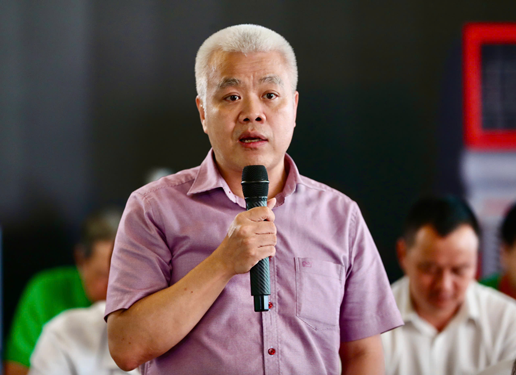
To boost consumption, one of the key factors is how the product's story is told. With coffee, the consumer experience needs to be conveyed in a compelling way. Businesses, cooperatives, and farmers are the ones who understand the product best, and therefore are the most persuasive "storytellers."
Based on this reality, I suggest that TikTok, the Nguoi Lao Dong newspaper, and related organizations could build a "coffee content club," focusing on sharing stories about coffee cultivation, processing, and enjoyment. This space could be organized on the TikTok platform with its own hashtag system, making it easy for users to search for and access information. Through this, we can gradually build trust and contribute to enhancing the image of Vietnamese coffee in the market.
Journalist - Dr. TO DINH TUAN, Editor-in-Chief of Nguoi Lao Dong Newspaper:
8 groups of solutions to promote deep processing.
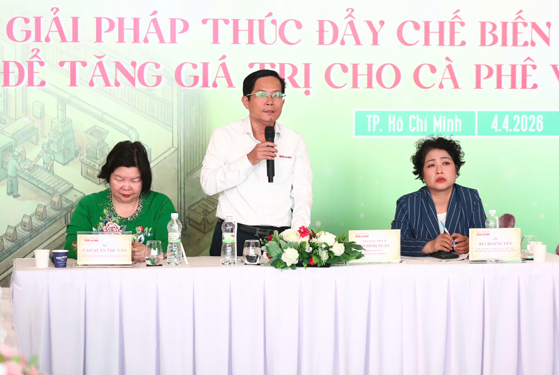
Over the past three years, the coffee industry, despite not having made significant progress in deep processing and primarily focusing on production, has more than doubled its export value. Therefore, if deep processing is effectively promoted, coffee export value in the next 3-4 years could easily reach 18-20 billion USD.
To achieve this goal, firstly, it is necessary to identify deep processing as a national strategic axis, with the participation of businesses, agencies, departments, relevant units, and even the media. Secondly, it is necessary to create a financial boost for businesses, as this is the biggest bottleneck.
Third, developing standardized raw material areas is crucial; otherwise, deep processing cannot be developed. Fourth, strengthening the attraction of foreign direct investment and technology transfer is essential. Fifth, building a Vietnamese coffee brand at the community level, alongside corporate brands, is also important. The Nguoi Lao Dong newspaper also hopes to organize a Vietnamese coffee festival abroad, with the support of the Ministry of Industry and Trade, businesses, and Vietnamese trade attachés. This is a goal that is still being pursued.
Sixth, develop specialty coffee and the premium segment. Seventh, it is necessary to strengthen participation in international trade fairs, while simultaneously developing e-commerce and international F&B (food and beverage) chains. Eighth, perfect a comprehensive policy framework, because the efforts of businesses alone are not enough.

In conjunction with the 4th Annual Vietnamese Coffee and Tea Festival - 2026 organized by Nguoi Lao Dong Newspaper at the ground floor lobby, Gigamall Shopping Center offers many exciting exploration and entertainment experiences for millions of customers in April and May this year:
• Gigamall Cherry Blossom Festival 2026 at the Pham Van Dong outdoor area from March 21st to May 3rd, 2026 : A vibrant Japanese cultural space with unique cosplay and anime festivals, food programs, shopping for Japanese and international goods, performances celebrating Japanese culture such as Yosakoi dance, Kendo and Aikido martial arts demonstrations, AI robot shows… along with a fireworks display from 7 PM every Saturday and Sunday throughout the festival season until May 3rd, 2026. Festival information: https://gigamall.com.vn/vn/khuyen-mai-su-kien/su-kien/le-hoi-hoa-anh-dao-2026-cung-duong-vang-sakura-lon-nhat-viet-nam/
• Gigaversal, a world-class multi-level entertainment technology park located at Gigamall Shopping Center on floors B1, L1, L6, L7, and L8: featuring a range of 12D+ game experiences, the surreal Fly Over The World flying technology, Infinity World, The Lost World, an international technology bowling area, and interactive multi-sensory art exhibitions such as Van Gogh and The Masters of Impressionism… with unmissable offers: buy one ticket, get one free exhibition ticket, technology game tickets starting from only 120,000 VND, free access to the AI ROBOT HUB… and many other summer promotions. See details here: https://jp-expo.com.vn/.
- Gigamall Shopping Center:
Address: 240-242 Pham Van Dong Street, Hiep Binh Ward, Ho Chi Minh City
Opening hours: Monday - Friday: 9:30 AM - 10:00 PM. Saturday, Sunday, and public holidays: 9:00 AM - 10:00 PM.
Website: https://gigamall.com.vn/
Facebook: https://www.facebook.com/@gigamallvietnam/
Tiktok: https://www.tiktok.com/@gigamallvietnam
Source: https://nld.com.vn/hien-ke-nang-tam-ca-phe-viet-196260404234833733.htm

























































































Comment (0)