Artificial intelligence (AI) is no longer a technology of the future but has become a part of the present. In just a few years, AI has been widely applied in many fields such as education, healthcare, finance, media, manufacturing, and business management.
However, alongside these enormous benefits come increasingly pressing questions related to ethics, human responsibility, labor skills in the new era, and collaboration between humans and AI.
AI is extremely complex, and misuse can lead to many negative consequences.
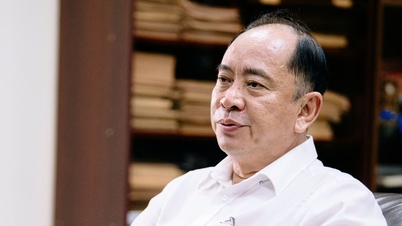
Associate Professor Trieu Van Hau, Head of the Information Systems and Business Analytics Group, Faculty of Business and Law, Deakin University (Australia), cited data from a May 2024 report surveying 11,900 people in Southeast Asian countries, including Vietnam, Thailand, the Philippines , Malaysia, and Indonesia. The results showed that 90% of students and 72% of workers use AI for generating applications. Even more noteworthy is the projected daily AI usage rate, which is expected to increase by 232% within the next five years.
According to the same report, more than 11 billion hours per week in the Asia-Pacific region are projected to be impacted by AI generation. Developing economies are leading in AI adoption, with adoption rates more than 30% higher than developed economies.
.jpg)
Using AI generation helps individuals save a day of work each week, freeing up time for learning and developing new skills. AI generation also contributes to increased job and learning satisfaction...
That's just for generative AI; if we consider all types of AI, the number would be much higher. "What are the risks of AI, and what are the most important factors for humanity in the AI era?" asked Associate Professor Trieu Van Hau.
Professor Tran The Truyen, Head of the AI, Health and Science Department at the Institute of Applied Artificial Intelligence, Deakin University (Australia), believes that there are many types of AI, which means many different risks. However, the most obvious risk is that AI does not reflect the truth but only represents it, a phenomenon known as an illusion.
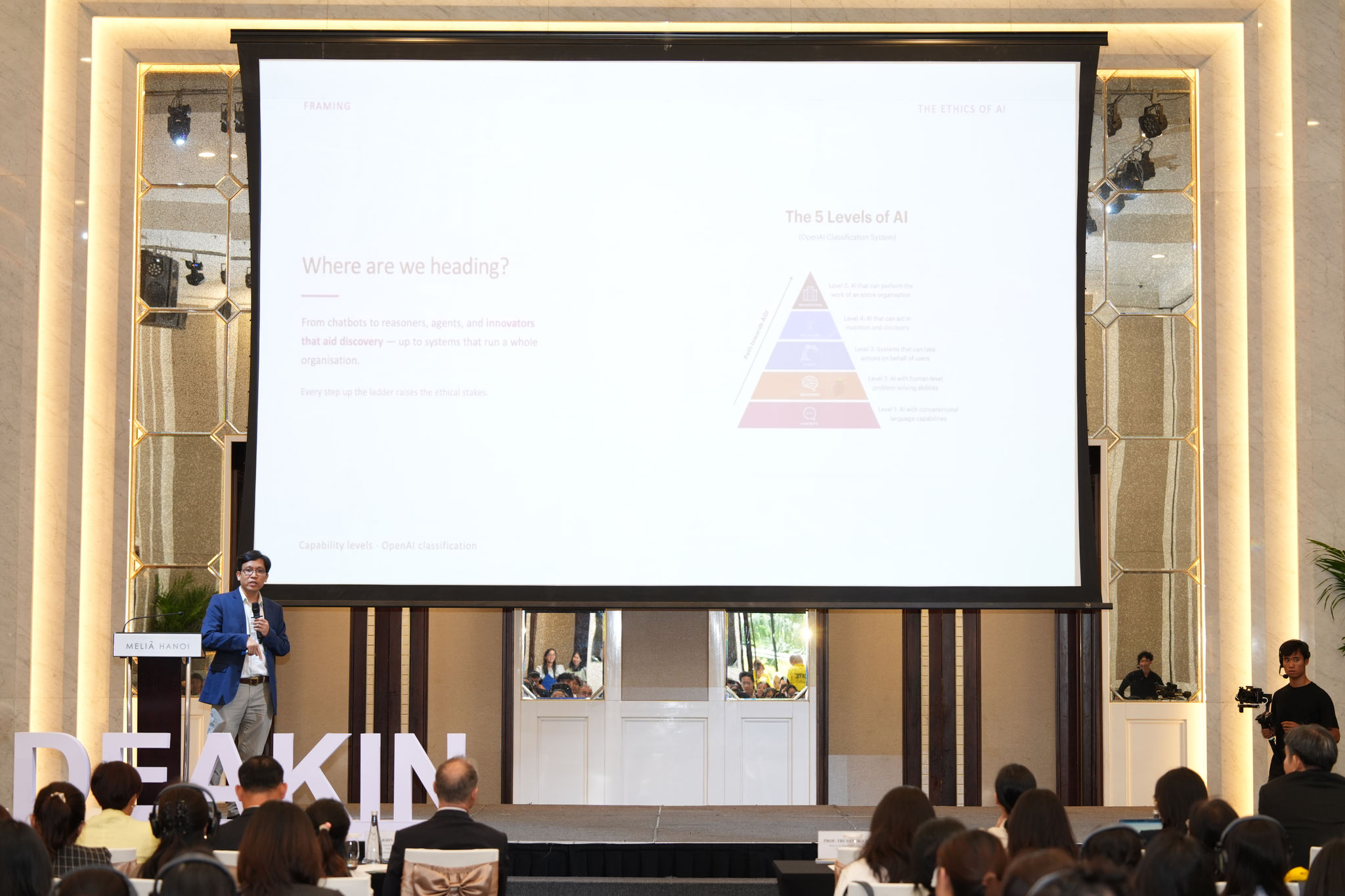


ChatGPT, for example, is a tool that mimics human writing style, not actually understanding what it's saying, but speaking as if it were real. "I think the biggest risk now is that we don't know the truth, and our over-reliance on AI gives us the illusion that we know everything," said Professor Tran The Truyen.
According to Professor Huynh Thi Thanh Binh, Vice Rector of the School of Information Technology and Communications, Hanoi University of Science and Technology, the current issue is how to make AI provide more support to us. "But more support doesn't mean AI can do everything for us without risk."
Professor Huynh Thi Thanh Binh gave an example: nowadays, people often use AI to synthesize and analyze data, but if the input data is even slightly inaccurate, it will lead to incorrect results. In this case, who will be held responsible? Similarly, banks use chatbots to answer customer inquiries 24/7; if the chatbot gives incorrect answers, who will be held responsible?
AI is an extremely complex system, with trillions of parameters that humans cannot fully control. Therefore, "improper use can lead to many negative consequences," emphasized Dr. Vu Tat Thanh, from the Systems and Computer Networks Engineering Group, Faculty of Information Technology, Hanoi University of Civil Engineering.
How to survive in the age of AI?
Experts agree that AI cannot replace humans, but is merely a tool to support and improve work efficiency.
Universities are changing their teaching and student assessment methods to adapt to the new context. Students are guided to apply AI effectively while still understanding the core issues and being able to draw conclusions. Student assessment is not based on final results but on the entire process, with multiple metrics to measure how well students understand the subject matter.
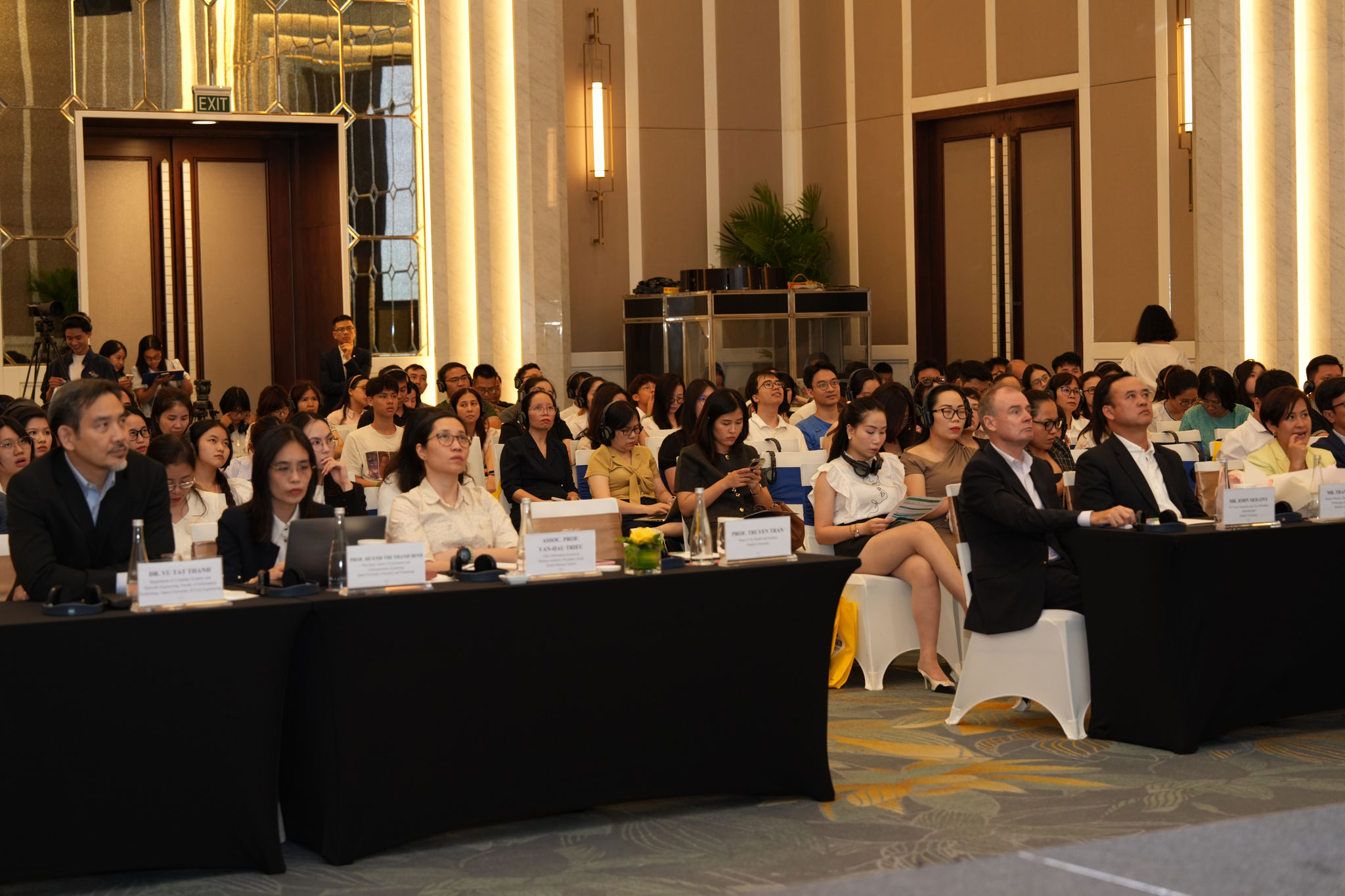
"Applications of AI can help us learn better and understand more things, but we must have the basic skills to avoid being misled by AI," said Dr. Vu Tat Thanh. "There are many things AI cannot match humans in, such as logical thinking, emotions, and ethics. But there are also many things humans cannot match AI in, such as big data. Therefore, we need to leverage the strengths of each side."
Besides critical thinking and decision-making skills, one of the most important skills in the AI era, according to Professor Tran The Truyen, is the ability to adapt to change. Every day brings new things, even completely changing the way we approach problems; if we cannot adapt, we will be immediately left out of the game.



"AI is machine learning. And just like machines learn, humans must also learn, and learn continuously," Associate Professor Trieu Van Hau concluded.
The scientific conference themed "AI - Understanding to Partner," part of the Deakin Thought Leadership series, brings together experts, researchers, education leaders, business representatives, students, and the community interested in AI to discuss the opportunities, challenges, and future development directions of AI.
With the overarching theme of "AI - Human Collaboration," this year's conference aims to foster multi-faceted dialogues on how humans can effectively, responsibly, and sustainably leverage AI. The program not only focuses on the latest technological trends but also emphasizes the role of education in preparing human resources for the AI era.
According to representatives from Deakin University (Australia), organizing the conference in Hanoi not only aims to share knowledge and connect academically, but also demonstrates the university's commitment to supporting the education community, businesses, and the younger generation in Vietnam in the face of the profound changes brought about by AI.
Source: https://daibieunhandan.vn/hieu-ai-de-dong-hanh-and-tien-xa-10422452.html