

Throughout the history of poetry, there has been a phenomenon of alternating between long and short poems. In medieval Vietnam, long poetic forms such as narrative poems, lyrical poems, spoken songs, and ballads coexisted simultaneously with short forms like Tang Dynasty regulated verse; the shortest of which were the seven-syllable and five-syllable quatrains. In modern times, to break free from the condensation and rigidity of Tang Dynasty regulated verse, New Poetry poets introduced prose elements to poetry to break the symmetrical syntax, thus creating long, flowing verses or connecting four-line stanzas into a poem that, theoretically, could be infinitely long. During the resistance wars against France and the United States, poetry was epicized, paving the way for the emergence of epic poems and narrative poems. Afterward, free verse overcame social stigmas to rise to prominence. Currently, once long poetry reaches its peak, a trend towards short poetry is emerging to create a balance between long and short forms, or to transform long poetry into short poetry.
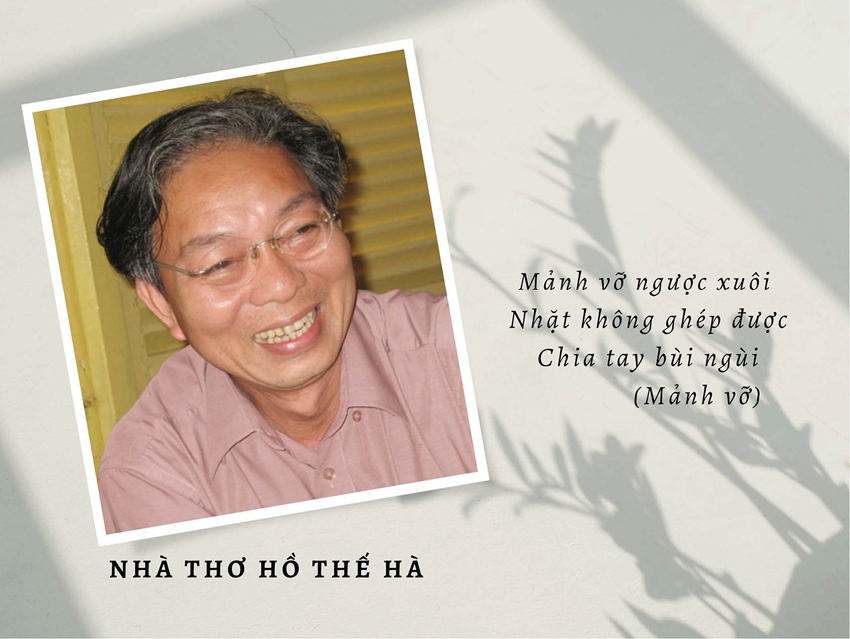 |
The first to experiment with short, or rather ultra-short, poetry was Doan Van Chuc: one-word poems (for example, the poem's title is "Husband and Wife," the content is "Finished," a commentary on Tran Dan's poem: "That tangled mess is finally finished!"). Tran Dan wrote mini-poems, meaning one-line poems (for example: "Rain falls, no translation needed"). Le Dat wrote Haiku poems reminiscent of Japanese haiku. After wielding his pen and writing extensively throughout the land, Mai Van Phan retreated to Hai Coc to write three-line poems. His collection "Tha" contains several hundred three-line poems. Recently, Tran Quang Quy has a collection of namkau poems… Following this trend, Ho The Ha published a collection of short poems in 2015, "Silk Mist," and this year, 2024, "Deep Far Away."
Hồ Thế Hà's collection of poems comprises 160 three-line poems, occasionally including four-line poems, two-line poems, and four beautiful supplementary works by Nguyễn Phước Hải Trung. The poet acknowledges that writing short poems is to "express the sad and joyful realities of life and the gratitude surrounding my life. I try to structure and compress my emotions and thoughts about each issue and subject into stanzas of 2, 3, or 4 lines, mainly three short lines, sometimes cut from a single line into a group of 2, 3, or 4 words." The poet adheres to this structure throughout the entire collection.
Uncontrollable joy
Sadness follows.
Poetry cubes life.
(Quietly)
Continuing the unique poetic thinking of Tơ Sương, in this collection, Thẳm Xa, Hồ Thế Hà attempts to develop poetic artistic thinking in a more novel way. Previously, people often separated content and form, considering form as the shell containing content, dependent on content, and therefore less important than content. As a result, poetry fell into a state of artistic decline. Today, it is recognized that content and form are unified and inseparable. To clarify this, content is divided into content of content and content of form; form is divided into form of form and form of content. Content of content is essentially just material, form of form is just material. These two have no artistic value. Only the content of form and the form of content are true art. In poetry, form and content are words and meaning; words give rise to meaning. Aware of this, Ho The Ha's short poems have elevated his poetic artistic thinking to a new level:
I wake up early every day.
Poetry and I call upon words
Words create meaning
(Verse)
When existentialist language and thought
The four-line poem is gradually being set aside in the house of the soul.
All signals have been detected!
(Four poems)
Short poems have few words, and with few words, how can one create many reflections of those words? In "Deep Distance," Ho The Ha wanted each word to simultaneously emit many reflections. He arranged them so that around each word there were many mirrors – other words, like many projections in a house of countless mirrors. This is the construction of poetic imagery and symbols to convey meaning with few words, even meaning beyond words, meaning without words. These are symbols with philosophical and philosophical significance. Let me cite a few poems to illustrate Ho The Ha's approach to short poetry:
The fragments are scattered in all directions.
Picking them up doesn't work.
A bittersweet farewell.
(Fragments)
Far away in space
Far away in time
Deep in the distance, we came together to knock on the door.
(Far away)
Ho The Ha is a multi-talented individual. He is a passionate educator, an enthusiastic literary critic, and a gifted poet. Regarding poetry alone, Ho The Ha has published eight volumes to date. His poetic journey has progressed from long poems to short ones, becoming increasingly minimalist. Hopefully, one day he will write one-word poems (monomot). Each poem would be just a single letter, a letter – an atom, containing the explosive energy of a Big Bang.
Source: https://baothuathienhue.vn/van-hoa-nghe-thuat/ho-the-ha-duong-tho-toi-gian-147347.html
![[Photo] Opening of the Second Conference of the Central Committee of the 14th Party Congress](https://vphoto.vietnam.vn/thumb/1200x675/vietnam/resource/IMAGE/2026/03/23/1774233781483_anh-1-bnd-4146-7258-jpg.webp)












































Comment (0)