

07:08, 08/11/2023
Livelihood support is considered an effective solution towards achieving sustainable poverty reduction. Through the implementation of programs and policies supporting production and business development, and building livelihood models, it has contributed to creating jobs, helping the poor increase their income, and improving their quality of life.
"Expanding" access to preferential capital
Year after year, working the land under the scorching sun, poverty continued to plague the family of Mr. Nguyen Xuan Hoang (residential group 7, Krong Kmar town, Krong Bong district). Concerned about finding a way to develop his economy , in 2019, he joined a savings and loan group in his residential area and was guided to borrow 50 million VND from the District Social Policy Bank. With this capital, Mr. Hoang built barns for raising cattle and wild boars, and converted his less productive crop land to growing grass for animal feed. After three years, the livestock farming model has proven effective, generating an income of over 150 million VND per year.
Like Mr. Hoang, tens of thousands of poor and near-poor households and other policy beneficiaries have been given access to preferential loans over the past period. According to statistics from the Dak Lak Social Policy Bank, the bank's capital has now covered all 184 communes, wards, and towns in 15 districts, towns, and cities. Many credit loan programs have been implemented promptly, such as loans for poor and near-poor households, households engaged in production and business in difficult areas, loans for job creation, clean water and rural sanitation, and loans for labor export… helping people improve their lives and rise out of poverty sustainably.
 |
| The family of Ms. Nguyen Thi Tin (Hoa Le commune, Krong Bong district) received preferential loans from the Social Policy Bank to invest in livestock farming. |
Along with the effective use of preferential loan capital for economic development, many new livelihood models with small capital are being implemented. One example is the "WeHome Café" business model – a simple, convenient business that doesn't require a large space, implemented by the Buon Ma Thuot City Women's Union in collaboration with TNI King Coffee Company for disadvantaged and unemployed women members. The women receive WeHome Café carts and coffee brewing equipment, as well as training in business knowledge, financial management, beverage preparation, and the use of ePOS software integrated into the King Coffee Super App… to operate the model effectively. In phase 1, 10 women in the city received carts and are operating the model, combining it with online sales through delivery, initially generating daily income.
Integrating with the collective economic model
To achieve sustainable poverty reduction, in addition to selecting investments in smart and appropriate livelihood models, the development of collective economic organizations and cooperatives is considered a crucial solution in poverty alleviation, especially in ethnic minority and mountainous areas.
With its flexible production and business practices, the Ea Súp Poverty Reduction Cooperative has successfully brought together many farmers to participate in agricultural production development. Established in 2019 with the aim of continuing the activities already carried out in the Central Highlands Regional Poverty Reduction Project, the cooperative has proactively linked with rice-growing farmers in Ea Súp district to maintain effective livelihoods; guided farmers in establishing raw material (rice) production cooperatives and agricultural service cooperatives; provided guidance on cultivation techniques, seed investment, finding markets for product consumption, managing and supervising the production and harvesting process to ensure quality... The cooperative has also formed production and consumption chains for high-quality Ea Súp rice, actively developing specialized processed rice products; and simultaneously creating stable outlets for its members and farmers producing within the chain.
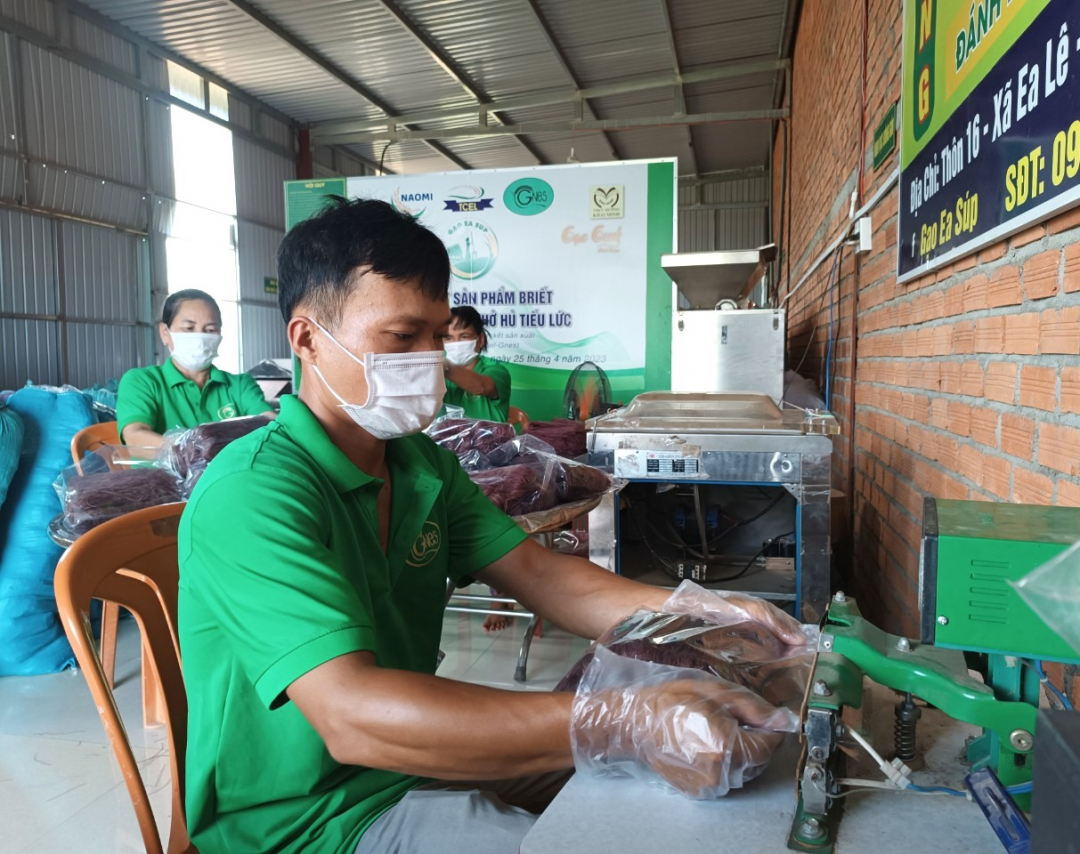 |
| The Ea Súp Poverty Reduction Cooperative's specialized rice processing production facility is located in Ea Lê commune (Ea Súp district). |
According to Nguyen Viet Duc, Director of the Ea Sup Poverty Reduction Cooperative, the cooperative is currently collaborating with 79 households (in the communes of Ya To Mot, Ea Le, and Ia Lop) on a total area of over 141 hectares. This collaboration aims to develop a green agricultural system in harmony with nature and unite farmers in achieving sustainable poverty reduction and wealth creation. While facing numerous challenges, particularly regarding working capital and limited machinery and equipment, the cooperative has contributed to job creation, increased income for its members, and improved living standards. Currently, the average monthly income of its members and affiliated farmers is over 4 million VND.
The Tơng Bông Brocade Weaving Cooperative (Ea Kao commune, Buon Ma Thuot city) has overcome numerous difficulties and gradually established its position, creating stable jobs for many Ede ethnic women. From 10 members at its inception, the cooperative now has 45 members with incomes ranging from 3 to 5 million VND per month. Not only has it preserved the traditional brocade weaving craft of the ethnic group, but by leveraging local advantages, the cooperative has also boldly invested in building a community tourism area and establishing free-range chicken and pig farms. Through this, it has developed an economy linked to community-based ecotourism, helping women escape poverty and stabilize their lives.
Mysterious
Source

































































Comment (0)