

Nguyen Xuan Hoang is a prominent figure among the contemporary artists of the 8X generation. In the exhibition "Bright Life in the Dharma" recently held in Hanoi , the artist Nguyen Xuan Hoang presented new works depicting the image of Buddha, based on the principle of "reverse perspective," a principle that has guided him throughout his long artistic journey.

That's also how he gradually explores the depths of his own consciousness. There are no limits or stopping points in this journey of discovery. The soul or mystical phenomena are expressions of the harmony between humans and nature, the universe...
The artist Nguyen Xuan Hoang's journey into Buddhism began with his mother. As a child, Hoang often went to temples with his mother and enjoyed admiring the Buddha statues. As he grew older, he read books on Buddhism, and in his free time, he enjoyed learning about other esoteric schools of thought, reading whatever he came across. He learned quite a lot but also forgot things quickly, forming general perceptions in his mind. From these perceptions, he began to deduce, practice, and experience things in a way that he felt was appropriate to his current level of understanding.
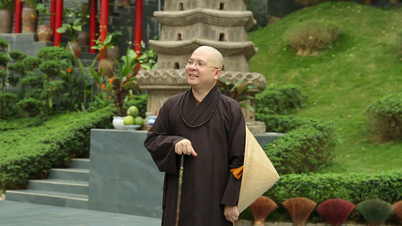
Artist Nguyen Xuan Hoang chose the path of Buddhism through practice.
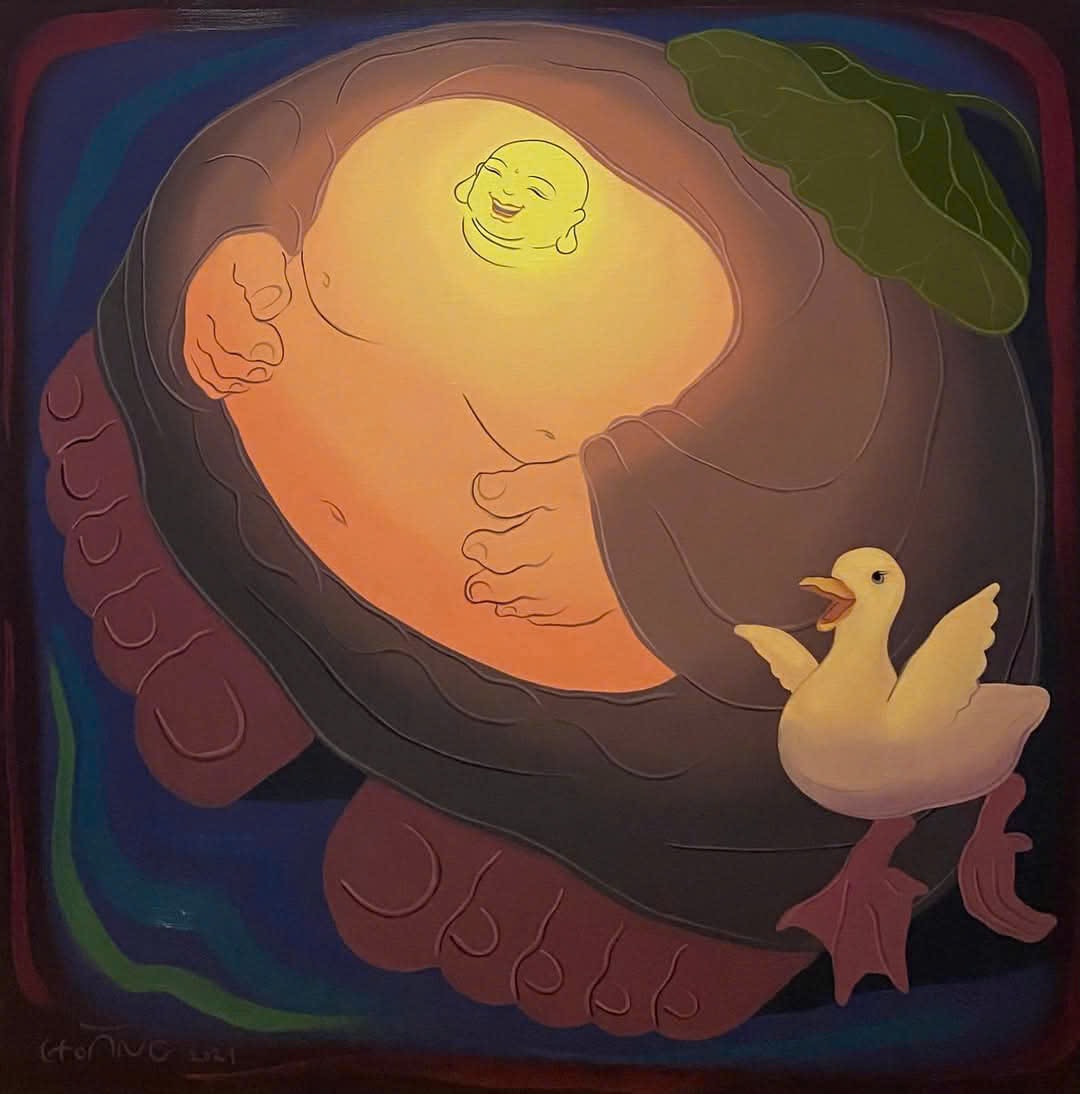
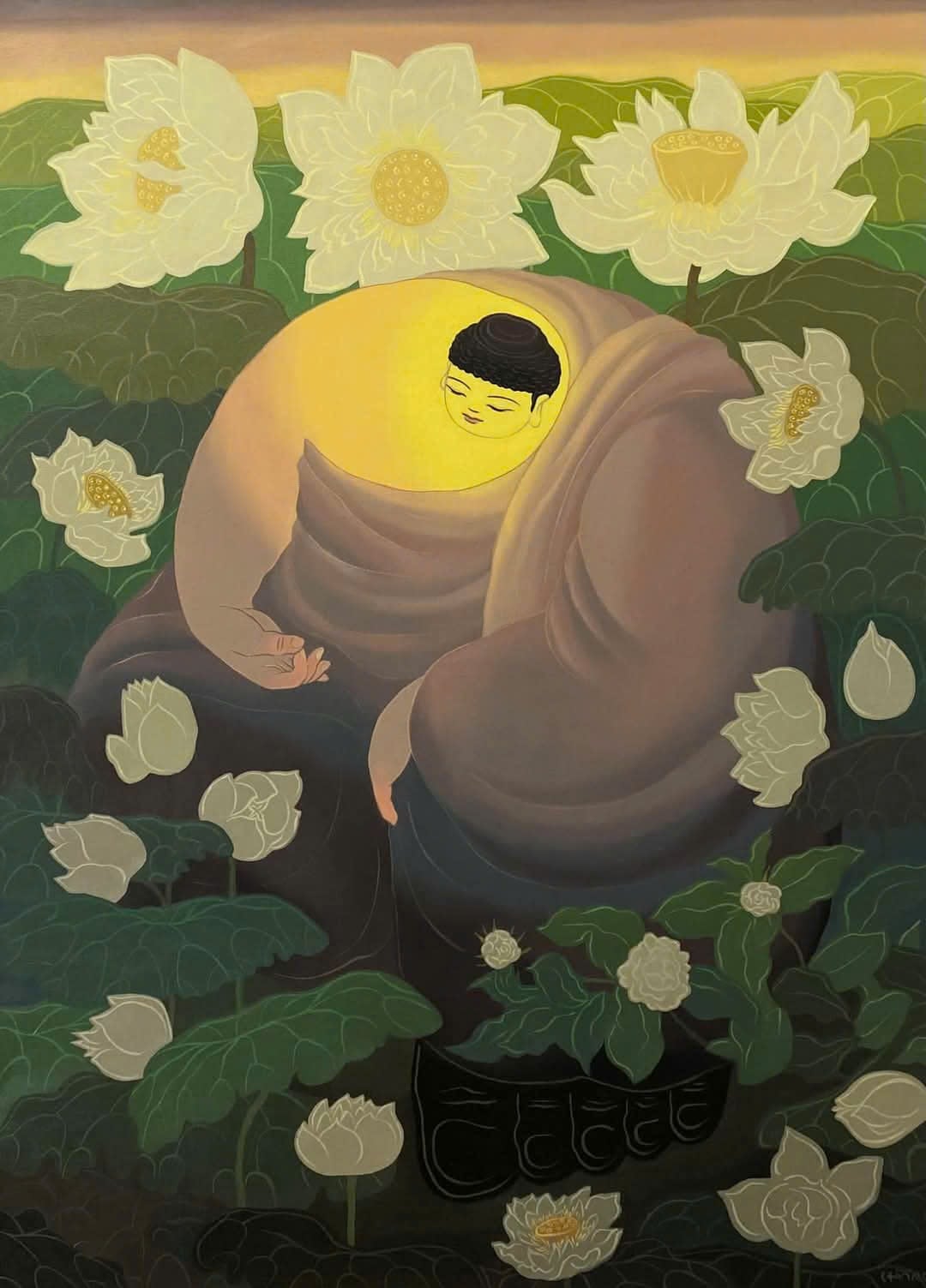
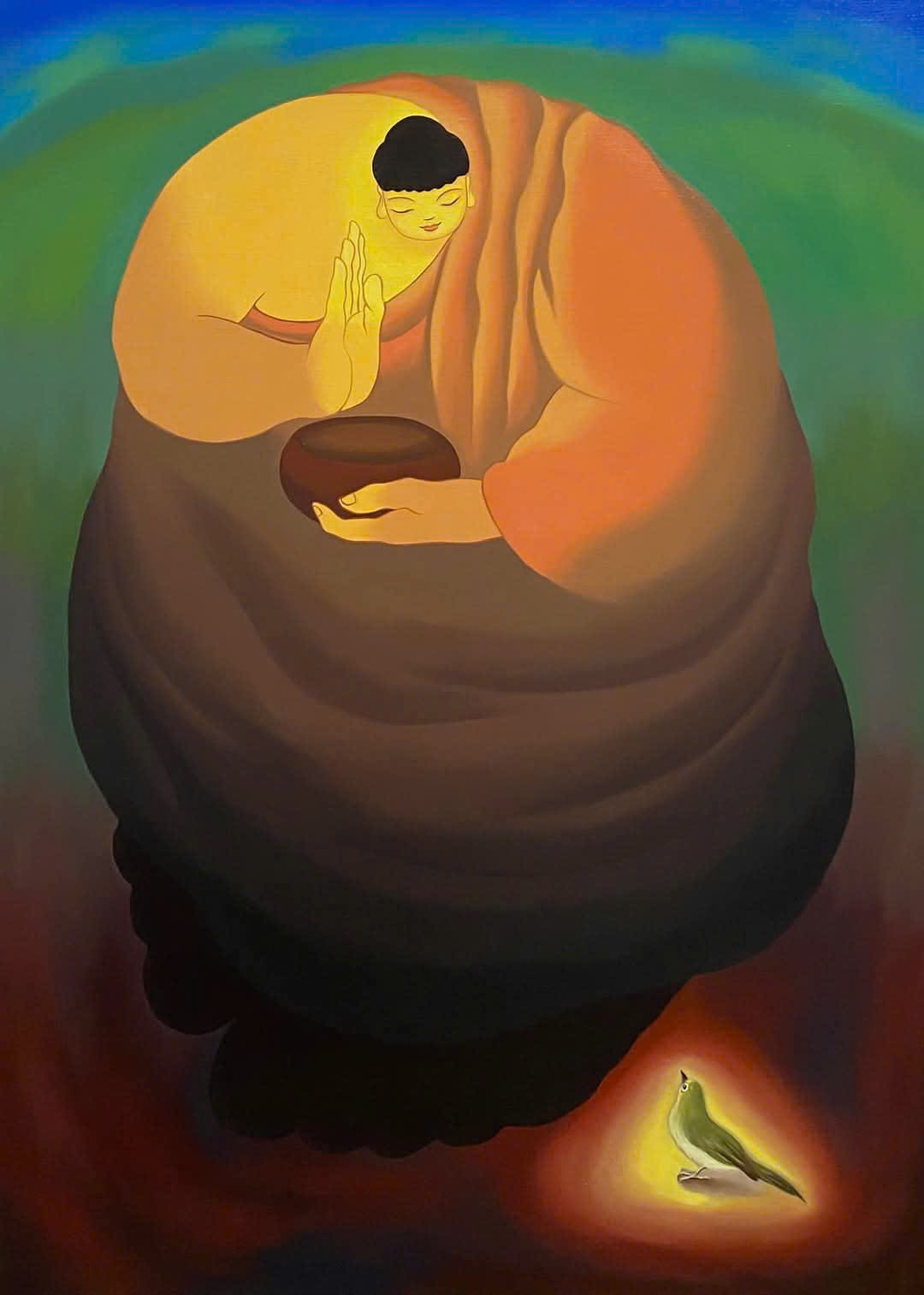
"It was quite chaotic at the beginning," Hoang recalled with a laugh. "Because I'm naturally curious and like to explore, I read a lot and tried practicing many different methods, learning about them and putting them into practice. Inside, I was full of illusions, just like other beginners, my nerves were on edge to all sorts of extremes."
Artist Nguyen Xuan Hoang shared that he hasn't actually practiced at any temple; everything he's learned is through online lectures. However, he believes that after all the practice and extensive, albeit not profound, understanding he gained beforehand, he can recognize a true Buddha. Mistakes are common, but diligent practice leads to fewer mistakes. That's what spiritual practice is like. Not everyone is lucky enough to meet a good teacher from the start; depending on each person's aptitude and karma, they will find a suitable teacher. Understanding also changes with each stage, just like the journey of creating art. Life is full of challenges that each person needs to overcome; no two people are alike. The important thing is to believe that each experience adds flavor to life, and whether one can always maintain a kind heart.
For Nguyen Xuan Hoang, the transformation of his mindset happened gradually over time. He wasn't in a hurry to see anything concrete, much like in painting; Hoang proceeded slowly, step by step, letting things unfold naturally. Gradually, he realized he was beginning to control his own mind better, no longer wanting to control others as much as before. He accepted and let go of what didn't belong to him, without interfering too deeply. He viewed all the right and wrong, good and bad events as a means to reflect on how his mind reacted to them. He experienced less anxiety, fear, and attachment than before.
From this shift in perspective, artist Nguyen Xuan Hoang paints completely new and different Buddhist paintings. “Perhaps the difference came to me naturally, rather than me setting any overly specific criteria,” Hoang confided. “Initially, I just thought: the path of enlightenment is the opposite; life is about desires, wants, and pursuits, while the path of enlightenment is about detachment, letting go, and relinquishing. The idea of the ‘reverse perspective’ painting style that I researched before was also a way of looking at things differently from the conventional perspective, so I thought, why not paint Buddhist paintings using that method? Thus, the ‘Buddha – Reverse Perspective’ painting style was born.”
Because the perspective is reversed, Nguyễn Xuân Hoàng's paintings depict the Buddha with enormous hands and feet, the viewpoint shifting from the top of the conical hat to the bottom. He resembles a pyramid – representing unwavering stability and steadfastness on the path of spiritual practice. Or a spiral – the principle of absolute harmony in nature, or an ancient tree with roots deeply embedded in the earth; a large trunk allows branches and leaves to grow tall and wide. Sometimes, truth is an image, and you must deduce it yourself through your own understanding and feelings.
“My observations of nature, based on the principle of ‘reverse perspective,’ have aligned with the image of the Buddha,” Hoang expressed. “It’s also a way to gradually explore the depths of my own consciousness, much like my exploration of nature. The more I delve into it and yearn to understand, the more I perceive its infinity. There are no limits or stopping points in this journey of discovery. The soul or mystical phenomena are, in fact, merely expressions of harmony between humanity, nature, and the universe. For me, the essence of Buddhism, in my opinion, is: a kind heart. Not to become some kind of spiritual being. The kinder you are, the clearer you see the unwholesome within yourself. ‘Light doesn’t accidentally shine into your house; it’s because you opened the door to welcome it.’”
The human soul, like a part of nature, contains infinite mysteries.
As Picasso famously said about painting: "Every child is a genius at painting, but the important thing is whether they retain that genius as they grow up."
And I've come to realize the same thing on my spiritual path: "Everyone is a Buddha when they are young or when they first begin practicing, but whether they can maintain that Buddhahood as they grow older is another matter entirely!" It can be said that Buddhism is the teachings of the Buddha on the path to enlightenment. That is a given; no one can deny it. Buddhism is a path of practice and mental training. A clear mind leads to clear wisdom, and vice versa.
According to artist Nguyen Xuan Hoang, "Morality - Concentration - Wisdom" is the journey of spiritual practice, like an artist painting a picture: Morality (diligence, perseverance in practice, cultivation of knowledge, morality, honesty), Concentration (achieving high sensitivity and subtlety, balancing colors and forms, reaching and stopping sensations at the right time). Wisdom (perhaps the understanding of impermanence - non-self, the immutability of time and all things). And for artist Nguyen Xuan Hoang: The Buddha "stopped" everything, while we, for some reason, keep going on and on, vaguely aware of the future in our own way, because of karma and cause and effect.
Drawing from his reflections and experiences in practicing the Buddha's teachings, artist Nguyen Xuan Hoang creates paintings of the Buddha in his own unique way. He hopes that the development of Buddhism will focus more on quality than quantity, on inner spirituality and self-discovery, rather than on material possessions and outward appearances… He hopes that everyone will live according to the ethical principles of humanity and the law of karma as taught by the Buddha.
Source: https://daidoanket.vn/hoa-si-nguyen-xuan-hoang-nguoi-say-me-ve-tranh-phat-10297122.html





















































Comment (0)