

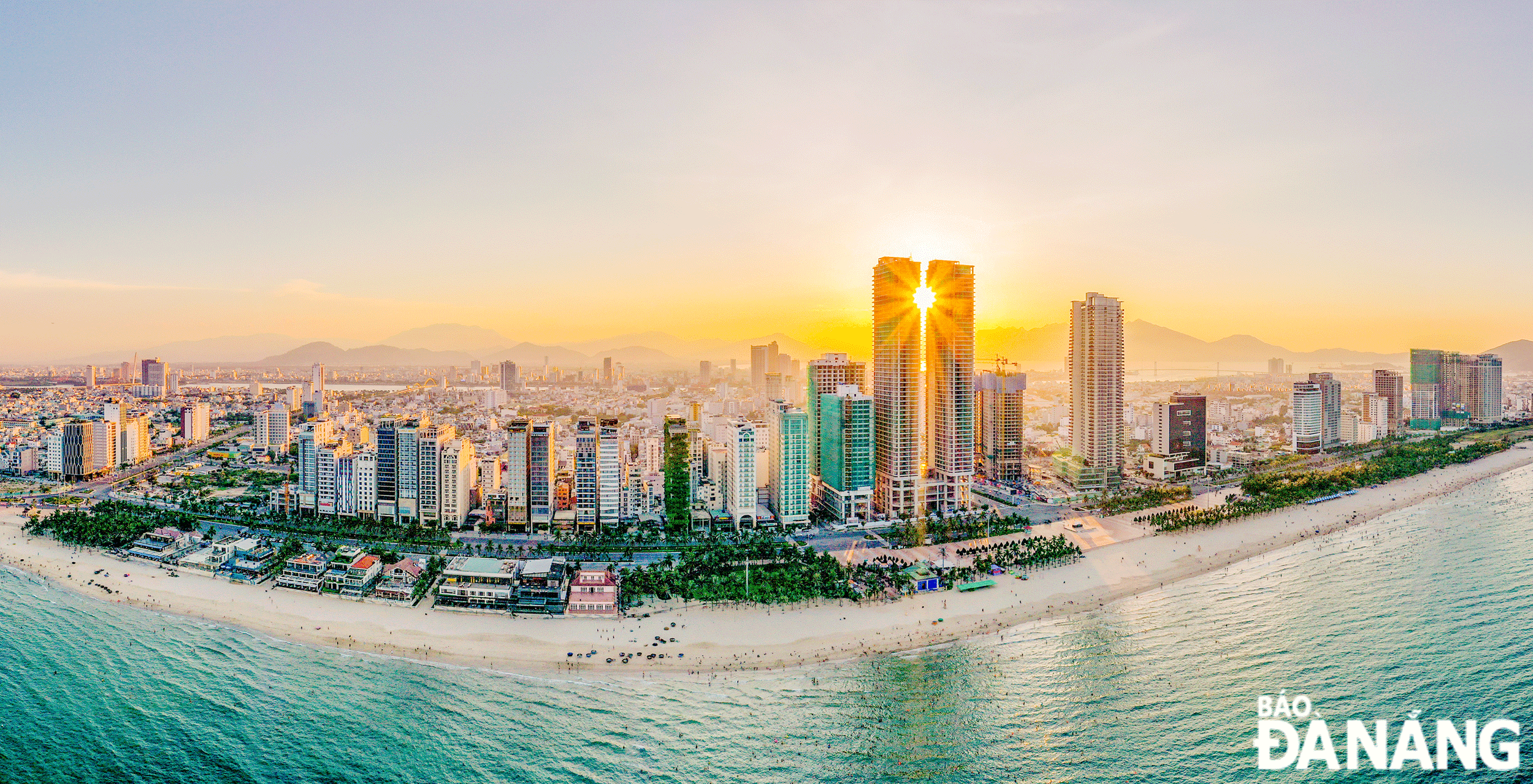
Because, in an era where climate change, ecosystem degradation, and urbanization pressures are increasing, land reclamation is no longer just a story of construction, but a story of awareness. It raises a much bigger question: do humans have the wisdom not only to "reclaim from the sea," but also to "live with the sea" in a harmonious, sustainable, and responsible way?
Institutional test
Entering the 21st century, the sea is no longer an object to be conquered, but a complex ecosystem that needs to be understood, respected, and integrated into urban structures. Humans do not stand outside of nature to control it, but become a part of nature, moving and adapting together.
Therefore, urban land reclamation is essentially a test of institutional capacity. A land reclamation project may be implemented using the most modern technologies and enormous financial resources, but without a sufficiently strong, flexible, and long-term institutional foundation, the risk of failure always exists. Institutional capacity here refers not only to legal regulations, but also to the organizational, coordination, and decision-making capabilities within a complex, multi-sectoral, and multi-level system.
In traditional governance models, projects are often implemented in a fragmented manner: planning goes one way, construction another, environmental processing follows, and data is disjointed. This approach may be suitable for single projects, but its limitations become apparent when faced with highly complex systems such as urban reclamation projects. In such systems, every spatial decision has environmental consequences; every technical intervention affects the ecosystem; and every small change can create long-term ripple effects.
Therefore, urban development on reclaimed land requires a new institutional model, where governance is based on an integrated ecosystem. Planning is not just about drawing out space, but about designing the interactions between systems. Management is not just about monitoring the current situation, but about forecasting and adjusting for the future.
More importantly, decisions are no longer based on intuition or isolated experience, but must be verified beforehand by data, simulations, and analysis. Here, science and technology play a fundamental role. Advances in hydrology, oceanography, geology, and climate research help people better understand the natural laws of the sea.
Meanwhile, digital technology enables the construction of urban simulation models, where development scenarios can be tested before becoming reality. Instead of "build first, then deal," the new approach is "simulate first, decide later." This is not just a change in tools, but a change in way of thinking.
Measures of growth mindset
From a planning perspective, urban development on land reclamation also requires a fundamental shift. Planning cannot continue to be a static, fixed blueprint for decades, but must become a dynamic process capable of adapting to the continuous changes in the environment and society.
Coastal urban spaces cannot be designed as concrete blocks, but rather as flexible structures capable of "breathing" with the sea, where the water can rise and fall, where the ecosystem can recover, and where humans and nature can coexist.
In this context, the value of land reclamation urbanization also needs to be re-evaluated. If the focus is solely on creating new land for real estate development, the value achieved will be short-term and easily fall into a cycle of speculation. However, if land reclamation urbanization is considered the foundation for developing a modern marine economic ecosystem, encompassing logistics, services, innovation, high technology, etc., then the value created will be more long-term and sustainable. In that case, land is no longer the goal, but merely a means; the true value lies in the ecosystem operating on that land.
However, alongside opportunities, significant risks always exist. Land reclamation, if not carefully planned, can disrupt the ecological balance, increase erosion, alter water flow, and even cause irreversible consequences in the future. Lessons from around the world show that the cost of "correcting mistakes" is often far greater than the cost of "doing it right from the start." Therefore, urban land reclamation is not just a technical or economic problem, but also an ethical issue of development, where every decision today will affect many generations to come.
Placed within the context of Vietnam, and specifically Da Nang, the story of urban land reclamation takes on special significance. It's not only an opportunity to expand urban space, but also a chance to experiment with a new development model where institutions, planning, and technology are integrated into a unified system. If successful, Da Nang could become a model for other coastal cities. But if it fails, the consequences will extend far beyond the local area.
Therefore, what is needed is not to chase scale or speed, but to build a sufficiently solid foundation for long-term growth. This requires a flexible yet robust institutional framework, a comprehensive and interconnected data system, an effective coordination mechanism among stakeholders, and a vision long enough to transcend short-term interests.
Looking back at the whole story, it's clear that urban reclamation is not simply about "creating land from water," but rather a process of "redefining how people exist in a new space." The measure of success for an urban reclamation project doesn't lie in the area of land created or the number of buildings constructed, but in something far more subtle: whether, ultimately, people live better, nature is better protected, and the relationship between the two sides becomes more harmonious.
Source: https://baodanang.vn/do-thi-lan-bien-suy-tu-va-ky-vong-3331059.html
![[Photo] Prime Minister Pham Minh Chinh receives the Chinese Ambassador to Vietnam](https://vphoto.vietnam.vn/thumb/1200x675/vietnam/resource/IMAGE/2026/04/05/1775397481797_ndo_br_dsc-5512-jpg.webp)
























































































Comment (0)