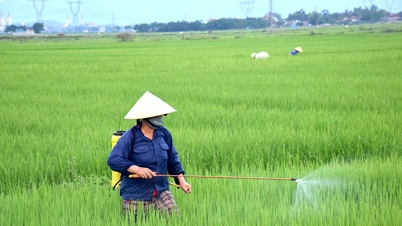
To prevent farmland from being left fallow, many farmers in Thanh Hoa City have taken the initiative to collect, lease, and invest in concentrated production, bringing high economic efficiency.
 Mr. Nguyen Huu Sinh, Director of the Long Anh Ward Agricultural Production and Service Cooperative (on the left), discusses rice cultivation techniques with Mr. Le Van Tuan, Quan Noi 1 Street.
Long Anh Ward ( Thanh Hoa City) is one of the localities with a large area of abandoned farmland, exceeding 100 hectares. The reasons farmers are abandoning their fields are low income from agriculture, local children choosing to work in factories, and people switching to service industries and trading.
Mr. Nguyen Huu Sinh, Director of the Long Anh Ward Agricultural Production and Service Cooperative, said: "Cultivating one sao (approximately 1000 square meters) of rice until harvest takes about 3 months. Farmers have to spend a lot of money on land preparation, planting and harvesting labor, seeds, pesticides, fertilizers, and other agricultural contributions. If the rice crop is good, farmers make a profit, but if there is a crop failure or the price of rice is low, farmers almost certainly suffer losses."


Meanwhile, working as a factory worker in the Hoang Long Industrial Zone earns a month's salary equivalent to the income from an entire rice harvest. Compared to that, it's easy to understand why farmers in the area are abandoning their fields.
However, that doesn't mean farming is unprofitable. According to Mr. Sinh, if farmers know how to consolidate land, produce in a concentrated manner, and increase crop yields, agriculture can still be a high-value sector. A typical example is Mr. Le Van Tuan, in Quan Noi 1 Street. In addition to contracting 18 hectares from the local government, he also took on an additional 2 hectares of abandoned land from families in the neighborhood to improve and cultivate; on average, Mr. Tuan earns hundreds of millions of dong annually.
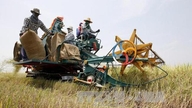
Originally a farmer, after many years working away from home, Mr. Tuan returned to his hometown and saw the fertile fields lying fallow. He approached the local authorities to lease the 18 hectares of land. To develop concentrated production into a large-scale model farm, Mr. Tuan partnered with a production group from Thua Thien Hue province. Depending on the time of year, this production group would bring in equipment and machinery to assist with plowing, sowing, spraying pesticides by drone, and harvesting.
Besides Mr. Tuan's case, Mr. Sinh also stated that in the ward, there are more than 30 cases of people leasing or contracting out abandoned rice fields, totaling over 140 hectares, for production investment. In particular, the concentrated rice production model has proven its advantages over traditional farming methods. Specifically, the investment cost per sao (approximately 1000 square meters) of rice cultivation is reduced by 15% when implementing concentrated production, and the economic efficiency is about 25% higher compared to small-scale, fragmented production.
According to Mr. Sinh, the Thanh Hoa Provincial People's Committee recently directed the Thanh Hoa City People's Committee to reorganize agricultural production on the land within the planned Hoang Long Industrial Park expansion area in Long Anh ward. Following the announcement, the local authorities have successfully rehabilitated and re-cultivated 40 hectares. Regarding the remaining un-rehabilitated land, although the Long Anh Ward Agricultural Production Service Cooperative wants to reclaim it, they face numerous difficulties. This land has been uncultivated for a long time, is barren, and rehabilitation requires significant costs. Furthermore, the irrigation canal system and internal road network are severely degraded, making irrigation difficult.


Mr. Luong Ba Nam, a land and construction official at the Long Anh Ward People's Committee, added: The increase in rice cultivation area in the ward in 2024 is partly due to the high market price of rice, leading people to switch from less efficient crops to rice cultivation. In addition, agricultural land previously reclaimed for industrial projects is now being allocated to the locality for re-production. To improve the efficiency of agricultural production, especially for long-abandoned land, the local government will encourage individuals and collectives to lease, contract, and cultivate the land in a concentrated manner. They will also plan to reinvest in the irrigation canal system and internal field transportation to meet production needs.
Text and photos: Dinh Giang
Source: https://baothanhhoa.vn/hoi-sinh-dat-chet-223367.htm