

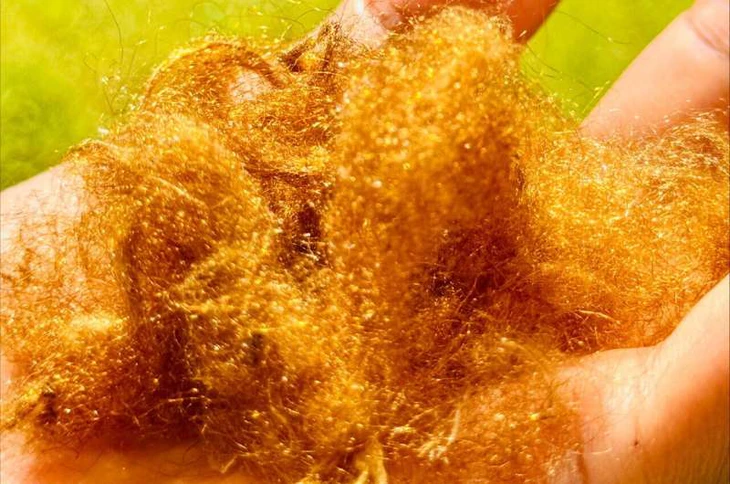
"Sea silk," a type of silk once used by the aristocracy, is woven from the "silk threads" of scallops - Photo: Giulio Gigante
A research team led by Professor Dong Soo Hwang and Professor Jimin Choi (Pohang University of Science and Technology - POSTECH) has created a gold fiber similar to the type that appeared 2,000 years ago, using scallops (Atrina pectinata) cultivated in the coastal waters of South Korea.
This groundbreaking result not only restores the legendary "sea silk," but also reveals the scientific basis behind its unchanging golden color. The research was recently published in the journal Advanced Materials.
Sea silk: the shimmering golden threads of the ocean.
Sea silk, or "golden silk of the sea," was one of the most precious materials in ancient Rome, reserved only for the highest echelons of power such as emperors and popes. This special fiber was made from byssus, silken threads secreted by the giant clam Pinna nobilis (which lives in the Mediterranean) to cling to rocks.
Thanks to its unfading golden sheen, lightweight nature, and exceptional durability, sea silk is known as "legendary silk." A famous example is the Saint Manoppello veil in Italy, believed to have been woven from sea silk and preserved for centuries.
However, due to marine pollution and ecosystem degradation, Pinna nobilis is now listed as endangered, and its harvesting is completely banned by the European Union. Sea silk has therefore become a relic of the past, only being hand-woven in extremely small quantities by a few artisans.
From scallops to legendary silk regeneration technology
POSTECH has focused its research on the clam Atrina pectinata, a species native to the Korean Sea that is farmed for food. Like Pinna nobilis, the clam secretes byssus fibers to attach itself to rocks. Analysis showed that the physical structure and chemical composition of these byssus fibers are almost identical to those of the Mediterranean species, allowing the research team to successfully recreate sea silk.
The remarkable aspect is that the research has unraveled the mystery of the long-lasting golden hue of sea silk. This golden color doesn't come from dyes, but from a phenomenon called structural coloring, where light reflects off the nanostructures within the fibers.
The team discovered a spherical protein called "photonin" that is arranged in regular layers, interacting with light to create a shimmering effect, similar to the color of butterfly wings or soap bubbles. This color is stable over time because it does not fade like conventional dyes.
Furthermore, research has shown that the more orderly the protein arrangement, the more vibrant the color. Unlike traditional dyeing, the color here originates from the fiber structure itself, allowing sea silk to retain its color for thousands of years.
This achievement also has significant environmental implications, transforming discarded clam shell byssus into a sustainable, high-value fabric. This both reduces marine waste and unlocks the potential of an environmentally friendly material with cultural and historical significance.
Professor Hwang stated, "Textiles rely on structural colors that are naturally colorfast. Our technology creates long-lasting colors without the need for dyes or metals, opening up new prospects for sustainable fashion and advanced materials."
Source: https://tuoitre.vn/hoi-sinh-lua-bien-huyen-thoai-tu-so-mai-20250813170720614.htm





![[E-Magazine]: The Warmth of the Changing Seasons](https://vphoto.vietnam.vn/thumb/402x226/vietnam/resource/IMAGE/2026/03/27/1774616373750_e-magazine-hoi-w1200t0-di2612d199d5171010t11920l1-hagm-027.webp)







































































Comment (0)