

At the foot of the monument in the Ba Hon Historical and Scenic Site (Tho Son commune, Hon Dat district, Kien Giang province ), I bowed and offered a bouquet of fresh flowers to the tombstone engraved with the image and name of the female hero Phan Thi Rang.
With utmost respect, I fondly recall the lines from "Hon Dat": Look, she is gently smiling and silently. Look, her slender oval face is wide open, revealing her beautiful, sincere eyes. Look, her lustrous hair is something everyone on Hon Dat is proud of...
Novel and real life
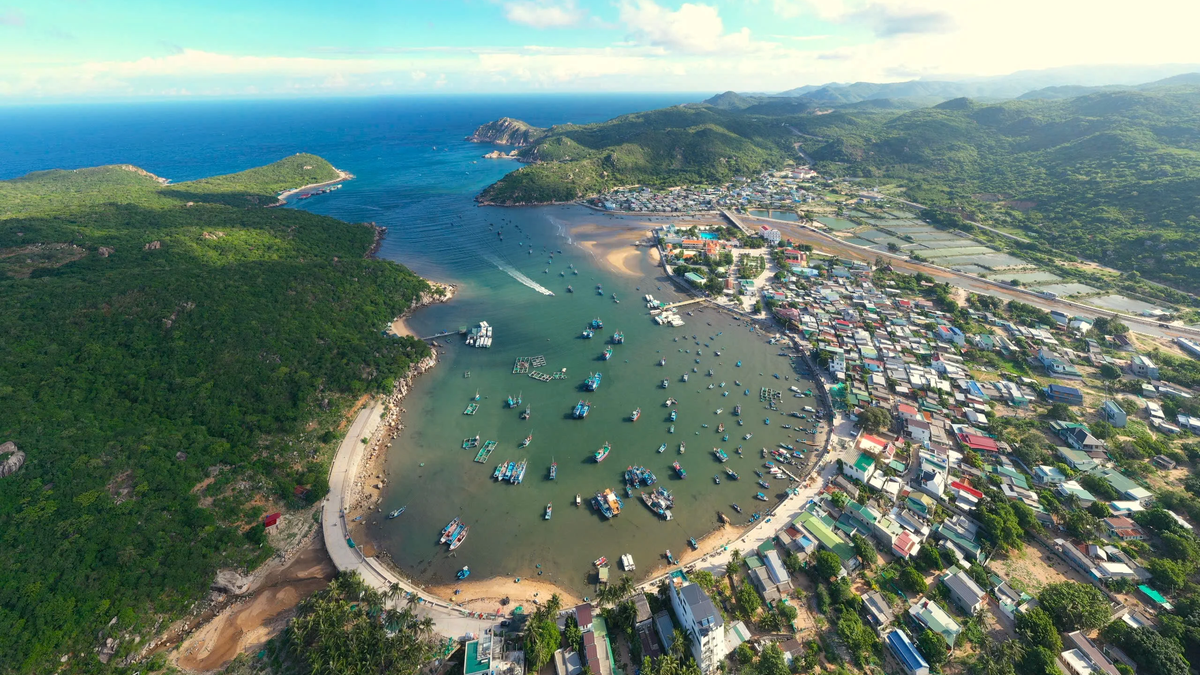
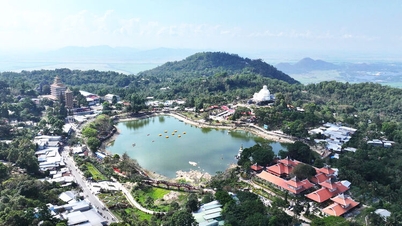
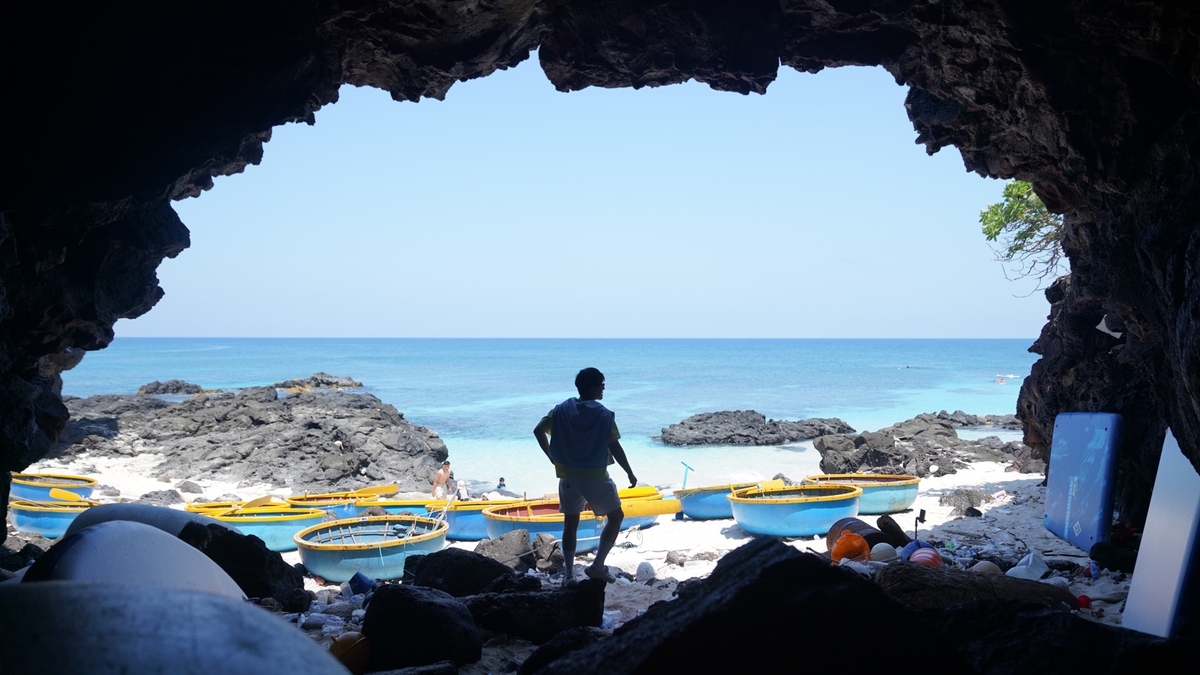
Spanning several hundred hectares, the Ba Hon Historical and Scenic Site (Hon Dat, Hon Me, Hon Queo) is the point where the sea meets the land. Nature has created a system of hundreds of interconnected caves and tunnels on these islands, forming an ideal defensive position for the unequal battles during the war against the Americans.
This place was once the site of battles that lasted for days and nights between our forces and the enemy, and the heroine of the People's Armed Forces, Phan Thị Ràng, bravely sacrificed her life in one such battle.
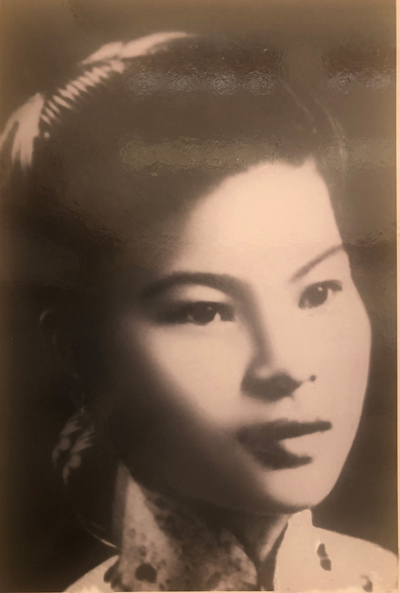
Portrait of martyr and Hero of the People's Armed Forces Phan Thị Ràng
From the summit of Hon Cave, looking in all directions, one sees a lush green expanse of trees and fruit, the sea breeze carrying a salty scent like an endless whisper of stories. Standing for the first time on the heroic Hon Dat, now a legend, every word and phrase from the novel of the same name by writer Anh Duc came flooding back as if it were present in real life: How much Sister Su loved this place, where she uttered her first cries, where the sweet fruits and ripened her rosy complexion. It was on this very land that her mother sang lullabies to her... It was here that she raised her small fist to salute the Party flag...
I stood silently beside Phan Thi Rang's grave for quite a while, listening to the wind whistling through the cave, imagining it to be her defiant, unwavering words from years ago, spoken in the face of the brutal torture inflicted by the enemy. Her grave lies at the foot of Hang Hon cave, nestled against the cliff, facing the road where the bustling Tho Son market is located. In front of the grave is a large pond filled with lotus flowers. Looking at this scene, it's hard to imagine that this place was once a flat plain, ravaged by the enemy with countless bomb craters.
On the way here, I asked about the tomb of the heroine Phan Thi Rang, but several people shook their heads, saying they didn't know. It wasn't until I met an old man in a small teahouse by the Kien Binh River that I received detailed directions. "Are you asking for directions to Sister Su's tomb? Go another 2 km and there's a turn to the west; go straight towards the island for about 10 km and you'll arrive," he said enthusiastically.
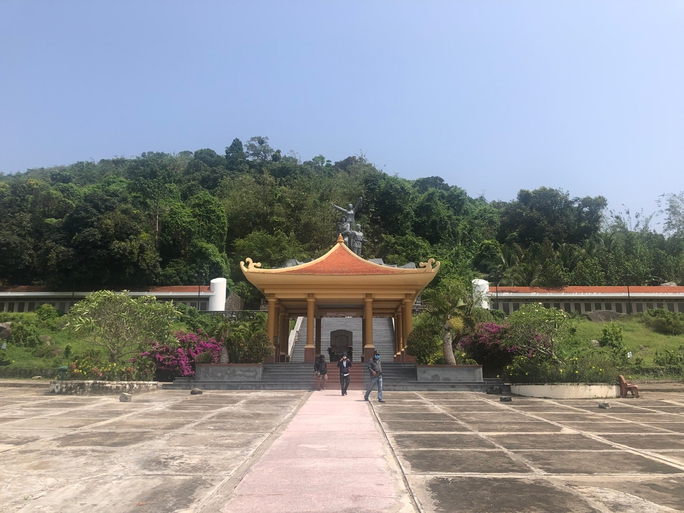
The tomb of heroine Phan Thị Ràng (Sister Sứ) in the Ba Hòn Historical and Scenic Site.
In the land of the heroine Phan Thi Rang, people understand that Rang is the same as Su in the literary work "Hon Dat," and Su is a real-life character. Along the way, I passed a school named Phan Thi Rang, with the words "Sister Su" added in parentheses below. In the memorial house of the Ba Hon Historical and Scenic Site, beneath the portrait of martyr Phan Thi Rang, there is also a simple note: "Sister Su."
Standing tall until death
Xăm hesitated, breathing heavily. He glanced at the blade, suspicious. But this wasn't because the American knife wasn't sharp! It was because Sứ's hair was so thick. It was precisely because the blade had touched the most beautiful, lush hair, the hair of a twenty-seven-year-old girl, both smooth and thick, consisting of thousands of strong strands cascading from that unyielding head down to her unyielding heels...
Standing before the portrait of Phan Thi Rang, gazing at her resolute eyes and thick black hair, and then recalling the vivid, lifelike passages in the work "Hon Dat," even the most stoic person would find it difficult to hold back tears.
The literary work depicts Sister Sứ as dying at the age of 27, but in reality, Phan Thị Ràng passed away at the age of 25 – the most beautiful age of a young, unmarried woman. In fact, Phan Thị Ràng was only engaged and died without ever having held her lover's hand due to the harsh realities of war. In the novel, Sister Sứ's husband was relocated to the North, and she stayed home to raise her young children and participate in revolutionary activities.
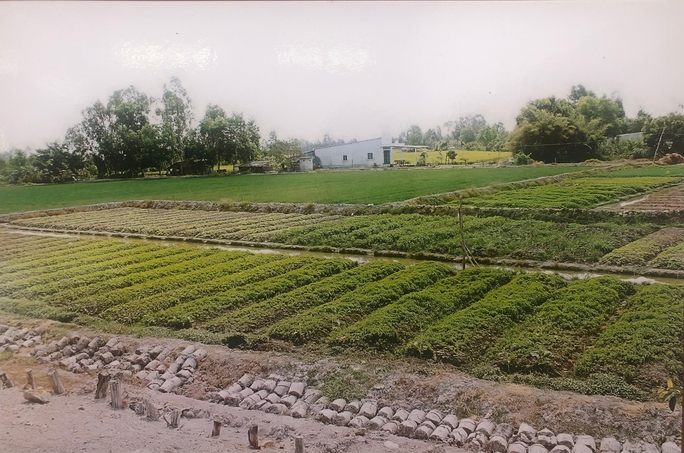
A peaceful corner in Tho Son today.
According to Phan Van My (Sau My), the younger brother of heroine Phan Thi Rang, she was the fourth child in the family, so she was often called Tu Rang at home. Her hometown is Luong Phi commune, Tri Ton district, An Giang province, but her name is closely associated with the heroic land of Hon Dat.
Phan Thi Rang's father died after being arrested and brutally beaten by the French colonialists for participating in the Viet Minh. In 1953, her mother remarried Mr. Nguyen Van Ho, the manager of Military Factory 18, and brought her children to live with him in Binh Son commune, Hon Dat district.
After the Geneva Accords, on July 20, 1954, Mr. Ho, along with his eldest son and the younger brother of Ms. Tu Rang, relocated to the North. Fearing enemy retaliation, from the end of 1954, she, along with her mother, Sau My, and youngest brother Binh Son, had to wander from place to place. With a Singer sewing machine bought with the money her uncle Ho left behind, she worked as a seamstress to help her mother raise her siblings...
In 1957, the four mother and children returned to Tri Ton, where Tư Ràng was introduced to the Núi Dài Party Branch by her uncle. Mr. Sáu Mỳ stated that the photograph of Tư Ràng on her tombstone was taken when she was just 20 years old. From then on, she adopted the pseudonym Tư Phùng.
To avoid being tracked by the enemy, Ms. Tu Phung had to constantly change her area of operation in the Ha Tien region, but she always kept her younger sister, Sau My, and her sewing machine with her. At the end of 1958, she was transferred back to Binh Son to work in youth mobilization and liaison. Afterwards, she was sent to attend a midwifery course, and then assigned to work as a women's affairs officer in the district...
In January 1962, the enemy concentrated over 2,000 troops and launched a protracted offensive against the Ba Hon base area. Sister Tu Phung acted as a liaison between units within the base area while also organizing and mobilizing the people to fight back, coordinating with military operations... causing the enemy to fail and abandon the offensive.
At dawn on January 9, 1962, while on duty, less than 50 meters from her rendezvous with her comrades, Tư Phùng fell into an enemy ambush and was captured. Among the enemy soldiers were two defectors: Captain Khen (Lieutenant Xăm in the novel "Hòn Ðất") and Tạo. They recognized her as Tư Ràng.
They hung Sister Tư Ràng from a tamarind tree to torture her, forcing her to reveal the hiding places of her comrades and revolutionary bases. When they couldn't get anything out of her, they took her to the foot of Hòn Ðất mountain, hung her from a mango tree using her own hair, stabbed her all over with sharp stakes, cut off her ears, and mutilated her flesh...
Despite enduring extremely brutal torture, Ms. Tu Rang did not confess or beg for mercy. Around 2 PM on January 9, 1962, she sacrificed her life at the young age of 25...
"If I die, you all die too."
"Those who worked with Ms. Tu Rang and the people of Tho Son recounted that when the soldiers captured her, they took turns torturing her, asking about her whereabouts, who her leaders were, who she knew, and how many people she lived with... They hung her from a tamarind tree and beat her with rifle butts as if hitting a sack of rice husks. When she fainted, they splashed soapy water on her to revive her before continuing the beating."
"Sister Tư Ràng didn't confess, but instead shouted directly at Khen's gang: 'If I die, you all die too!' Then she breathed her last that afternoon. When she died, they used her long, thick, silky hair to hang on a tree for 3-4 days, waiting for someone to come and retrieve her body before shooting her. Even now, the people of Thổ Sơn and her comrades can't hold back their tears when they recall the moment she sacrificed herself," Mr. Sáu Mỳ recalled with emotion.
By DUY NHÂN (Người Lao Động newspaper)
Source link







































































Comment (0)