

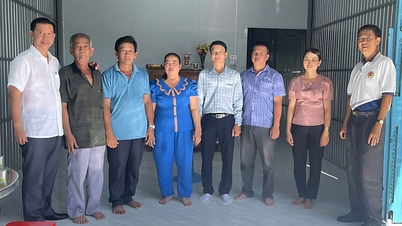
One afternoon in late March 2026, in Kim Quy B hamlet, Van Khanh commune, the commune police went to each household to guide them on integrating their social security accounts into the VNeID application. Thanks to this support, Mr. Le Hoang Hai learned that his citizen identity card had expired at the beginning of 2024. Mr. Hai's case illustrates that digital transformation is gradually permeating rural life, but people's awareness and habits of using technology are still limited. Therefore, local forces must "go door to door" to provide direct guidance and support.

The Vân Khánh commune police guided Mr. Lê Hoàng Hải's family in integrating their social security account into the VNeID application. Photo: ĐẶNG LINH
In line with the policy of promoting cashless payments associated with digital transformation, from March 26th to 28th, the People's Committee of Van Khanh commune, in coordination with the An Minh Kien Giang II branch of the Agricultural and Rural Development Bank, organized the opening of free bank accounts for residents right in the hamlets. The beneficiaries included policy recipients, hamlet officials, and those without bank accounts. Simultaneously, the commune police provided guidance on integrating social security accounts into the VNeID application for residents. This activity not only increases transparency and security in benefit payments but also creates a foundation for the implementation of cashless payments in the future. However, according to Major Pham Van Kien, Head of the Van Khanh Commune Police, the implementation process still faces many obstacles. "The biggest challenge is that many elderly people don't use smartphones, some change their phone numbers after registration, or they have difficult economic circumstances and therefore don't own a phone. This hinders the implementation of digital transformation in the community," Mr. Kien said.
In An Minh commune, the "Digital Literacy Movement" is also being widely implemented. The locality has strengthened 18 community digital technology teams in 18 hamlets, using them as the core force to disseminate information and guide people in accessing technology. Following the motto "hands-on guidance," the teams visit each household, instructing them on using online public services, integrating bank accounts, using personal digital signatures, and electronic health records. This approach has initially yielded positive results. People have formed the habit of carrying out administrative procedures from home, reducing travel time and accessing public services more conveniently. However, to build a digital government, the prerequisite remains the presence of digital citizens, while this is a weak link in many places.
According to Tran Trung Lap, Deputy Secretary of the Party Committee and Chairman of the People's Committee of An Minh commune, the locality has successfully encouraged residents to install the VNeID application and verify their identity at level 2, achieving a rate of 98.2%. The few who have not yet completed the process are mainly the elderly, the sick, poor households, single-parent households, or those without smartphones. "These cases are almost impossible to implement, while the rest have basically completed the process as directed," Mr. Lap stated.
Despite the achievements, digital transformation in rural areas still faces many obstacles. In U Minh Thuong commune, Ms. Tran Thi Ngoc Lanh proactively utilizes social media to sell her products. From selling only within her neighborhood, her products now reach a wider customer base through live streams. However, the joy is not complete due to the weak network infrastructure. "Many times, the live stream would drop midway, and customers would leave, which is a real shame. I've worked hard to learn new things, but a weak network makes it difficult to do business in the long run," Ms. Lanh said.
It is clear that digital transformation in rural areas is not just a matter of technology, but also a challenge related to infrastructure, the economy, and human resources. When internet access is unstable, equipment is scarce, and digital skills are limited, even with sound policies and strong determination, implementation is unlikely to achieve the desired results. To overcome these "bottlenecks," in addition to continued investment in telecommunications infrastructure, practical support policies for vulnerable groups are needed, along with maintaining the "hands-on" training models of community digital technology groups. Only when people truly access and master technology can digital transformation in rural areas become truly profound and sustainable.
DANG LINH
Source: https://baoangiang.com.vn/nut-that-trong-chuyen-doi-so-o-nong-thon-a481532.html



















![[INFOGRAPHICS] 25 targets and groups of targets that Can Tho City strives for by 2030](https://vphoto.vietnam.vn/thumb/402x226/vietnam/resource/IMAGE/2026/05/25/1779688983034_1779688951.webp)

















































































Comment (0)