

Following beekeepers into the "honey land" of the mangrove forest.
U Minh Ha National Park, spanning over 8,000 hectares, is a rare and distinctive melaleuca forest ecosystem in the Mekong Delta. It boasts a rich and diverse flora and fauna, with the melaleuca tree considered the "soul" of the forest. Each flowering season, the fragrance of the melaleuca spreads throughout the area, creating an abundant source of nectar that attracts wild bees to collect nectar and build their nests.
Thanks to these favorable natural conditions, over many generations, the people of U Minh Ha have developed the profession of beekeeping – a method of harvesting forest honey entirely based on the laws of nature, both for livelihood and for forest preservation.
I followed two beekeepers: Mr. Pham Duy Khanh, owner of the Muoi Ngọt community eco- tourism area (Hamlet 10, Da Bac Commune, Ca Mau Province), and Mr. Huynh Vu Hoang (42 years old, residing in the same commune). Both have been involved with the U Minh Ha forest for more than two decades, continuing the family tradition in this southernmost region of Vietnam.
Preparing for their honey "hunt," they carried knives, torches wrapped in coconut fiber, and wore protective mesh hats that covered their necks. The lightweight motorboat glided through the thick green carpet of water hyacinths, weaving between forests of reeds with their white flags, venturing deep into the deep green of the mangrove forest – where more than 1,000 beehives were scattered.
According to Mr. Khanh, before the melaleuca flowering season, the workers rely entirely on experience to select the planting area, carve the rafters, and determine the wind direction and sunlight direction.
"If the bees set up the hives successfully, they will naturally return to build their nests, providing sweet honey all year round. This profession depends on the heavens, the forest, and the dedication of the forest guardians," Mr. Khanh shared.

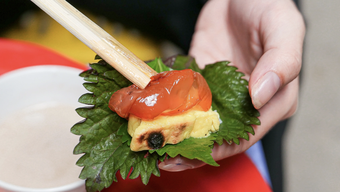
Young bees are used in the preparation of many traditional dishes.
such as battered and fried young bees, bee salad...
Approaching the nearly meter-long beehive, Mr. Khanh and Mr. Hoang gently waved their coconut fiber torches in front of it. The smoke was just enough, not suffocating, causing the bees to scatter. According to experienced beekeepers, hunting for bees in the early morning is the safest, when dew is still clinging to the leaves, reducing the risk of forest fires, and the bees are not yet very active.
In just a few minutes, the honeycomb pieces were neatly cut. The honey was thick, golden, and emitted the intoxicating aroma of melaleuca flowers.
"I've been going bee hunting with my father since I was 15, and getting stung by bees was a common occurrence. At first, I was very scared, but then I got used to the job and the forest," Mr. Hoang said with a gentle smile.
Setting up beehive frames is considered an art. Frames are usually made from the Terminalia catappa tree or Areca palm; Terminalia catappa is preferred because it dries quickly, has little sap, and the bee nesting rate reaches 40-50%. The frame area must be spacious, airy, and sunny; the frames must not be damp or moldy. The tallest posts are about 2.6m, the shortest about 1.4m, and the frames must be sloped to maximize honey production. From the time the bees build their nests until harvest takes about 15-20 days.
The main honey harvesting season lasts from November to March according to the lunar calendar. On average, each hive yields 3-5 liters of honey, with larger hives potentially producing over 10 liters.
What's special is that the beekeepers never take the entire hive. Usually, they only cut about 3/4 or 4/5 of the hive, so that the bees can continue to build a new nest on the old one – a harmonious relationship between humans and nature.
The harvested beehives are processed into many traditional dishes: young bees cooked in porridge, fried in batter, used in salads, and fermented bee paste... Bee pollen helps restore health; beeswax is used to make candles and lamps. Over time, the profession of beekeeping has created "artisans" who understand bee habits, are familiar with the forest terrain, and possess a strong sense of protecting nature.
Following the bee hunters, many tourists were delighted. Mr. Nguyen Thong Nhat (a tourist from Thu Duc City, Ho Chi Minh City) shared: “This is the first time I’ve witnessed the honey harvesting process firsthand, and enjoying it right in the middle of the vast melaleuca forest is a very special feeling. Combining it with watching them set eel traps and fish traps made the trip even more attractive.”
Foreign tourists, Mr. Peters Olaf and Ms. Regenister Anja (Germany), were also impressed by the opportunity to directly extract honey, taste the sweet and distinctive aroma of U Minh Ha forest honey – an unforgettable experience amidst pristine nature.

Mr. Peters Olaf and Ms. Regeniter Anja (Germany) were impressed when they had the opportunity to taste the delicate sweetness and distinctive aroma of U Minh Ha forest honey.
According to the Department of Culture, Sports and Tourism of Ca Mau province, the profession of beekeeping is a unique cultural feature of the inhabitants of the U Minh Ha melaleuca forest, and has been included in the National List of Intangible Cultural Heritage according to Decision No. 4613/QD-BVHTTDL dated December 20, 2019. In recent times, the locality has organized many training courses, passed on the craft, and combined it with promoting experiential tourism to preserve and promote the value of this unique heritage.
Setting eel traps - the land's charm captivates people.
Alongside beekeeping, setting eel traps is a long-standing traditional occupation of farmers in Ca Mau. The eel trapping season lasts from June to December, when there is abundant rain and vegetation thrives, creating an ideal environment for eels to live in.
Around early afternoon, Mr. Pham Duy Khanh paddles his small boat, carrying dozens of eel traps, spreading out along the canals in the forest. These traps are usually made from old, thorny bamboo, about 1.05-1.1 meters long, hollowed out inside, with a loop at the end to hold the eels, and ventilation holes to prevent them from suffocating. Nowadays, many places replace them with PVC pipes for convenience.

Mr. Khanh paddled his small boat, carrying his eel traps, searching for reeds and sedges to set the snares; the next morning, he checked the traps and caught plump, golden-yellow eels, with many traps having one or two eels caught.
“The bait for the eel traps is very simple, such as minced and cooked fish like snakehead fish, freshwater crabs, frogs, snails, and worms, mixed with fish oil for aroma, then placed inside the tubes. The traps are placed at an angle, with the tails floating 5-7 cm above the water surface. After one night, the traps can be removed early in the morning to harvest large eels with bright yellow skin. On average, 30 eel traps yield 3-5 kg of eels per night, selling for about 350,000 VND/kg,” Mr. Khanh shared.

Eel is prepared into many traditional and nutritious dishes such as sour eel soup, stir-fried eel with lemongrass and chili, eel porridge, etc.
Beyond providing income, honey hunting and eel trapping have become an integral part of the cultural life of the people of U Minh Ha. The fruits of their labor are processed into simple yet nutritious dishes such as eel stewed with noni leaves, eel sour soup, eel stir-fried with lemongrass and chili, or grilled eel enjoyed with rice wine – a unique flavor of the Southern Vietnamese countryside.
Amidst the vast mangrove forests, the sweet nectar and rustic eel traps not only sustain generations but also contribute to the unique appeal of tourism in Ca Mau.
Source: https://baophapluat.vn/huong-mat-vi-dat-rung-u-minh-ha.html

![[Photo] Prime Minister Pham Minh Chinh receives the Director of RMIT University Melbourne (Australia)](https://vphoto.vietnam.vn/thumb/1200x675/vietnam/resource/IMAGE/2026/04/02/1775142120087_thiet-ke-chua-co-ten-2026-04-02t214220784-png.webp)

















































































Comment (0)