Famous throughout the region
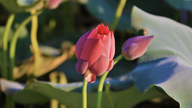
With their gentle, pure beauty and pleasant fragrance, blending harmoniously with the clear blue sky and bright golden sunshine, the blooming pink lotus flowers resemble a beautiful ink painting. Wherever you go in Ninh Binh during the summer, you can easily find lotus ponds in full bloom.
Lotus flowers are everywhere, cultivated by the local people. They bloom in rice paddies, lakes, at the foot of dikes, and along both sides of the Ngo Dong River. Even in the homestay where you're staying, you might find beautiful potted lotus plants or ponds.
It seems that the lotus ponds in the ancient capital of Hoa Lu have a longer blooming period and retain their beauty for much longer than in many other places. While ordinary lotus ponds only bloom for a little over a month, the lotuses in some of these areas bloom beautifully until the end of the year. However, the period from June to August is when the lotuses are in full bloom and at their most beautiful.
Lotus in Ninh Binh is grown extensively by locals in the fields of Cua Dinh, Trieu Sau, Bay Doi… in Hoa Lu district. These areas are relatively close to tourist attractions such as Tam Coc-Bich Dong, Thung Nham, and Thung Nang…
With its vast valleys and distant verdant mountain ranges, the area is ideally suited to serve the tourism needs of visitors from all over. Having lotus ponds that bloom profusely and beautifully at the right time, especially those that can last for several months, requires lotus growers to carefully select lotus varieties, conduct trial plantings to monitor their adaptability, and record the timing of flowering and fruiting…
Thanks to hard work, the area has produced "lotus experts," businesses specializing in supplying various types of lotus seedlings. Currently, it boasts some of the leading lotus varieties in Vietnam, such as the thousand-petal lotus (S1000), SuperLotus, white Quan Am lotus, Bluedarling lotus, and pink lotus…
Ms. Le Thanh Huyen, Director of HaLi Production, Trade and Service Joint Stock Company in Ninh Tien commune (Ninh Binh city), said: "Recognizing the advantages of diverse and abundant tourism resources, my family has invested in lotus cultivation, while also focusing on creating an eco-tourism environment."


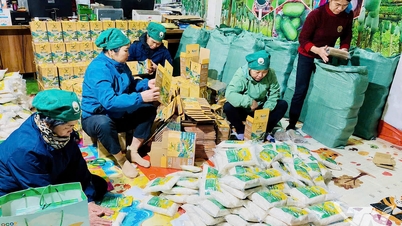
Currently, HaLi has 48 hectares of various lotus varieties, located in Ninh Thang and Ninh Xuan communes, of which 22 hectares are being directly cultivated. The lotus plants have been and continue to be a valuable asset to the tourist area. Besides creating beautiful scenery for visitors, the lotus plants also provide a harvest of flowers and leaves. When winter arrives, the lotus plants are harvested for their tubers. From the lotus plant as a raw material, HaLi has developed nearly 20 products. Notable examples include Thanh Xuan lotus leaf tea (OCOP 3 stars), dried lotus seeds, lotus root starch, dried lotus tubers, lotus wine, and the main ingredient in handicrafts such as everlasting flowers and lotus paper.
It is understood that, in the future, HaLi is promoting investment in the construction of a lotus-themed cultural exhibition space, a handicraft experience area, and economic development linked to tourism development in the locality.
Multipurpose lotus cultivation
For over three years now, implementing Resolution No. 02-NQ/HU of the Standing Committee of the Hoa Lu District Party Committee on promoting the transformation of crop and livestock structures, improving production efficiency, and linking agricultural production with tourism and service development, approximately 55 hectares of lotus are now grown in the district.
Many models of cultivating new lotus varieties combined with fish farming to serve tourism and services in the communes of Ninh Hai, Ninh Xuan, Ninh Thang, Ninh My, and Truong Yen have yielded very good economic results. Thanks to this "multi-purpose" lotus cultivation, many households in Hoa Lu have become wealthy.
Comrade Pham Thai Thach, Head of the Agriculture and Rural Development Department of Hoa Lu district, said: Due to the low-lying terrain, the agricultural economy of the district is difficult to develop. The entire district has more than 3,000 hectares of rice-growing land, however, many areas are interspersed with land at the foot of mountains and waterlogged land, making rice cultivation difficult, so many households are no longer committed to rice farming.
To address the issue of abandoned farmland, Hoa Lu district has adopted a policy to develop agriculture aimed at increasing the production value of cultivated land. This includes converting areas unsuitable for rice cultivation to growing new lotus varieties combined with fish farming, linked to the development of ecotourism.
Recognizing this trend, many communes in Hoa Lu district are conducting surveys and selecting areas to convert inefficient rice cultivation land to growing specialty crops and raising specialty livestock, linking agricultural development with ecotourism development and leveraging local strengths. Among these solutions, researching the cultivation of various lotus varieties is a promising approach.
According to statistics, in recent years, many households, groups of households, or companies in Ninh Thang commune have signed agreements to lease and invest in planting dozens of hectares of new lotus varieties on low-lying land and poor-quality rice fields belonging to commune members. The model of lotus cultivation combined with ecotourism has brought high economic efficiency to the people. Lotus plants yield an average of 3.6 tons of seeds/ha, an average of over 30,000 flowers/ha, and an average of 4.2 tons of tubers/ha.


In addition, lotus also yields other products such as lotus leaves, lotus roots, lotus tea, etc. Estimated income from lotus cultivation and fish farming reaches over 400 million VND/hectare/year. This does not include income from recreational fishing and resort services in many households with ponds, combined with homestay models. Observations in localities with new lotus cultivation and fish farming models combined with tourism show that, with many lotus varieties planted in staggered seasons, the lotus flowering season extends from May to the end of November each year.
Along with the beautiful natural scenery, the lotus ponds in full bloom, especially those blooming out of season, offer tourists many choices for sightseeing and taking photos with the fragrant lotus ponds in the ancient capital region.
Even more exciting, in early August 2023, the departments, agencies, and Hoa Lu district organized a conference to announce the certification mark "Hoa Lu-Ninh Binh Lotus" for lotus products from Hoa Lu district. The "Hoa Lu-Ninh Binh Lotus" certification mark, representing a product of prestige and quality associated with the ancient capital of Hoa Lu, will undoubtedly bring many benefits to growers, producers, and consumers, contributing to the promotion of local economic development and enhancing the image of the thousand-year-old cultural capital.
Text and photos: Minh Duong
Source