

Meets the technical requirements for a speed of 350 km/h.
On November 13th, the National Assembly will hear the Government present the plan for the high-speed railway project on the North-South axis.
Regarding the Pre-feasibility Study Report, there are still some concerns about whether the route alignment and station placement are optimal.
Speaking with the Traffic Newspaper, the leader of the Railway Project Management Board stated that the high-speed railway route was researched, compared, and selected by consultants based on the following principles: compatibility with national and local sectoral planning; meeting requirements regarding control points; shortest route length between stations; meeting technical requirements (maximum slope of 15‰), ensuring a smooth ride for passengers; and suitability to the topographical conditions of the area through which the route passes.
Simultaneously, restrict passage through environmentally and socially sensitive areas, historical sites, scenic spots, and national defense land; limit the amount of land to be cleared, avoid densely populated areas, minimize the impact on existing structures; and ensure the connectivity of the East-West corridor and railway lines connecting China, Laos, and Cambodia.

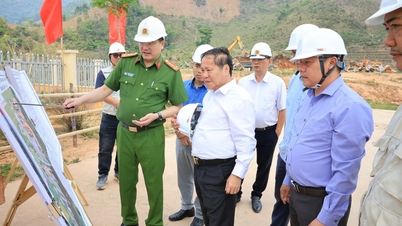
The North-South high-speed railway route is being studied based on the "straightest possible" option, meeting economic and technical requirements equivalent to a speed of 350 km/h (Image: illustration).
In 2018, the Ministry of Transport developed three route options with the support of international consultants to analyze, evaluate, and reach a consensus with local authorities. Based on that, the chosen route option was agreed upon by all 20 provinces and cities through which the high-speed railway passes, based on the principle of being as straight as possible.
Recently, following the State Appraisal Council's recommendations, the investor and consultant collaborated with local authorities to review the entire route through the area. The Ministry of Transport sent out documents to solicit opinions and held meetings with the People's Committees of provinces/cities regarding the proposed route. As a result, 18 out of 20 localities submitted documents requesting that the route remain unchanged as presented in the feasibility study report.
Only two localities proposed adjustments to certain locations compared to the route outlined in the National Technical Report.
Specifically, Quang Binh proposed making localized adjustments to some locations based on the 2018 route plan, shifting the station's position.
Thua Thien Hue province has proposed adjusting the route to the east, whereas the route previously proposed in 2018 was to the west.
Regarding the recommendations from the two provinces, the investor has instructed the consultant to incorporate them into the project documentation. As a result of the review, the total length of the route has been reduced from 1,545km to 1,541km.
Regarding the route of the high-speed railway through Nam Dinh city, the leaders of the Railway Project Management Board stated that it has been studied to ensure compliance with national sectoral planning, regional planning, and provincial planning. Nam Dinh city, as the southern center of the Northern coastal region, has a planned population of 600,000 by 2040; it also attracts neighboring localities in the Red River Delta such as Thai Binh and Hung Yen, with a combined population of approximately 4 million people. This is a major transportation hub with high transport demand; it is projected that by 2050, the demand for travel to and from Nam Dinh station will reach nearly 3 million passengers per year.
If we consider the investment and operating costs over 30 years for the 12km section through Nam Dinh, the estimated cost would be approximately US$1.66 billion, while the benefits would be around US$2.06 billion. Therefore, operating the high-speed railway line through Nam Dinh city would yield estimated benefits of approximately US$400 million over 30 years compared to a straight high-speed railway line that bypasses this area.
On the other hand, global experience has shown that there are many cases where high-speed rail lines detour through major centers to attract passengers instead of going straight, as in Japan, South Korea, China, etc.
“The project's route has been updated by local authorities into the provincial planning, the Ministry of Planning and Investment has appraised it, and it has been approved by the Prime Minister in the provincial planning. Thus, it can be seen that the route has been carefully studied according to the ‘straightest possible’ option, meeting the economic and technical requirements corresponding to the design speed level, ensuring a smooth ride for passengers during operation. In the next step, the Ministry of Transport will direct the investor to continue optimizing the route to be as straight as possible,” said a leader of the Railway Project Management Board.
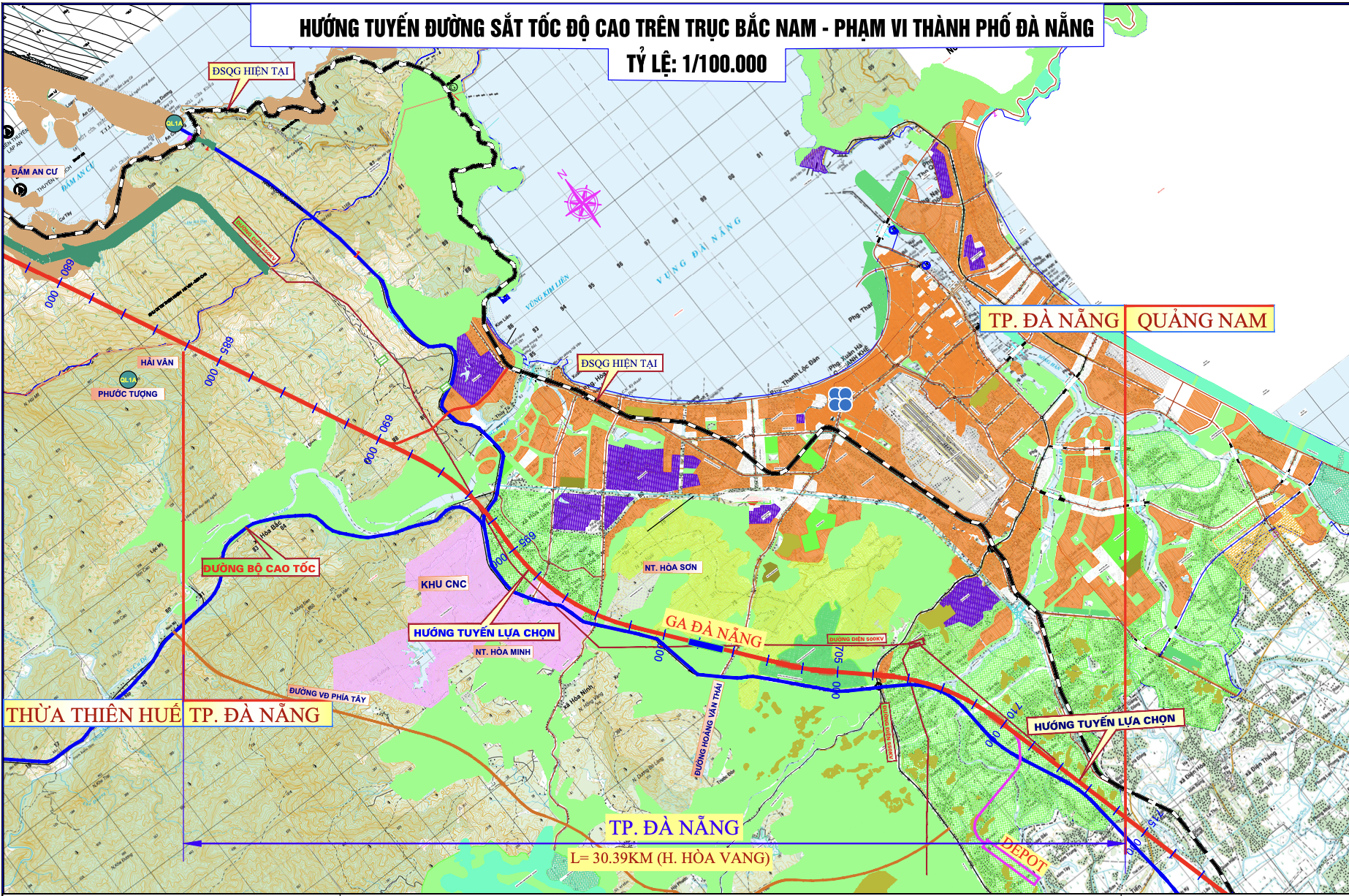
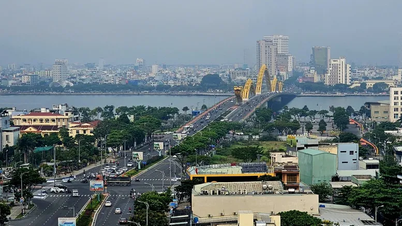
The North-South high-speed railway route will pass through Da Nang city.
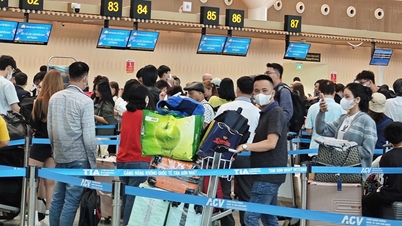
Each province will have at least one passenger station.
Regarding the location and number of stations, the head of the Railway Project Management Board stated that the high-speed railway line is 1541km long, passing through 20 provinces/cities, and has 23 passenger stations and 5 freight stations.
The station is located according to the following principles: It must be suitable to the current conditions and development plan of the locality; it must be situated in the central economic and political areas of the provinces, with easy access to urban centers and planned areas with development potential.
Simultaneously, ensure good connectivity with the national transportation system and public transport; appropriate distances to create new development spaces, effectively utilize land resources, and ensure efficient use of infrastructure and vehicles (ensuring appropriate distances for acceleration and deceleration).
Based on the above principle, each province is allocated one passenger station, with an average length of approximately 67km per station; however, the provinces of Ha Tinh, Binh Dinh, and Binh Thuan are allocated two stations due to their planned large urban areas. To date, the locations of all stations have been approved by the Prime Minister in the provincial planning.
In addition, the National Economic and Technical Report proposed several potential stations according to the plan, such as Nghi Son, Chan May, La Gi, and Cam Lam. When localities develop urban areas with sufficient population and transportation demand, and the distance between stations meets technical requirements, the Prime Minister will assign the localities to take the lead in implementation. However, in this phase, transportation demand is not high, and investment may lead to inefficient operation.
Regarding the route and station locations, local planning has already been agreed upon and integrated, allocating land for investment in the high-speed rail line. While the planning for Hanoi and Ho Chi Minh City has not yet been approved, the proposed route and station locations (Ngoc Hoi and Thuong Tin stations at the beginning of the line in Hanoi; Thu Thiem station and Long Truong depot at the end of the line in Ho Chi Minh City) have been agreed upon by the cities, integrated into the draft plans, and have been largely approved by the Politburo.
Recently, the National Assembly's Economic Committee led working groups to conduct on-site surveys of the high-speed railway project on the North-South axis, passing through provinces from Hanoi to Nam Dinh and from Khanh Hoa to Ho Chi Minh City.
At the meetings, all provinces and cities unanimously agreed with the investment plan and route of the high-speed railway. Some provinces proposed increasing the number of potential stations and expanding the size of the station areas…
Representatives from Hanoi emphasized that this is the optimal route for Hanoi. Hanoi has a huge demand for transportation hubs in the South, both for passengers and goods. Therefore, compared to previous studies that suggested locating the freight station within the complex, the new plan to move the Thuong Tin freight station outside the Ring Road 4 will avoid congestion and connect with other railway lines.
Hanoi has also allocated land for the planned route. Furthermore, investing in a high-speed railway with such functional areas will give Hanoi the opportunity to renovate the urban landscape; create jobs; and create new spaces for development.
According to the National Technical Report, the North-South high-speed railway project involves the construction of a new double-track railway line with a 1,435mm gauge, electrified, a design speed of 350km/h, and a load capacity of 22.5 tons per axle; the main line length is approximately 1,541km; it will transport passengers, meet dual-use requirements for national defense and security, and can transport goods when necessary.
The project starts at Ngoc Hoi station (Hanoi) and ends at Thu Thiem station (Ho Chi Minh City).
The route passes through 20 provinces and cities, including: Hanoi, Ha Nam, Nam Dinh, Ninh Binh, Thanh Hoa, Nghe An, Ha Tinh, Quang Binh, Quang Tri, Thua Thien Hue, Da Nang, Quang Nam, Quang Ngai, Binh Dinh, Phu Yen, Khanh Hoa, Ninh Thuan, Binh Thuan, Dong Nai, and Ho Chi Minh City.
The proposed route construction will utilize three main structural types: bridge structures (approximately 60% of the route length), tunnel structures (approximately 10%), and earth foundation structures (approximately 30%).
![[Photo] General Secretary and President To Lam meets with National Assembly delegates from ethnic minorities.](https://vphoto.vietnam.vn/thumb/1200x675/vietnam/resource/IMAGE/2026/04/20/1776696701056_a1-bnd-8331-3342-jpg.webp)




![[Image] National Assembly discusses the implementation of the socio-economic development plan.](https://vphoto.vietnam.vn/thumb/1200x675/vietnam/resource/IMAGE/2026/04/20/1776696707422_ndo_br_img-20260420-185419-jpg.webp)







![[Infographic] Details of the Hanoi-Quang Ninh High-Speed Railway Project](https://vphoto.vietnam.vn/thumb/402x226/vietnam/resource/IMAGE/2026/04/16/1776338188424_anh-man-hinh-2026-04-16-luc-18-16-10.png)













![[Infographic Series] Historical Sites in Dong Nai: Long Khanh Provincial Administrative Building, Long Khanh Town Party Committee Base, Xuan Loc Temple - Xuan Hoa Pagoda Complex](https://vphoto.vietnam.vn/thumb/402x226/vietnam/resource/IMAGE/2025/9/26/1331532306fb4ad18e4a849e5c64202a)
































































Comment (0)