

The five-day search and rescue operation, involving forces from the United States, Canada, France, and the United Kingdom, concluded after wreckage of the ship was discovered.
Debris area near the Titanic wreck
At a press conference yesterday morning (Vietnam time) in Boston, Massachusetts, Rear Admiral John Mauger of the US Coast Guard announced that a Canadian vessel's unmanned submersible had discovered a "debris area" on the seabed approximately 500 meters from the Titanic wreck. Among these, five large pieces of debris belonged to the ill-fated submersible Titan, which disappeared on the morning of June 18th while taking tourists to the seabed to view the famous Titanic wreck at a depth of 3,800 meters. Titan was a submersible belonging to OceanGate Expeditions (headquartered in Everett, Washington, USA).
What did the director of Titanic say about the tragedy of the Titan submersible being crushed in the ocean?
Rear Admiral Mauger said the submersible found the tip of the Titan's stern, along with two pieces of the submersible's pressure chamber. "The debris field is consistent with the possibility that the ship suffered a crumple zone," Reuters quoted the U.S. Coast Guard commander as saying. Experts explain that a crumple zone occurs when a ship's hull is compressed inward by hydrostatic pressure in the ocean. A crumple zone can occur in about a thousandth of a second, meaning victims die before they realize what's happening. The U.S. Coast Guard did not mention whether any human remains have been found.
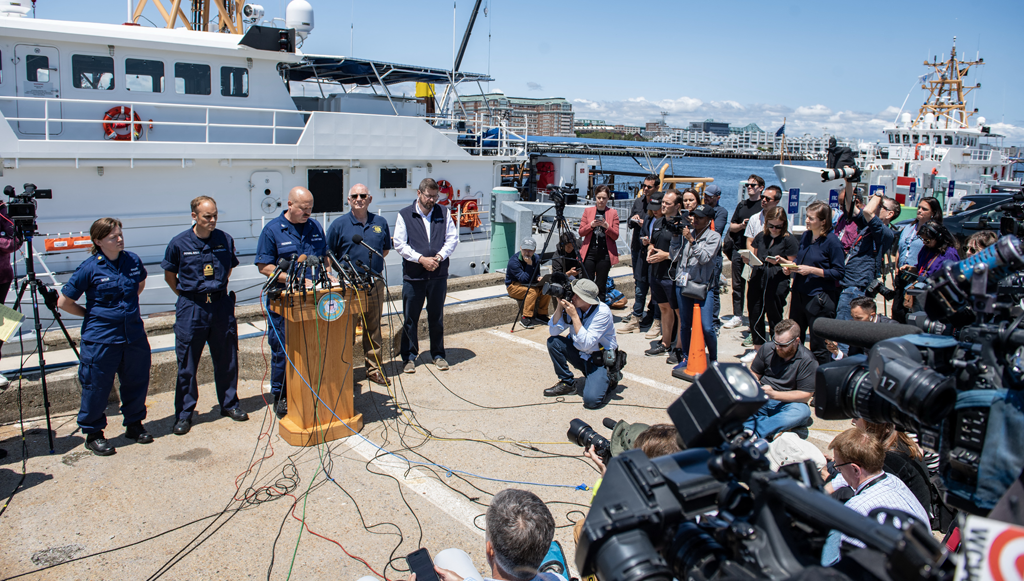
The U.S. Coast Guard held a press conference on June 23rd in Boston, Massachusetts.
Before the U.S. Coast Guard held a press conference, OceanGate also issued a statement saying there were no survivors on the Titan submersible. The victims included OceanGate's founder and CEO, Stockton Rush (61); British billionaire Hamish Harding (59); British-Pakistani billionaire Shahzada Dawood (48) and his son Suleman (19); and French oceanographer and renowned Titanic expert Paul-Henri Nargeolet (77).

From left to right, top to bottom: Mr. Hamish Harding, Mr. Stockton Rush, Mr. Paul-Henri Nargeolet, and father and son Suleman Dawood and Shahzada Dawood.
Sounds from the deep sea
Rear Admiral Mauger said it was still too early to determine the exact moment the Titan met its tragic end. Search teams had deployed buoys in the North Atlantic for more than three days and had not recorded any loud or violent sounds from the ocean depths. However, it appears the submersible ran into trouble near its destination, based on the debris field being located relatively close to the Titanic wreck and the fact that the vessel lost contact after about 1 hour and 45 minutes of its planned journey of over two hours.
Why didn't the man who survived by refusing to board the Titan submersible during the catastrophic voyage participate?
The Wall Street Journal reported yesterday, citing a senior U.S. Navy official, that the Navy had detected a signal likely originating from an underwater explosion near the submarine's location at the time it lost contact. The newspaper, citing U.S. military sources, revealed that the sound was recorded by a top-secret system installed by the U.S. Navy in the area. This system is designed to detect other submarines, but details were withheld for security reasons. This information was quickly shared with the command team of the search operation for the submarine.
Unmanned submersibles on the seabed continue to collect evidence. It remains unclear whether it is possible to recover any remains (if any) of the victims, given the intensity of the explosion and the extremely difficult conditions at the deep seabed. CNN quoted experts as saying that recovering the Titan wreck is necessary to find accurate answers to the tragedy.
No one survived; fragments of the missing submarine were found while visiting the Titanic wreck.
In 1912, the Titanic sank after striking a massive iceberg on its maiden and final voyage. Of the 2,224 people on board, more than 1,500 perished. The wreck was found in 1985 and has since consistently attracted the attention of explorers and adventure enthusiasts.
Titanic, Titan, and the need to revise maritime rules.
Following the Titanic disaster in 1912, governments on both sides of the Atlantic collaborated to protect seafarers. This resulted in the adoption of the Convention for the Safety of Life at Sea (SOLAS) in 1914, with numerous provisions designed to prevent similar tragedies from recurring. With the Titan submersible explosion that killed five people, legal experts believe it's time to revise maritime regulations to control deep-sea tourism , with OceanGate as an example. In 2018, experts warned that OceanGate's operation of the Titan submersible was outside of established safety regulations, yet the vessel continued to carry passengers due to its location in international waters. The Titan tragedy could be a catalyst for the development of new regulations to ensure the safety of future deep-sea exploration tourists.
Source link


![[Photo] General Secretary and President To Lam meets with National Assembly delegates from ethnic minorities.](https://vphoto.vietnam.vn/thumb/1200x675/vietnam/resource/IMAGE/2026/04/20/1776696701056_a1-bnd-8331-3342-jpg.webp)
![[Image] National Assembly discusses the implementation of the socio-economic development plan.](https://vphoto.vietnam.vn/thumb/1200x675/vietnam/resource/IMAGE/2026/04/20/1776696707422_ndo_br_img-20260420-185419-jpg.webp)
















































































Comment (0)