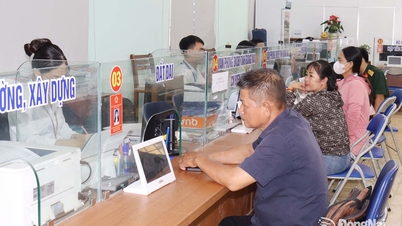
Ms. Tuyet Phuong pays by scanning a QR code via bank transfer after buying two glasses of orange juice in Duc Nhuan ward, Ho Chi Minh City - Photo: QUANG DINH
While nearly 10 years ago, the term digital finance was still unfamiliar to many, or they only understood it simply as the application of technology to financial services, today digital finance is present in every aspect of life and is changing people's lives in unexpected ways.
Previously, opening a bank account required bringing documents to the bank, and paying electricity and water bills required paying directly to the bill collector. Now, with just a phone and a banking app, electricity and water bills, service fees, meals are paid, and even cross-border purchases can be made with just a few taps.
Two years ago, the household business kept records of its goods purchases and sales, paid a fixed monthly tax, and paid no attention to invoices, receipts, or input/output data. However, in just over a year, the changes have been dramatic.
The new policy has categorized tax management for household businesses based on revenue, and household businesses must switch to the declaration-based tax payment method.
Consequently, they had to get used to electronic invoices, accounting records, digital signatures, and sales software – all things that were previously completely unfamiliar.
However, digital transformation and digital finance are irreversible trends in all areas of life today and can become a "gold mine" for economic development if exploited properly.



In recent times, digital finance and digital payments have brought many benefits, such as contributing to the promotion of modern consumption and stimulating trade and services, opening up many new opportunities for various industries.
In the context of the government promoting the digital economy as a new growth engine, expanding digital payments also contributes to completing the e-commerce ecosystem, creating conditions for Vietnamese businesses to access a larger market.
More importantly, the use of digital payments will facilitate transactions and enhance the transparency of the economy.
Digitizing transaction data helps improve management efficiency, reduce social costs, support tax administration, prevent fraud, and build a healthier business environment.
However, on the other hand, ensuring that people can make payments safely is a matter that needs serious attention.
Recently, the State Bank of Vietnam has issued a series of new regulations on customer verification and account management to enhance the security of digital payments and prevent the use of "ghost" accounts for fraud and scams.
Notably, the requirements include customer identification, enhanced biometric verification through chip-embedded citizen ID cards and the VNeID application to accurately verify users when opening accounts.
The State Bank of Vietnam is also coordinating with the Ministry of Public Security to utilize population data, chip-embedded citizen identification cards, and the VNeID application to clean up customer data and prevent impersonation and the use of forged documents to open accounts for illegal purposes.



However, criminals still exploit loopholes to carry out fraudulent transactions. This loophole needs to be closed in order to build a digital financial ecosystem that is not only modern but also safe for all citizens and businesses.
Therefore, we have reason to expect that digital finance will unlock a "gold mine" to boost economic growth in the coming period.
Source: https://tuoitre.vn/khai-thac-mo-vang-tai-chinh-so-20260606081015892.htm
![[Photo] National Assembly Chairman Tran Thanh Man attends the Conference to announce the Master Plan for Hanoi Capital City with a 100-year vision.](https://vphoto.vietnam.vn/thumb/1200x675/vietnam/resource/IMAGE/2026/06/29/1782709639728_ndo_br_1-jpg.webp)

![[Image] A look back at the capital's preparations for the century-long master plan.](https://vphoto.vietnam.vn/thumb/1200x675/vietnam/resource/IMAGE/2026/06/29/1782750453122_quy-hoach-100-nam-minh-duy-1-2118-jpg.webp)

![[Photo] General Secretary and President To Lam works with the Party Committee of the Government on the work of preventing and combating storms, floods, extreme natural disasters and climate change.](https://vphoto.vietnam.vn/thumb/1200x675/vietnam/resource/IMAGE/2026/06/29/1782729441945_a1-bnd-0385-9454-jpg.webp)