

The Tro Chieng Festival in Trinh Xa village takes place from the 10th to the 12th of January, aiming to preserve and develop unique traditional cultural values, while also honoring the great contributions of Tam Cong Trinh Quoc Bao - a figure who made significant contributions to the history and culture of the nation during the Ly Dynasty. He was also the creator of the Tro Chieng Festival - a precious intangible cultural heritage of the nation.

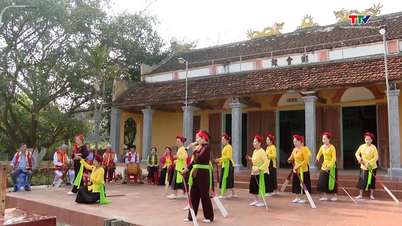
On the morning of February 21st (12th day of the first lunar month), Yen Ninh commune (Yen Dinh district) held the opening ceremony of the 2024 Tro Chieng Festival on a grand scale. Representatives from the Department of Culture, Sports and Tourism, leaders of Yen Dinh district, communes within the district, along with a large number of local people and tourists from all over, attended the event.

Delegates and a large number of people attended the opening ceremony of the festival.
The Tro Chieng festival in Trinh Xa village reflects the working life, struggles, and dreams of the people, closely linked to the history of resistance against foreign invaders and the name of General Trinh Quoc Bao - a man who made great contributions to repelling invaders, preserving the country, and creating and teaching Tro Chieng to the people in the commune.
On June 20, 2017, the Tro Chieng Festival was recognized by the Ministry of Culture, Sports and Tourism as a National Intangible Cultural Heritage.

The Phung Nghinh sacrificial ceremony
General Trinh Quoc Bao (998 - 1085), also known as Trinh Ban, was from Trinh Xa village (Chieng village). He served as an official under the Ly dynasty, helping King Ly Thanh Tong fight the Song army in the North and quell the Champa rebellion in the South, for which he was bestowed the title of Dong Phuong Hac Quang Dai Vuong (Great King of the Eastern Black Light).


The ritual of bringing the performers out to the field.
According to folklore, King Ly Thanh Tong ordered General Trinh Quoc Bao to devise a strategy to defeat the enemy. One day, in a dream, he saw two elephants (representing two mountains: Mount Vang and Mount Khoai, located west of Trinh Xa village) snarling at each other in a field. He then devised a plan to defeat the enemy by building an elephant cavalry made of bamboo and reeds that resembled real elephants. Furthermore, fireworks were attached to the elephants' trunks so that during battle, the fireworks would ignite with thunderous explosions, lightning flashes, and thick smoke, causing the enemy to flee in terror. After the victory, the Ly dynasty held a celebration to commemorate the triumph over the Champa invaders.

Comrade Hoang Trung Hung, Head of the Propaganda Department of the District Party Committee, beat the drum to officially open the festival.
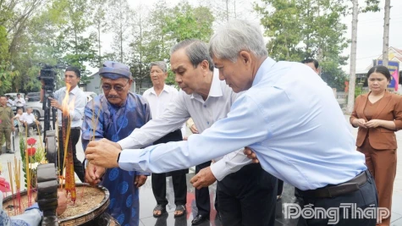
The Tro Chieng Festival consists of two parts: The ceremonial part begins with the Phung Nghinh ritual, offering incense and carrying elephants from the Trinh Xa village temple to the commune's stadium to report to the village's guardian deity about the local people's year of labor and production.


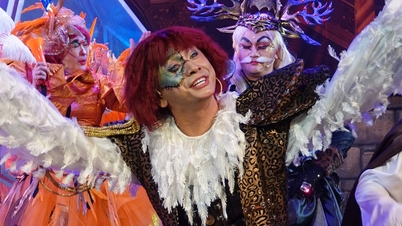
The festival features 12 spectacular performances such as: the groom selection game, horse racing, elephant fighting, dragon fighting, carp transforming into dragons, the Phoenix procession...; among them, the elephant fighting is considered the most unique and has become a beautiful cultural tradition preserved and organized annually by the authorities at all levels and the people. The festival also includes lively competitions in making traditional local products such as "bánh nhãn" and "bánh lá răng bừa".

After the performance ends, all the elephants, horses, and dragons are offered as sacrifices to heaven and earth, expressing gratitude for the merits of our ancestors and forefathers. The festival is a cultural activity that fulfills the spiritual needs of the people, praying for prosperity, abundance, and bountiful harvests; it is an opportunity for people to express their reverence and gratitude to the deities and ancestors who contributed to the nation-building and national defense.
Le Ha
Source
![[Photo] Solemn bathing ceremony and Buddha procession in Hue](https://vphoto.vietnam.vn/thumb/1200x675/vietnam/resource/IMAGE/2026/05/31/1780228263543_1-jpg.webp)

![[Image] Hanoi Police officially crowned champions of V-League 2025/2026](https://vphoto.vietnam.vn/thumb/1200x675/vietnam/resource/IMAGE/2026/05/31/1780244769054_ndo_br_039d561b692be875b13a-jpg.webp)
![[Photo] The General Secretary, President and his wife begin their state visit to the Philippines.](https://vphoto.vietnam.vn/thumb/1200x675/vietnam/resource/IMAGE/2026/05/31/1780230559452_anh-man-hinh-2026-05-31-luc-19-28-11.png)
![[Photo] Admire the coral "masterpiece" amidst the million-year-old heritage of Dak Lak province.](https://vphoto.vietnam.vn/thumb/1200x675/vietnam/resource/IMAGE/2026/05/31/1780221235105_anh-man-hinh-2026-05-31-luc-16-53-27.png)









![[Video] Sunset at Lap An Lagoon – Where the sun sets over the fishing nets](https://vphoto.vietnam.vn/thumb/340x192/vietnam/resource/IMAGE/2026/05/31/1780192137701_beach-landscape-sea-water-nature-grass-745871-pxhere-com.jpeg)



























![[Photo] Admire the coral "masterpiece" amidst the million-year-old heritage of Dak Lak province.](https://vphoto.vietnam.vn/thumb/402x226/vietnam/resource/IMAGE/2026/05/31/1780221235105_anh-man-hinh-2026-05-31-luc-16-53-27.png)




























Comment (0)