

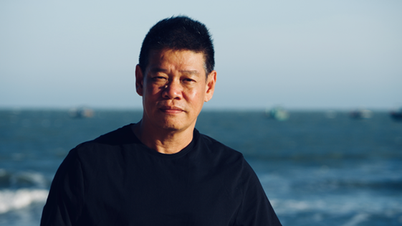
Ho Si Binh, originally from Quang Tri province, currently lives and works at the Vietnam Writers Association Publishing House - Central and Western Highlands Branch. He is a member of the Da Nang Writers Association and the Vietnam Writers Association. "Waiting for the Scent to Release the Wind"* is his third poetry collection, and his seventh book overall, released in May 2024, following "Rain and Sunshine on the Mountain Pass" (2018) and "The Birth of the Wind" (2021).

Hồ Sĩ Bình's extensive life experience and passion for exploring new lands have given him a unique poetic personality. His poetry is both free-spirited and carefree, yet also rebellious, unrestrained, and imaginative.
The sadness and regret over life's values fading away due to the dust of time and the hustle and bustle of the present, along with the yearning to rediscover a touch of the past, are quite evident in Ho Si Binh's work: "I mourn the grapefruit blossoms and the crape myrtle flowers / Waiting for their fragrance to drift away with the next monsoon. I return."
His travels awakened in him feelings and aspirations; traveling extensively wasn't about forgetting, but about returning, returning to moments of quiet reflection and distant memories. Hanoi , a place he visited frequently, its winds, streets, alleys, and delicious food stalls couldn't hold back the wanderer's footsteps; "only a cup of tea on the sidewalk / kept me here / and the sun / caressing the shimmering autumn colors of Hanoi / that no one has ever been able to paint" (Hanoi Pulls Me Away)...
Indeed, in Hanoi, everyone enjoys stopping at a roadside tea stall, savoring a cup of tea to relax their minds, reflecting on the changes, and then strolling through the narrow streets under the gentle, golden sunlight of autumn. For Ho Si Binh, Hanoi is both familiar and strange, "always rushing to say goodbye / only managing to take with me / a little bit of the light, verdant scent of the season."
Da Lat, the dreamy land of cherry blossoms with its magnificent golden flower-lined roads, is no more; only emptiness remains: "The paintings have been removed / a faded, illusory color / the lingering echo of a abandoned seat" (Da Lat and Me).
A feeling of emptiness and loss fills the soul of the returning traveler as the winding roads of the misty mountain town lack the vibrant colors of countless flowers. Returning to Bac Ninh , listening to the Quan Ho folk songs of the male and female singers, and admiring Dong Ho paintings, the poet feels as if he has met Hoang Cam again, along with the soul of Kinh Bac: “The romantic Duong River flows through Kinh Bac / smitten with Quan Ho, its waters flowing gracefully throughout its life” (Quan Ho Longing); “I meet Hoang Cam again by the old wharf / Where is his soul now, with the colorful paper?” (Beside Dong Ho paintings).
The ancient city of Hue is also where Ho Si Binh is most attached, as it holds a sky full of memories: the lecture halls and his friends of many years. A series of poems in the collection bear the mark of memories with a certain "she" and the lingering feelings of an unexpressed love: "The very old afternoon, like days gone by / I hear in the desolate heart a fading dream" (The Day She Returned to Ben Ngu). Hue and Ho Si Binh are like destined lovers, and the city is always as charming as the poems he writes: "Meeting Hue Again," "Returning to the Old Street," "The Day After the Storm," "Afternoon at Thua Luu Station," "Love Letter to Nam Giao," "Oh, Fragrance"...
Wandering through the 56 poems in the collection "Waiting for the Scent to Release on the Wind," we encounter a whole system of place names; the frequent appearance of this word class testifies to the paths marked by Ho Si Binh's wandering footsteps; his passion for travel has inspired his "quick-written" poems, yet they are by no means simplistic in their structure and word choice. In the poetry collection "The Birth of the Wind" (2021), he has expressed more than once: "sometimes I'm afraid of the roads / that I can't fully explore."
Traveling to return, these journeys not only broadened Ho Si Binh's horizons and provided him with abundant material for his writing, but also served as a place for him to reflect on himself. The self-reflections about his profession permeate every word of Ho Si Binh's work, reflecting the shared pain of a poet's life, as Xuan Dieu once lamented: "The hardships of life are showing their claws / Food and clothing are no joke for poets." Ho Si Binh's poetry conveys a glimpse into poetry through the maximum application of his life experiences gained from his travels and his continuous reading and learning.
The awareness of stagnation and gradual decline is the consciousness of an ego constantly troubled and yearning for uniqueness and individuality: "Poetry and words/tremble, struggling, and clamoring in my heart with disappointment/Alas/how can I bring my poetry to the temple gate/where you are waiting" (How). The more conscious he becomes of his writing profession, the more Ho Si Binh realizes he is like an old, weary horse: "Old horse, don't sing the eternal song/the shadow of a horse outside the window... Lock in your memory/the silent fields/and the longing for grass/the southern sky/old horse, clinging to the shadow to return" (Old Horse). He even worries about the day when: "I fear there will come a day when people will read my poetry with utter weariness/like a half-empty glass of wine, like snail water/in a deserted riverside tavern on the thirtieth day of the lunar month" (If One Day)...
Originally a reclusive poet, always engrossed in his creative aspirations, in his poetry collection "Waiting for the Scent to Release on the Wind," Ho Si Binh always pays attention to exploring unique ways of expression through diverse writing styles and poetic forms; a free-spirited, dreamy tone; and a discourse that harmoniously blends archaic words with reduplicated words strongly characteristic of North Central Vietnam, such as "ngui ngui" (melancholy), "chac chiu" (evening shards), and "bui bui" (bushes): "In the old street, the sorrow of life, the green grass/searching for someone, a melancholy scent of betel nut/the evening has turned purple, who knows/when crossing the river, the bui bui of thousands of years later" (Returning to the Old Street).
Thuy Nguyen
"Waiting for the fragrance to be released by the wind," a poem by Ho Si Binh, Vietnam Writers Association Publishing House, 2024.
Source: https://baoquangtri.vn/khao-khat-tim-huong-qua-tho-ho-si-binh-186880.htm
![[Photo] General Secretary and President To Lam meets with National Assembly delegates from ethnic minorities.](https://vphoto.vietnam.vn/thumb/1200x675/vietnam/resource/IMAGE/2026/04/20/1776696701056_a1-bnd-8331-3342-jpg.webp)
![[Image] National Assembly discusses the implementation of the socio-economic development plan.](https://vphoto.vietnam.vn/thumb/1200x675/vietnam/resource/IMAGE/2026/04/20/1776696707422_ndo_br_img-20260420-185419-jpg.webp)











































































Comment (0)